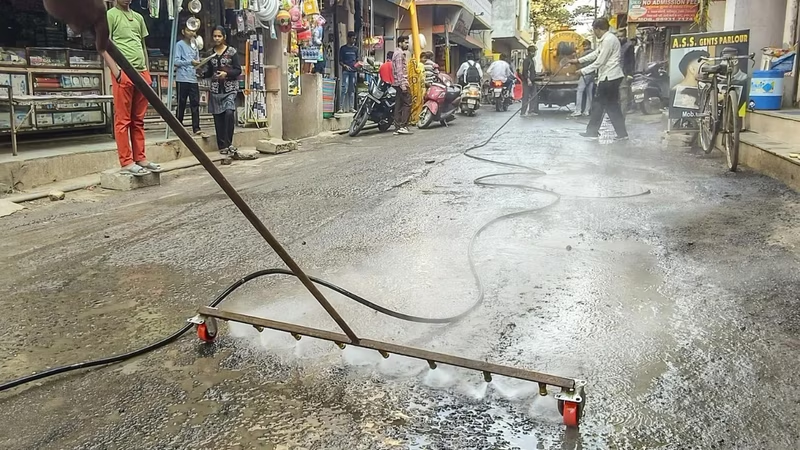
The title of ‘India’s Cleanest City’ now carries a bitter irony for the residents of Bhagirathpura in Indore. What began as isolated cases of stomach upset has exploded into a full-blown public health disaster, with **Indore water contamination** confirmed as the source of a deadly diarrhea outbreak that has claimed at least 10 lives and left over 1,400 people severely ill . This is not just a local tragedy; it’s a stark warning about the fragility of our most basic infrastructure: our water supply.
Table of Contents
- The Human Cost: A Community in Crisis
- What Caused the Indore Water Contamination?
- Official Response and Critical Failures
- The Science Behind the Outbreak
- What Residents Can Do Right Now
- A Broader Wake-Up Call for India
- Conclusion
- Sources
The Human Cost: A Community in Crisis
For the families in Bhagirathpura, the past few days have been a nightmare. Residents began flooding local hospitals on Monday, January 1, 2026, suffering from severe vomiting, high fever, and acute diarrhea . The speed and scale of the outbreak were terrifying. What makes this situation even more harrowing is the complete loss of trust in the water supply. Even water from government tankers, meant to be a lifeline, is now met with deep suspicion and fear by residents who are desperate for a safe alternative .
What Caused the Indore Water Contamination?
Officials have pinpointed the root cause of the **Indore water contamination** to a critical infrastructure failure. A leakage was discovered in the city’s main drinking water pipeline near a police outpost in Bhagirathpura . The location of this leak is chilling: it was found directly beneath a toilet . This created a direct pathway for raw sewage, teeming with dangerous pathogens, to seep into the drinking water supply that serves the entire community. Laboratory tests have since confirmed the presence of harmful bacteria in the municipal water, validating the residents’ worst fears .
Official Response and Critical Failures
The Indore Municipal Corporation (IMC) and the Madhya Pradesh government are now in damage control mode. Mayor Pushyamitra Bhargava has confirmed a death toll of 10, though local residents claim the number could be as high as 14 [[5], [9]].
However, this crisis raises serious questions about systemic failures. The Public Health Engineering Department (PHED) of Madhya Pradesh is tasked with ensuring that the water supplied is “free from pathogenic organisms” . So, how did a toilet end up being constructed directly over a critical, pressurized water main? This points to a catastrophic breakdown in urban planning, construction oversight, and routine water quality monitoring—core responsibilities outlined in the state’s own policies and the Water (Prevention & Control of Pollution) Rules .
Immediate Actions Taken
- The contaminated pipeline section has been isolated and is being repaired.
- Water tankers are being deployed to provide an alternative supply, though trust in them is low.
- A high-level health team has been sent to the area to manage the medical response.
- Health camps have been set up for affected residents.
The Science Behind the Outbreak
According to the World Health Organization (WHO), “Microbial contamination of drinking-water as a result of contamination with faeces poses the greatest risk to drinking-water safety” . The presence of bacteria like E. coli is a definitive “indicator of faecal contamination” .
Diarrhea is the body’s natural, albeit dangerous, response to these pathogens. For vulnerable populations—like young children, the elderly, and those with pre-existing conditions—this can rapidly lead to severe dehydration and death, which tragically explains the fatalities in Bhagirathpura. The WHO emphasizes a “multiple barrier” approach to water safety, from the source to the consumer, to prevent exactly this kind of cross-contamination .
What Residents Can Do Right Now
Until the water supply is officially declared safe, residents should take extreme caution. Here are critical steps to protect yourself, a topic we’ve covered in our guide on [INTERNAL_LINK:home-water-safety]:
- Do Not Drink Tap Water: This includes using it for brushing teeth or washing fruits and vegetables that will be eaten raw.
- Boil Water Vigorously: If you must use tap water, boil it for at least one full minute to kill most pathogens.
- Use Certified Filters: Invest in a water filter certified to remove bacteria and cysts.
- Seek Medical Help Early: If you or a family member shows symptoms of severe diarrhea, vomiting, or fever, seek medical attention immediately to prevent complications from dehydration.
A Broader Wake-Up Call for India
The Indore tragedy is not an isolated incident. It serves as a powerful wake-up call for cities across India that are grappling with aging infrastructure, rapid urbanization, and the immense pressure on water resources. If the ‘cleanest city’ can suffer such a fundamental and deadly failure, nowhere is truly safe. This demands a nationwide audit of water supply networks, stricter enforcement of construction regulations near critical utilities, and a massive investment in real-time water quality monitoring systems—a key objective of the MP PHED’s own stated goals .
Conclusion
The **Indore water contamination** crisis is a devastating blend of infrastructure failure and institutional oversight. While the immediate focus is on saving lives and containing the outbreak, the long-term lesson is clear: the title of ‘cleanest city’ is meaningless if the water flowing from the tap can kill. A thorough, transparent investigation and significant systemic reforms are the only acceptable responses to this preventable tragedy.
Sources
- Times of India: Indore water row: 10 dead, over 1,000 affected; reports flag ‘presence of bacteria’
- Government of Madhya Pradesh, Public Health Engineering Department: Official Website [[12], [13]]
- World Health Organization (WHO): Guidelines for Drinking-water Quality [[18], [21], [22]]
- The Hindu: Reporting on the Indore Water Crisis [[1], [5], [6], [8], [9]]