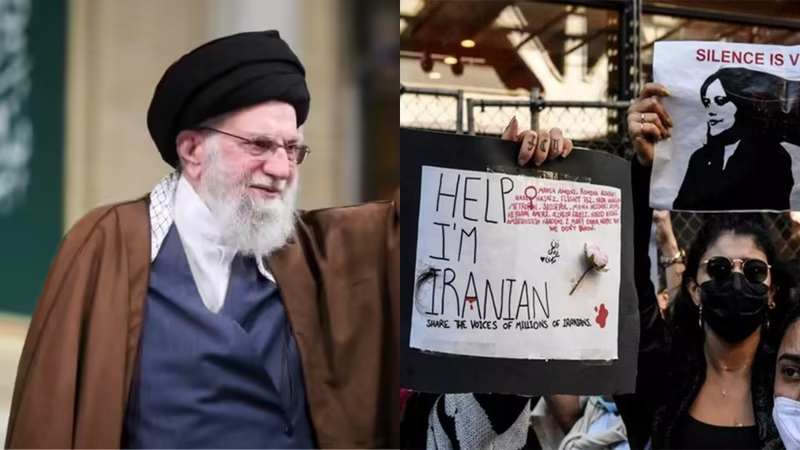
The streets of Iran are boiling over. What began as scattered demonstrations against soaring prices has rapidly escalated into nationwide unrest, leaving at least seven dead—including both protesters and security forces—as the Islamic Republic grapples with its deepest economic crisis in decades. At the heart of this turmoil? A **currency collapse** that has wiped out ordinary Iranians’ savings and an inflation rate that now threatens basic survival. This isn’t just another protest—it’s a cry of desperation from a population pushed to the brink.
As the **Iran protests** intensify from the capital Tehran to remote provinces like Sistan-Baluchestan and Khuzestan, the government’s response has been a mix of force, concessions, and symbolic gestures—including declaring a sudden public holiday. But with the rial trading at record lows and food prices doubling in months, many Iranians are no longer willing to wait for promises. Here’s everything you need to know about this unfolding crisis.
Table of Contents
- What Sparked the Iran Protests?
- The Economic Collapse Driving the Unrest
- Casualties, Crackdowns, and Government Response
- How This Compares to Past Iran Protests
- International Reaction and Geopolitical Stakes
- What Comes Next for Iran?
- Conclusion: A Nation at a Crossroads
- Sources
What Sparked the Iran Protests?
While the immediate trigger appears to be another sharp spike in the price of essential goods—especially bread, cooking oil, and medicine—the roots run much deeper. For months, ordinary Iranians have watched helplessly as the **Iranian rial** tumbled against the US dollar, losing over 60% of its value since early 2025. This collapse has made imports unaffordable and devastated local purchasing power.
Unlike previous protests driven primarily by political or social demands—like the 2022 demonstrations over women’s rights—these **Iran protests** are overwhelmingly economic. They cut across demographics: shopkeepers, teachers, factory workers, and even state employees are all affected. The anger is not just at market fluctuations, but at a system perceived as corrupt, inefficient, and disconnected from the people’s suffering.
The Economic Collapse Driving the Unrest
Iran’s economy is in freefall, and the numbers tell a grim story:
- Inflation Rate: Official figures cite inflation at 45%, but independent economists estimate it’s closer to 65–70% for essential goods .
- Currency Value: The rial now trades at over 600,000 to 1 USD
- Unemployment: Youth unemployment hovers near 25%, with women disproportionately affected.
- Sanctions Impact: US and EU sanctions on oil exports and banking have crippled foreign revenue, limiting the government’s ability to stabilize the economy.
Compounding the crisis is a severe drought affecting agricultural output and a banking sector riddled with bad loans. For many families, even a full-time job no longer covers rent and food—a reality that fuels daily frustration and now, open revolt.
Casualties, Crackdowns, and Government Response
According to reports from local human rights monitors and international news agencies, **at least seven people have died** in clashes between demonstrators and security forces since the protests began. Among the dead are both civilians and members of the Basij militia—a volunteer paramilitary force loyal to the regime .
The government’s response has been characteristically dual-pronged:
- Security Measures: Internet slowdowns, mass arrests, and deployment of riot police in major cities.
- Symbolic Concessions: A surprise public holiday declared by the Interior Ministry and vague promises of “economic reforms” from President Masoud Pezeshkian.
Meanwhile, Supreme Leader Ayatollah Ali Khamenei—who holds ultimate authority—has remained largely silent. His public appearances have avoided economic commentary, focusing instead on “enemies plotting against national unity.” This silence, however, is being interpreted by many as a sign of internal division within Iran’s leadership.
How This Compares to Past Iran Protests
Iran has seen waves of unrest before—most notably in 2009, 2017–18, and 2022. But the current **Iran protests** differ in key ways:
- Economic Focus: Unlike 2022’s protests centered on morality policing, today’s anger is purely economic.
- Geographic Spread: Demonstrations are not confined to big cities but have erupted in smaller towns and conservative strongholds—areas traditionally supportive of the regime.
- Lack of Central Leadership: There’s no single figure or group leading the movement, making it harder to suppress—but also harder to negotiate with.
This decentralized, survival-driven nature makes the current crisis particularly unpredictable.
International Reaction and Geopolitical Stakes
The West has treaded carefully. The United States State Department expressed “deep concern” over the violence but stopped short of endorsing the protests, wary of being seen as interfering—a charge the Iranian regime uses to delegitimize dissent .
Meanwhile, regional rivals like Saudi Arabia and Israel are watching closely. A destabilized Iran could shift power dynamics across the Middle East, especially as Tehran continues backing groups in Yemen, Lebanon, and Gaza. For more on how regional tensions are evolving, see our coverage on [INTERNAL_LINK:middle-east-geopolitics-2026].
Notably, even traditional allies like Russia and China have remained publicly neutral, prioritizing economic ties over political commentary.
What Comes Next for Iran?
Three scenarios now loom large:
- Short-Term Suppression: The regime uses force to quell unrest, but underlying economic issues remain unaddressed—leading to future flare-ups.
- Economic Reforms: Under pressure, authorities introduce targeted subsidies or currency controls to ease public pain—though past efforts have failed.
- Leadership Crisis: If protests grow and security forces fracture, it could trigger an internal power struggle within Iran’s ruling elite.
What’s clear is this: without structural economic reform, no amount of security force or holiday declarations will restore public trust.
Conclusion: A Nation at a Crossroads
The **Iran protests** of January 2026 are more than a reaction to high prices—they’re a symptom of systemic failure. A generation of Iranians, raised under sanctions and isolation, is now demanding dignity, stability, and a future. Whether the regime can—or will—respond in a meaningful way will determine not just the fate of its economy, but the very stability of the Islamic Republic itself.
Sources
- “Currency collapse and soaring inflation: Iran protests turn deadly — 10 things to know”, The Times of India: https://timesofindia.indiatimes.com/…
- International Monetary Fund (IMF) – Iran Economic Outlook: https://www.imf.org/en/Countries/IRN
- Amnesty International – Iran Crackdown Reports: https://www.amnesty.org/…
- U.S. Department of State – Iran Human Rights Statement: https://www.state.gov/…