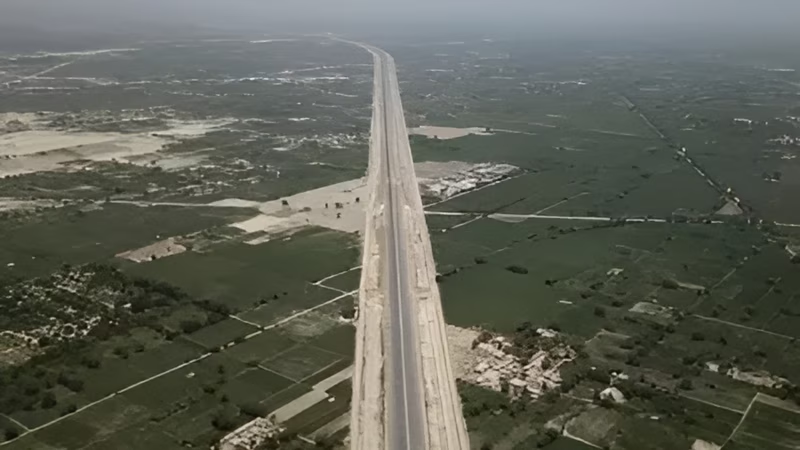
In a move that has sent shockwaves through diplomatic circles, a prominent Baloch leader has issued a dire warning: China is on the cusp of deploying its military forces in Pakistan’s restive Balochistan province. This isn’t just a regional concern; it’s a potential game-changer for India’s national security and the fragile stability of South Asia. But who is making this claim, and why should we take it seriously?
Table of Contents
- The Urgent Plea from Balochistan
- Decoding the China-Pakistan Military Puzzle
- Why Balochistan is the Epicenter of Geopolitical Tension
- India’s Tightrope Walk on Balochistan
- What’s Next for the Region?
- Conclusion: A Region on the Brink
- Sources
The Urgent Plea from Balochistan
In an open letter addressed to India’s External Affairs Minister, S. Jaishankar, Baloch human rights defender Mir Yar Baloch has sounded a clarion call. He claims that a deepening strategic alliance between Beijing and Islamabad could lead to a Chinese military deployment in Balochistan “within months” . This, he argues, is not just a threat to his people, who have endured decades of repression, but a “serious threat” to India’s future as well .
Mir Yar Baloch’s letter is a desperate appeal for India to bolster its support for Baloch resistance forces. He points to the China-Pakistan Economic Corridor (CPEC), a flagship project of China’s Belt and Road Initiative, as the primary catalyst for this potential military move. As CPEC enters its “final phases,” the need for its physical security is becoming paramount for both China and Pakistan .
Decoding the China-Pakistan Military Puzzle
The idea of a foreign military presence in Balochistan is not new, but the prospect of it being China—a nuclear power and a key strategic rival of India—adds a dangerous new dimension. The CPEC, which has already channelled billions of dollars into the region, is a lifeline for Pakistan’s economy but a source of deep resentment for many Baloch people.
Why? Because the project is seen as an exploitative venture that prioritizes Chinese and Pakistani state interests over the welfare of the local Baloch population. Critics argue that CPEC has worsened economic inequalities and neglected local development, fueling anti-China sentiment across the province . Given the history of multiple insurgencies in Balochistan, the Pakistani military has long struggled to secure the region . China, with its immense stake in CPEC, is now seen as ready to take a more direct role in its protection.
The History of Unrest in Balochistan
To understand the gravity of Mir Yar Baloch’s warning, one must look at the deep-seated conflict in Balochistan. The province has been the site of a persistent, low-level insurgency since 1948, with major flare-ups in the 1950s, 60s, and 70s . The current wave of unrest was reignited in 2002 when the Gwadar Port project—a cornerstone of CPEC—was announced without meaningful consultation with Baloch leaders .
Key militant groups like the Balochistan Liberation Army (BLA) have repeatedly targeted CPEC infrastructure and Chinese nationals, viewing them as symbols of an occupying force . This ongoing security threat is the primary justification Pakistan and China might use for a more robust, formal military presence.
Why Balochistan is the Epicenter of Geopolitical Tension
Balochistan is a geopolitical tinderbox for several reasons:
- Strategic Location: It provides China with a crucial land route to the Arabian Sea via the Gwadar Port, bypassing the vulnerable Malacca Strait.
- Resource Wealth: The province is rich in natural resources like natural gas, coal, and copper, which are central to CPEC’s economic logic .
- Local Alienation: Decades of political marginalization and economic neglect have left the Baloch people feeling like strangers in their own land, creating fertile ground for rebellion .
India’s Tightrope Walk on Balochistan
Mir Yar Baloch’s direct appeal to India puts New Delhi in a delicate position. Historically, India has used the Balochistan issue as a diplomatic counterweight to Pakistan’s stance on Kashmir . Prime Minister Narendra Modi notably raised the issue on the international stage in 2016, a move that was seen as a significant shift in India’s foreign policy.
However, India’s official stance remains one of non-interference in Pakistan’s internal affairs. Pakistan, for its part, has long accused India of covertly supporting Baloch insurgents, a claim India denies . Mir Yar Baloch’s request for India to actively bolster resistance forces is a request that New Delhi is highly unlikely to fulfill publicly, as it would risk a major escalation with both Pakistan and China.
Instead, India’s response is likely to be diplomatic and strategic, focusing on highlighting the human rights situation in Balochistan on global forums and strengthening its own security posture in the region. For more on India’s foreign policy challenges, see our analysis on [INTERNAL_LINK:india-china-border-tensions].
What’s Next for the Region?
The situation is fluid and fraught with peril. If China does formalize a military presence in Balochistan, it would mark a significant escalation in its overseas power projection and further cement the China-Pakistan “all-weather friendship.” This would, in turn, force India to reassess its entire security calculus in its western neighborhood.
For the people of Balochistan, it could mean an even more intense and brutal security crackdown, as a joint Pakistani-Chinese security apparatus would be far more formidable than the Pakistani military alone. The cycle of violence and repression could deepen, pushing the region further into chaos.
Conclusion: A Region on the Brink
Mir Yar Baloch’s warning is more than just a plea; it’s a stark reminder of the volatile intersection of great power rivalry and local insurgency. The prospect of a China military in Balochistan is no longer a fringe theory but a real and present danger that could reshape the strategic landscape of South Asia. Whether India chooses to engage more directly or maintain its current cautious stance, the world will be watching as this geopolitical drama unfolds. The future of Balochistan, and perhaps the stability of the entire region, hangs in the balance.
Sources
- Times of India. “China to deploy military in Balochistan? Mir Yar Baloch flags ‘serious threat’; writes to Jaishankar on CPEC.” https://timesofindia.indiatimes.com/world/pakistan/china-to-deploy-military-in-balochistan-mir-yar-baloch-flags-serious-threat-writes-to-jaishankar-on-cpec/articleshow/126299614.cms
- IANS. “Baloch human rights defender writes to EAM Jaishankar.”
- Siddiqui, K. (2023). “Security of the China Pakistan Economic Corridor (CPEC).”
- “CPEC: How China is Exploiting Balochistan.” (2024).
- Wikipedia. “Insurgency in Balochistan.”
- “The Balochistan Quagmire.” GJIA (2025).
- Sahoo, P. (2019). “INDIA’S BALOCHISTAN TACTIC.”
- “Pakistan’s Baloch Insurgency: History, Conflict Drivers, and…” (2025).