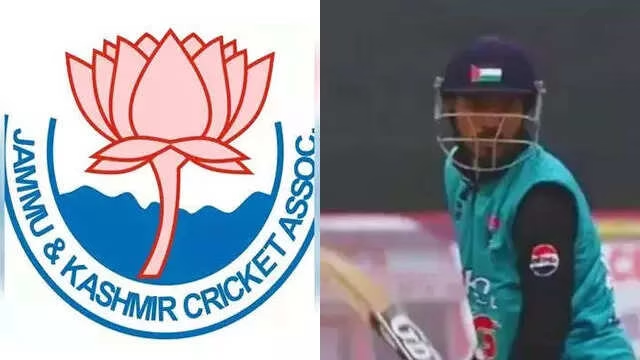
Cricket in India is often described as a religion—a unifying force that transcends regional, linguistic, and even political divides. But what happens when a symbol of a deeply polarizing global conflict appears on the sacred pitch? That’s the dilemma currently unfolding in Jammu, where a local cricketer’s decision to paint a Palestinian flag on his helmet has triggered a police investigation and a nationwide debate.
The incident, during a private T20 league match, has moved far beyond the boundary ropes. The Palestine flag at Jammu cricket match has become a flashpoint, caught between arguments for humanitarian solidarity and concerns over public order and the politicization of sport. With the Jammu and Kashmir Police now formally probing the event and summoning both the player and the tournament organiser, this local incident has ballooned into a complex question of law, sportsmanship, and freedom of expression .
Let’s break down the facts, the legal and sporting context, and the broader implications of this controversy.
Table of Contents
- The Incident: A Flag on the Field Sparks a Storm
- The Official Response: J&K Police Launch Formal Probe
- The Sporting Rules: Does the ICC Forbid Political Gestures?
- The Legal Landscape: Can You Display a Foreign Flag in India?
- The Broader Debate: Free Speech vs. Sporting Neutrality
- Conclusion
- Sources
The Incident: A Flag on the Field Sparks a Storm
The controversy began at a privately organised cricket tournament in Jammu. During a match, a local player took the field wearing a helmet prominently featuring the Palestinian flag—its black, white, green, and red stripes a clear and unambiguous symbol . The league itself operates outside the purview of the Jammu and Kashmir Cricket Association (JKCA), with no official recognition from the state’s governing cricket body .
Images of the player quickly circulated on social media, drawing sharp and immediate reactions. Supporters hailed it as a brave act of solidarity with civilians in Gaza, while critics condemned it as an inappropriate and potentially inflammatory political statement in a sensitive region like Jammu and Kashmir.
The Official Response: J&K Police Launch Formal Probe
In response to the public outcry and social media uproar, the Jammu and Kashmir Police initiated a formal investigation. “We are looking into the intent and circumstances surrounding the display of the foreign flag at the cricket venue,” a senior police officer confirmed, adding that both the player and the tournament organiser have been summoned for questioning .
The police are likely examining whether the act violated any sections of the Indian Penal Code (IPC) related to promoting enmity between groups or acts prejudicial to national integration. The sensitivity of the J&K region often means authorities take a zero-tolerance approach to any act perceived as having political overtones.
The Sporting Rules: Does the ICC Forbid Political Gestures?
From a purely sporting perspective, the International Cricket Council (ICC) has a clear and strict policy. Its Code of Conduct for Players and Player Support Personnel explicitly prohibits “personal, political, religious, or racial comments or gestures” on the field of play .
This rule exists to maintain cricket’s status as a neutral ground for competition. While this Jammu match was not an international fixture, the ICC’s code sets a global standard for the sport. The principle is that the cricket field should be a place for athletic contest, not a platform for political messaging. Past instances, like when players have worn awareness ribbons without prior approval, have resulted in official reprimands, underscoring the seriousness of this rule .
The Legal Landscape: Can You Display a Foreign Flag in India?
In India, the display of foreign national flags is governed by the Emblems and Names (Prevention of Improper Use) Act, 1950, and the Flag Code of India. While these laws primarily focus on protecting the dignity of the Indian national flag, they also imply that the display of other national flags must not be done in a manner that causes public disorder or is seen as an official act of a foreign state on Indian soil .
The context is everything. Displaying a flag in a private home is different from doing so on a public platform like a sports field, where it can be interpreted as a public statement with the potential to influence or provoke.
The Broader Debate: Free Speech vs. Sporting Neutrality
This incident sits at the heart of a global tension in modern sports. Athletes all over the world, from the NFL to the Olympics, have used their platforms to advocate for social and political causes. The argument is that they are citizens first, with the right to their conscience.
However, the counter-argument, particularly strong in international sports bodies, is that sport’s unique power lies in its ability to unite people from all backgrounds. Injecting divisive political issues can shatter that fragile unity. The Palestine flag at Jammu cricket match has become a local manifestation of this global debate, forcing us to ask: where should the line be drawn?
For a deeper dive into this ongoing conflict between activism and athletics, see our analysis on [INTERNAL_LINK:sport-and-politics-in-modern-india].
Conclusion
The investigation into the Palestine flag at Jammu cricket match is about more than just one player’s helmet. It’s a test case for how India navigates the complex intersection of personal expression, public order, and the cherished neutrality of its national sport. As the probe continues, the hope is for a resolution that respects the rule of law, upholds the integrity of cricket, and acknowledges the deep humanitarian concerns that motivated the original gesture.
Sources
- Jammu and Kashmir Police official statement on the investigation .
- Reports on the nature of the private cricket league and its non-affiliation with JKCA .
- International Cricket Council (ICC) Code of Conduct .
- The Emblems and Names (Prevention of Improper Use) Act, 1950 .
- Historical precedents of political gestures in international cricket .