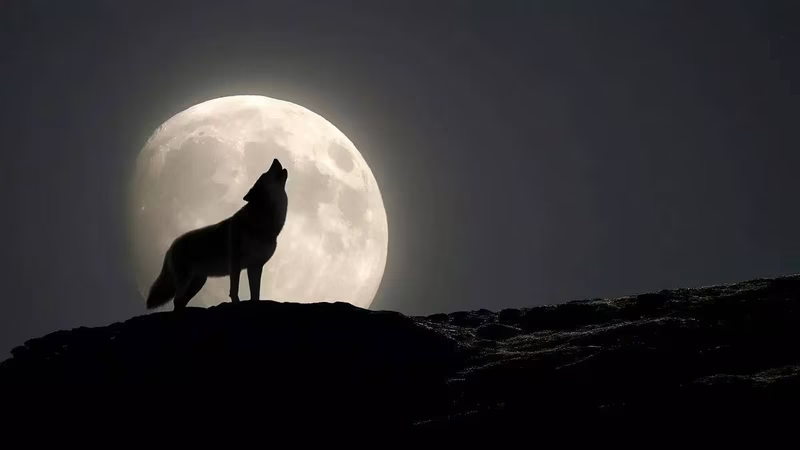
Look up this weekend. Seriously, put down your phone (after reading this, of course) and gaze east just after sunset on Saturday, January 3rd, 2026. What you’ll witness isn’t just a full moon—it’s the Wolf Supermoon 2026, a celestial event that’s bigger, brighter, and far more significant than your average lunar visit.
This isn’t just a pretty sight; it’s the opening act of a rare cosmic play. 2026 is an unusual year, graced with not twelve, but thirteen full moons, a phenomenon that sets the stage for a spectacular Blue Moon later in May . So, grab a blanket, find a spot away from the city lights, and let’s dive into everything you need to know about this must-see event.
Table of Contents
- What’s in a Name? The Ancient Origins of the Wolf Moon
- Wolf Supermoon 2026: Your Ultimate UK Viewing Guide
- Why 2026 is a Lunar Anomaly: The Rare 13th Moon
- Your Wolf Supermoon Viewing Checklist
- What Comes Next: The Rest of 2026’s Lunar Calendar
- Conclusion
- Sources
What’s in a Name? The Ancient Origins of the Wolf Moon
Before we get to the *how* of viewing, let’s unpack the *why* behind that evocative name. Why is it the Wolf Moon?
The name “Wolf Moon” is steeped in history, tracing its roots back to both Native American and European traditions . During the harsh, food-scarce depths of January, wolves were often heard howling more frequently near villages, their calls echoing through the cold winter nights . Some Algonquian tribes in North America named it as such, while in parts of Europe, the association with wolves and the struggles of midwinter was a common theme . It’s a name that speaks to a time when humans were far more attuned to the rhythms of the natural world—a stark contrast to our modern, screen-lit lives.
Wolf Supermoon 2026: Your Ultimate UK Viewing Guide
Now, for the main event. The Wolf Supermoon 2026 will reach its peak of fullness at 10:03 GMT on Saturday, January 3rd . However, the absolute best time to see it in all its glory isn’t necessarily at that exact moment. The magic happens when it first rises.
Best Viewing Time: Head outside just after sunset. The moon will appear on the eastern horizon, looking its largest and most dramatic due to the “moon illusion” effect. Its proximity to Earth as a supermoon means it will appear up to 14% larger and 30% brighter than a typical full moon .
For UK stargazers, this is a particularly special opportunity. After this January spectacle, the UK won’t see another supermoon until late 2026, making this the prime lunar event of the year for local viewers . So, make it count!
Why 2026 is a Lunar Anomaly: The Rare 13th Moon
What makes the Wolf Supermoon 2026 even more noteworthy is the company it keeps this year. Most years have 12 full moons, one for each month. But 2026 is different thanks to the intricate dance between our Gregorian calendar and the lunar cycle (which is about 29.5 days long) .
Because January’s full moon arrives so early in the month, it creates just enough room for a 13th full moon to squeeze in before the year ends. This extra moon will fall on May 31st, 2026, and is officially known as a Blue Moon . It’s a fascinating reminder that our human-made calendars are a bit messy when compared to the elegant, steady clock of the cosmos.
Your Wolf Supermoon Viewing Checklist
Want to make the most of this celestial event? Here’s your quick guide:
- Find Location with a Clear Eastern View: Tall buildings or hills to the east will block your view of the rising moon.
- Dress Warmly: It’s January in the UK! Layers are your friend.
- Bring a Thermos: A hot drink (cocoa, anyone?) makes the experience infinitely more cozy.
- Consider Binoculars (But They’re Not Essential): While your naked eye will see the supermoon’s size and brightness, binoculars can reveal more craters and details on its surface.
- Put Your Phone in Night Mode: If you’re taking photos, use night mode or a dedicated camera app to avoid a blurry, overexposed white blob. Share your shots with #WolfSupermoon2026!
What Comes Next: The Rest of 2026’s Lunar Calendar
While the Wolf Moon is the first, it’s not the only supermoon of 2026. Two more are expected later in the year, in November and December . And of course, there’s the highly anticipated Blue Moon on May 31st . For those who love the night sky, 2026 promises to be a year of repeated wonder. You can mark these dates in your calendar for a full year of lunar appreciation.
Conclusion
The Wolf Supermoon 2026 is more than just a beautiful sight; it’s a cosmic kick-off to a rare and extraordinary year. It connects us to ancient traditions, showcases the raw beauty of our nearest celestial neighbor, and reminds us of the fascinating mechanics of time and space. So, on the evening of January 3rd, step outside, tilt your head back, and let the brilliance of the Wolf Moon wash over you. It’s a moment of quiet awe that’s been witnessed for millennia—and you’re part of that story.
Sources
- National Aeronautics and Space Administration (NASA) – https://science.nasa.gov/skywatching/supermoons/
- Time and Date – https://www.timeanddate.com/astronomy/moon/supermoon.html
- Peak time for Wolf Supermoon: ,
- 2026 has 13 full moons, including a Blue Moon in May: , ,
- Origin of the name ‘Wolf Moon’: , ,
- UK viewing importance: