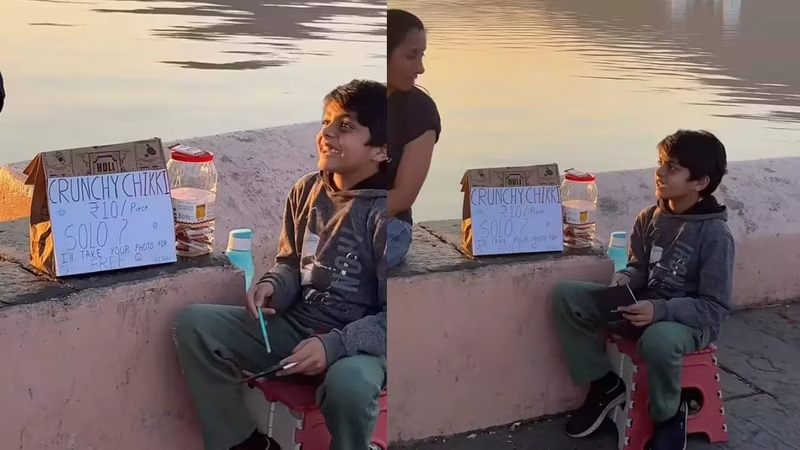
Forget textbooks and flashcards—sometimes, the most powerful classroom is a busy street corner with a tray of chikki in hand. A recent viral video from India has captured the internet’s heart, not just for its charm, but for its profound parenting wisdom. It shows a young boy, initially hesitant, standing proudly beside his mother as they sell traditional Indian peanut brittle to passersby. But here’s the genius twist: every customer gets a free instant photo with the boy. Why? Because this isn’t really about chikki. It’s about confidence, courage, and the art of human connection. The mother’s simple yet radical act—letting her child face the world on his own terms—has sparked a nationwide conversation about what real education looks like.
Table of Contents
- The Viral Moment That Took Over Social Media
- Mother Teaches Son to Sell Chikki: The Lesson Behind the Stall
- Why Mental Barriers Hold Kids Back
- The Genius of the “Free Photo” Gimmick
- How Real-World Experiences Build Resilience
- What Experts Say About Entrepreneurship for Kids
- Inspired Parents Share Their Own Stories
- How You Can Try This at Home
- Conclusion: Education Beyond the Four Walls
The Viral Moment That Took Over Social Media
Posted on Instagram and later shared widely on WhatsApp and X (formerly Twitter), the video shows a boy of around 8–10 years old standing beside a small stall labeled “Chikki.” At first, he avoids eye contact, fidgeting nervously. But as customers approach—many smiling warmly—he gradually gains confidence, handing over chikki packets and posing for photos. His mother stands nearby, not interfering, just watching with quiet pride.
The caption, written by the mother, reads: “Society tells us to protect our children from embarrassment. But what if embarrassment is the very thing that builds courage?” Within 48 hours, the post had over 2 million views and thousands of comments praising her approach .
Mother Teaches Son to Sell Chikki: The Lesson Behind the Stall
This wasn’t a one-off stunt. The mother, who wishes to remain anonymous, shared in a follow-up interview that her son struggled with extreme shyness. “He wouldn’t speak to strangers, even to order food,” she explained. “I realized that no amount of coaxing at home would fix it. He needed real stakes, real interaction.”
So she turned a simple street vending idea into a social experiment. She taught him how to make change, greet customers, and smile—even when he didn’t feel like it. The goal wasn’t profit (though they sold out quickly); it was **emotional muscle memory**. Every “thank you” from a customer, every photo taken, was a brick in the foundation of his self-worth.
Why Mental Barriers Hold Kids Back
Psychologists have long noted that overprotection can stunt emotional development. According to the American Psychological Association, children who are shielded from minor social risks often develop heightened anxiety and lower problem-solving skills .
Common mental barriers include:
- Fear of judgment (“What if they laugh at me?”)
- Perfectionism (“I have to do it right or not at all”)
- Learned helplessness (“Someone else will do it for me”)
By placing her son in a low-stakes but real-world scenario, this mother created a safe space to fail—and succeed.
The Genius of the “Free Photo” Gimmick
Why include a free photo? It’s marketing brilliance meets emotional strategy. The photo serves multiple purposes:
- Breaks the ice: It gives customers a reason to stop and engage beyond just buying.
- Builds connection: Smiling for a photo creates instant rapport.
- Creates memory: The child sees himself as someone worth photographing—boosting self-image.
- Generates social proof: Happy customers share the photos, amplifying the experience.
It’s not just a gimmick; it’s a psychological tool for confidence-building.
How Real-World Experiences Build Resilience
Traditional education excels at teaching facts, but it often falls short on emotional intelligence. Real-life ventures—like selling chikki—teach kids:
- Negotiation and communication
- Handling rejection (“No, thank you”)
- Money management
- Empathy (reading customer cues)
As highlighted by [INTERNAL_LINK:experiential-learning-benefits], these soft skills are increasingly valued in the modern workforce—and in life.
What Experts Say About Entrepreneurship for Kids
Child development experts endorse age-appropriate entrepreneurial activities. Dr. Laura Markham, author of Peaceful Parent, Happy Kids, notes: “When children earn something through effort, they develop intrinsic motivation and grit.” Similarly, organizations like Entrepreneurship Education Alliance advocate for “mini-business” projects in schools to foster innovation from an early age .
Inspired Parents Share Their Own Stories
Following the video’s success, social media flooded with similar stories: a boy selling handmade bookmarks, a girl offering “pet-sitting certificates,” twins running a lemonade stand with QR code payments. One parent wrote, “I’m taking my daughter to the park tomorrow with her painted rocks—your post gave me the push I needed.”
How You Can Try This at Home
You don’t need a chikki stall to replicate this lesson. Try these simple ideas:
- Set up a “homemade goods” table at a local fair.
- Have your child order their own food at a café.
- Encourage them to sell or donate old toys with a handwritten note.
- Role-play customer interactions at home first.
The key? Let them lead. Your role is support, not control.
Conclusion: Education Beyond the Four Walls
The viral video of a mother teaching her son to sell chikki is more than a cute internet moment—it’s a powerful manifesto for hands-on parenting. In a world obsessed with academic scores and digital achievements, this simple act reminds us that the most valuable lessons happen in the messy, unpredictable arena of real life. By confronting fear with kindness and creativity, this mom didn’t just sell chikki; she sold a vision of childhood where courage is cultivated, not coddled. And that’s a lesson every parent can take home.