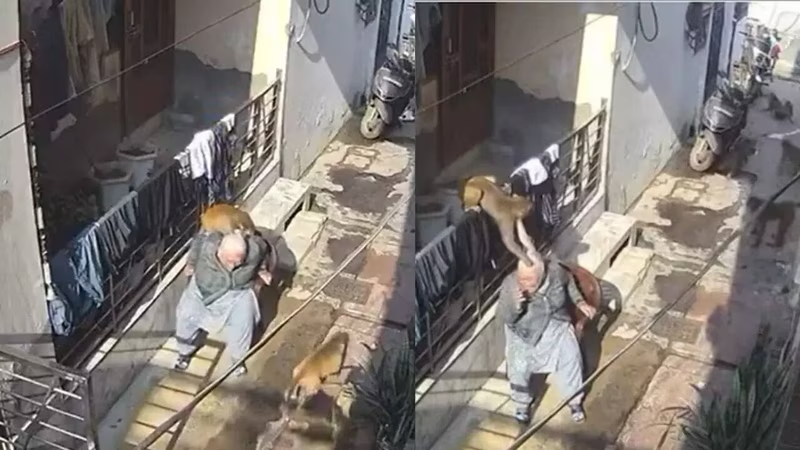
Bahadurgarh Monkey Attack: A Disturbing Glimpse into India’s Urban Wildlife Crisis
On December 26, 2025, a quiet residential street in Bahadurgarh, Haryana, turned into a scene of terror. An elderly woman, seated peacefully outside her home, was suddenly swarmed by a troop of six to seven rhesus macaques. In seconds, the primates began biting her arms and legs, yanking her hair, and dragging her from her chair—all while neighbors watched in horror. The entire assault, lasting nearly 90 seconds, was captured in chilling detail by a nearby CCTV camera .
The footage, now circulating widely on social media, has sparked outrage and renewed calls for urgent action against India’s worsening Bahadurgarh monkey attack problem—a crisis emblematic of a larger national issue: the dangerous convergence of urban expansion and wildlife habitat loss.
How did we get here? And what can be done to prevent the next attack?
Table of Contents
- The Attack in Detail: What the CCTV Revealed
- Victim’s Condition and Community Response
- Why Are Monkeys Attacking Humans in Urban Areas?
- Bahadurgarh’s Growing Monkey Menace: By the Numbers
- Why Past Solutions Have Failed
- What Actually Works? Global and Indian Best Practices
- Conclusion: Coexistence or Conflict?
- Sources
The Attack in Detail: What the CCTV Revealed
The video, recorded around 10:30 AM, shows the woman—believed to be in her late 70s—sitting on a plastic chair near her gate. Without warning, a group of monkeys descends from a nearby tree. Within seconds:
- Two monkeys latch onto her arms, biting repeatedly.
- A third pulls her hair violently, causing her to fall.
- Neighbors shout and throw stones, but the primates show no fear.
- The attack ends only when a man rushes out with a stick, scaring them off.
Local police confirmed the incident was unprovoked—the woman was not feeding the animals, nor did she appear to threaten them .
Victim’s Condition and Community Response
The victim was rushed to a nearby hospital with multiple bite wounds, deep scratches, and severe psychological trauma. She received anti-rabies and tetanus shots immediately—a standard protocol since monkeys are known rabies carriers in India .
Residents of the neighborhood say such encounters are increasingly common. “They raid kitchens, steal food, and now they’re attacking people,” said Rajesh Kumar, a local shopkeeper. “We’ve complained for years, but no one listens.”
Why Are Monkeys Attacking Humans in Urban Areas?
This isn’t mindless aggression—it’s a symptom of ecological imbalance. Experts point to three key drivers:
- Habitat destruction: Rapid urbanization around the Aravalli foothills has wiped out natural forest corridors.
- Human feeding: Decades of religious and cultural practices—like offering food to Hanuman langurs—have conditioned monkeys to associate humans with food.
- Failed translocation: Moving monkeys to forests often fails; they either return or disrupt existing primate groups, increasing stress and aggression.
According to the Wildlife Institute of India, Haryana alone has seen a 40% rise in human-monkey conflict reports since 2020 .
Bahadurgarh’s Growing Monkey Menace: By the Numbers
Bahadurgarh, once a quiet town, has exploded into a major industrial and residential hub near Delhi. This growth came at an ecological cost:
- 🌳 Over 60% of green cover lost in the last 15 years.
- 🐒 Estimated 2,500+ rhesus macaques now roam urban zones.
- 🚨 More than 200 monkey-related complaints filed with municipal authorities in 2025 alone.
Local officials admit they lack the staff, training, or legal authority to manage the crisis effectively.
Why Past Solutions Have Failed
Previous attempts to control the population have backfired:
- Langur deployment: Introducing larger langurs to scare macaques often escalates violence between species.
- Sterilization drives: Underfunded and slow—only a fraction of the population is treated annually.
- Monkey temples: Centralized feeding zones become overcrowded hotspots that breed disease and aggression.
Worse, the 2001 Wildlife Protection Act lists rhesus macaques as “protected” in many states, making lethal control illegal without special permits.
What Actually Works? Global and Indian Best Practices
Successful models exist—if implemented with consistency:
- Shimla’s “Monkey Force”: Trained squads use non-lethal deterrents and rapid response units—reducing attacks by 60% since 2018.
- Chandigarh’s waste management: Strict segregation and covered bins cut open food sources, driving monkeys back to forest edges.
- Singapore’s primate corridors: Urban planning that integrates wildlife movement paths prevents encroachment.
[INTERNAL_LINK:urban-wildlife-conflict-india] For more on sustainable coexistence strategies, explore our guide to managing human-animal conflict in Indian cities.
Conclusion: Coexistence or Conflict?
The Bahadurgarh monkey attack is not an isolated freak event—it’s a predictable outcome of ignoring ecological boundaries. As cities like Bahadurgarh continue to sprawl, the line between “wild” and “urban” vanishes. Without integrated planning, community education, and humane wildlife management, such attacks will only grow more frequent—and more tragic. Protecting the elderly, children, and wildlife alike requires more than CCTV cameras; it demands policy, empathy, and foresight.
Sources
Times of India. “Caught on cam: Group of monkeys bite, pull hair of elderly woman; video sparks concern.” January 2, 2026. https://timesofindia.indiatimes.com/…
National Centre for Disease Control (NCDC), India. “Rabies Surveillance Report 2025.”
Wildlife Institute of India. “Human-Primate Conflict in Northern India: Trends and Mitigation,” 2024.
Haryana Forest Department. “Annual Wildlife Conflict Data,” 2025.