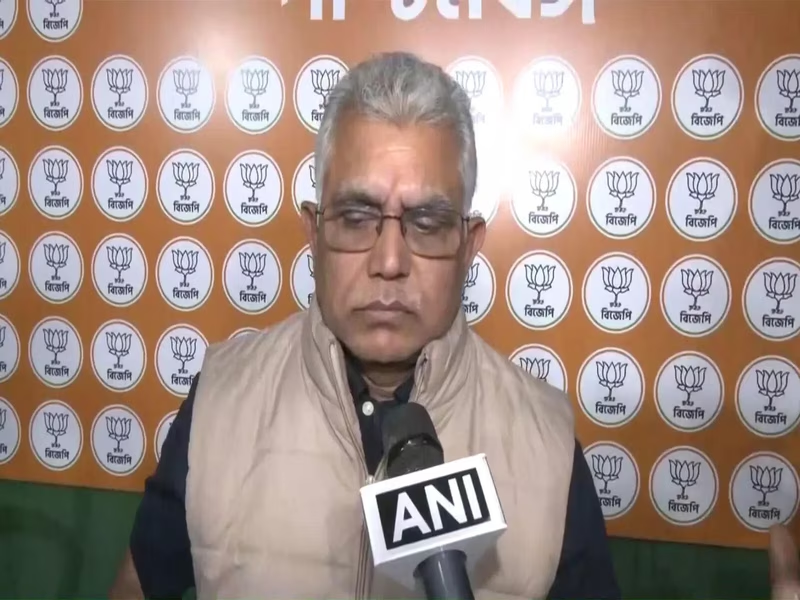
Dilip Ghosh Challenges BJP Orthodoxy: ‘Mandir-Masjid Politics Doesn’t Win Votes’
In a statement that has sent shockwaves through West Bengal’s political landscape—and raised eyebrows in Delhi—former state BJP president Dilip Ghosh has bluntly declared that mandir-masjid politics “does not sway elections.” The remark, made during a recent media interaction following his meeting with Union Home Minister Amit Shah, marks a rare public divergence from the BJP’s long-standing national strategy of leveraging religious symbolism to consolidate its base .
Coming just months before the crucial 2026 West Bengal assembly elections, Ghosh’s comments aren’t just ideological—they’re deeply personal. The firebrand leader, once the face of BJP’s aggressive Bengal campaign, claims he’s been “sidelined” by “recent entrants” in the state unit and is now fighting for a chance to contest from his home turf. His critique of identity-based politics may be as much a survival tactic as it is a strategic observation.
So, what’s really going on behind the scenes of BJP’s Bengal project? And could Ghosh’s stance signal a major shift in how the saffron party plans to challenge Mamata Banerjee’s Trinamool Congress?
Table of Contents
- Ghosh’s Explosive Claim: Breaking Down the Statement
- BJP’s National Narrative vs. Bengal Ground Reality
- Internal Party Tensions: Who Are the ‘Recent Entrants’?
- Ghosh’s Political Future and 2026 Ambitions
- Expert Analysis: Does Religious Politics Work in Bengal?
- Conclusion: A Calculated Rebellion or a Cry for Relevance?
- Sources
Ghosh’s Explosive Claim: Breaking Down the Statement
Speaking to reporters on January 2, 2026, Ghosh said: “Mandir-masjid ke masle se election nahi jeete jaate” (Elections are not won on temple-mosque issues) . He argued that voters in Bengal care more about livelihoods, law and order, and development than “symbolic religious debates.”
This is striking because the BJP’s national campaign—especially around the Ram Mandir consecration in Ayodhya—has heavily relied on this very symbolism to mobilize support across north and central India. In Bengal, however, the equation is different. The state has a 27% Muslim population and a strong tradition of secular, syncretic politics. Ghosh, a former RSS pracharak with deep grassroots experience, appears to be telling the high command: “What works in UP won’t work here.”
BJP’s National Narrative vs. Bengal Ground Reality
The BJP’s performance in Bengal tells a complex story:
- ✅ 2019 Lok Sabha: BJP won 18 seats—a historic high.
- ❌ 2021 Assembly: Collapsed to just 77 seats (from 77 candidates won, but far short of majority).
- ⚠️ 2023 Local Body Polls: Further erosion in urban strongholds like Kolkata.
Analysts like Dr. Subir Bhaumik, author of “Trouble in the Hills”, argue that while the BJP made inroads by tapping into anti-TMC sentiment among Hindu Bengalis, its overt majoritarian messaging alienated minorities and moderate Hindus alike. “Ghosh might be the only senior BJP leader willing to say this publicly,” Bhaumik notes .
Internal Party Tensions: Who Are the ‘Recent Entrants’?
Ghosh didn’t mince words when criticizing “recent entrants” in the Bengal BJP—widely interpreted as a jab at leaders who defected from TMC in recent years, such as Mukul Roy and Suvendu Adhikari.
“People who joined just before elections are now making decisions,” Ghosh lamented, suggesting that loyalists who built the party from scratch are being ignored . This reflects a broader tension within the BJP between “organic RSS workers” and “opportunistic defectors”—a conflict playing out in states like Maharashtra and Punjab too.
[INTERNAL_LINK:bjp-defectors-india-politics] For more on how party-hopping is reshaping Indian politics, see our in-depth feature on political defections.
Ghosh’s Political Future and 2026 Ambitions
Ghosh’s push to contest from his “home seat” in the 2026 assembly polls isn’t just about pride—it’s about survival. After losing the 2021 election from Bishnupur, he was stripped of the state president role and given a marginal Rajya Sabha seat.
His meeting with Amit Shah is seen as a last-ditch effort to reclaim relevance. If the BJP denies him a ticket, Ghosh—known for his volatility—could either go silent or become a vocal internal critic. Either outcome poses a risk to BJP’s fragile unity in Bengal.
Expert Analysis: Does Religious Politics Work in Bengal?
Data suggests Ghosh may be right. A 2025 CSDS-Lokniti survey found that only 12% of Bengali voters cited “religious identity” as a top voting factor—compared to 34% in Uttar Pradesh . Instead, issues like price rise (48%), unemployment (41%), and corruption (39%) dominated.
This aligns with historical voting patterns: even in the 1990s, when the Ram Janmabhoomi movement peaked, the BJP never crossed 15% vote share in Bengal assembly polls. The state’s political culture prioritizes regional identity over pan-Indian religious nationalism.
Conclusion: A Calculated Rebellion or a Cry for Relevance?
Dilip Ghosh’s rejection of mandir-masjid politics is both a tactical assessment and a personal plea. It highlights the growing disconnect between BJP’s Delhi-centric messaging and the nuanced realities of India’s most politically diverse state. Whether his warnings will be heeded—or whether he’ll be sidelined further—will shape not just his career, but the fate of BJP’s 2026 Bengal dream. One thing is clear: in Bengal, identity politics has its limits. And Ghosh, for all his controversies, might just be the only one in the room saying it out loud.
Sources
Times of India. “‘Mandir-masjid issues do not sway elections’: Dilip Ghosh.” January 2, 2026. https://timesofindia.indiatimes.com/…
Bhaumik, Subir. Trouble in the Hills: Bengal’s Darjeeling and the Gorkhaland Movement. Oxford University Press, 2019.
CSDS-Lokniti. “State of the States: West Bengal Voter Survey 2025.” Centre for the Study of Developing Societies.
Election Commission of India. “West Bengal Assembly Election Results 2021.”