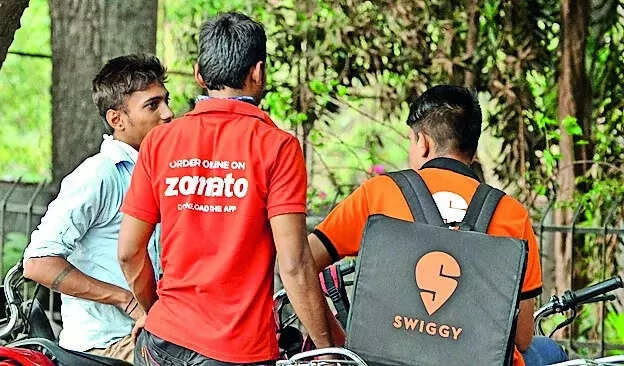
Gig Worker Social Security Shakeup: 90-Day Rule Divides Experts and Workers
In a move that’s drawing both cautious optimism and sharp criticism, the Indian government has unveiled a key provision under the new Social Security Code: to be eligible for social security benefits, gig workers must be engaged with a single aggregator (like Swiggy, Zomato, or Uber) for at least 90 days in a financial year. If they split their work across multiple platforms, the threshold jumps to 120 days .
On the surface, it’s a step toward formalizing protections for India’s estimated 15 million gig and platform workers. But many labor advocates, economists, and workers themselves argue the 90-day rule is arbitrary, exclusionary, and out of touch with the realities of gig work—where income instability, platform deactivation, and seasonal demand are the norm.
So, does this policy truly protect gig workers—or push millions further into the shadows? Let’s unpack the details, the debates, and what it means for the future of India’s digital workforce.
Table of Contents
- What the New Gig Worker Social Security Rules Actually Say
- Why the 90-Day Threshold Is Sparking Outrage
- Who Gets Left Out? The Hidden Exclusions
- The Role of the National Social Security Board
- How India Compares to Global Gig Worker Protections
- What Gig Workers Really Need: Beyond the 90-Day Rule
- Conclusion: A Step Forward or a Bureaucratic Barrier?
- Sources
What the New Gig Worker Social Security Rules Actually Say
Under the draft rules of the Code on Social Security, 2020—finally being operationalized in 2026—the government has defined clear eligibility criteria:
- ✅ Single-platform workers: Must be engaged for ≥90 days in a financial year with one aggregator.
- ✅ Multi-platform workers: Must have a combined engagement of ≥120 days across all platforms.
- ✅ Registration: Workers must self-register on the proposed e-Shram-like national portal.
- ✅ Governing body: A National Social Security Board will oversee fund allocation and policy design .
Benefits are expected to include health insurance, accidental death coverage, maternity benefits, and old-age protection—funded through a mix of government, platform contributions, and worker co-payments.
Why the 90-Day Threshold Is Sparking Outrage
While well-intentioned, the gig worker social security 90-day rule faces three major criticisms:
- It ignores income volatility: Many gig workers can’t guarantee 90 days of continuous work due to algorithmic deactivations, low demand, or personal emergencies.
- It disincentivizes platform diversification: Workers often juggle multiple apps to survive. The 120-day rule punishes this resilience.
- Verification is nearly impossible: Platforms rarely provide work-duration records. How will a delivery rider prove they worked 91 days, not 89?
“This rule assumes gig work is stable and trackable—when it’s anything but,” says Dr. Reetika Khera, a development economist at IIT Delhi . “It’s eligibility designed for bureaucrats, not for workers.”
Who Gets Left Out? The Hidden Exclusions
Consider these real-world scenarios:
- A food delivery rider injured in March misses two months of work—falling short of 90 days.
- A woman doing part-time gig work while caring for children averages 60 days/year across two apps.
- A seasonal worker (e.g., during Diwali or IPL) earns heavily for 2 months but vanishes from platforms the rest of the year.
These workers—the most vulnerable—are precisely the ones who need social security the most. Yet under the current proposal, they’re disqualified.
The Role of the National Social Security Board
The government plans to establish a National Social Security Board comprising government officials, platform representatives, and—critically—worker representatives. This board will:
- Determine contribution rates from platforms and government
- Design benefit schemes tailored to gig worker needs
- Monitor fund utilization and accessibility
However, labor unions are demanding that worker reps hold a majority vote, not just a token seat. “Without real power, the board becomes a photo-op, not a protector,” warns the All India Gig Workers Union.
How India Compares to Global Gig Worker Protections
Globally, countries are experimenting with gig worker safety nets:
- 🇪🇸 Spain: Passed the “Rider Law” classifying delivery workers as employees.
- 🇺🇸 California: Introduced portable benefits tied to hours worked across platforms.
- 🇫🇷 France: Mandates platforms contribute to a universal social fund regardless of days worked.
India’s 90-day rule is notably more restrictive than these models. For context, the International Labour Organization (ILO) recommends social protection be universal and not conditional on arbitrary work thresholds.
What Gig Workers Really Need: Beyond the 90-Day Rule
Instead of rigid day-counts, experts propose:
- Income-based thresholds: Eligibility based on annual earnings (e.g., below ₹3 lakh).
- Automatic enrollment: Platforms auto-register workers upon first gig.
- Portable benefits: Benefits that follow the worker, not the platform.
[INTERNAL_LINK:gig-economy-india-future] For a deeper look at the future of work in India, explore our analysis of platform capitalism and labor rights.
Conclusion: A Step Forward or a Bureaucratic Barrier?
The intent behind the gig worker social security framework is commendable—millions of informal workers deserve dignity and safety. But the 90-day rule risks becoming a gatekeeping mechanism that excludes the very people it aims to help. If the government is serious about inclusive social protection, it must listen to worker voices, simplify verification, and prioritize coverage over compliance. Otherwise, this policy may go down as a missed opportunity in India’s evolving labor story.
Sources
Times of India. “Govt proposes 90-day work a year for gig workers to get social security.” January 2, 2026. https://timesofindia.indiatimes.com/…
Interview with Dr. Reetika Khera, IIT Delhi (public statements on social security policy, 2025).
International Labour Organization (ILO). “Social Protection for All.” https://www.ilo.org/…
Ministry of Labour & Employment, Government of India. “Code on Social Security, 2020 – Draft Rules.”