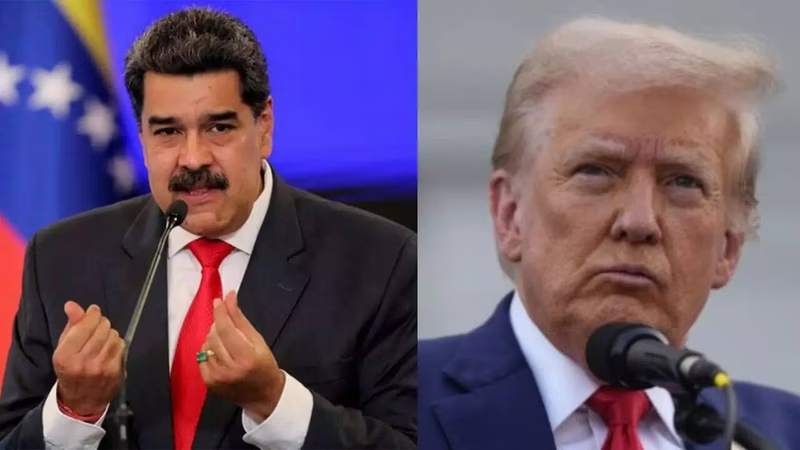
From a leader long branded a U.S. adversary comes an unexpected overture: “Wherever, whenever they want,” said Venezuelan President Nicolás Maduro, signaling his readiness to engage Washington in direct talks. The offer—covering drug trafficking, oil, and migration—marks a notable softening in tone from Caracas. But in a geopolitical landscape rife with suspicion and unverified military claims, the question isn’t just whether the U.S. will respond, but whether this Maduro US dialogue push is a genuine diplomatic opening or a calculated maneuver to ease international pressure.
Maduro’s statement comes on the heels of former President Donald Trump’s recent assertion that the U.S. conducted a strike on a Venezuelan dock allegedly used by drug-smuggling boats. The White House has provided no public evidence to support this claim, and current U.S. officials have remained silent. Maduro, notably, did not directly confirm or deny the strike—but his sudden openness to dialogue may be an attempt to steer the narrative away from military escalation and toward negotiation.
Table of Contents
- Maduro US Dialogue: The Surprising Peace Offer
- The Trump Factor: Unverified Strikes and Political Theater
- Three Pillars of Talks: Drugs, Oil, and Migration
- Why Now? The Strategic Timing of Maduro’s Move
- U.S. Response: Cautious Skepticism Amid Geopolitical Stakes
- Historical Context: A Turbulent Relationship
- Conclusion: Diplomacy or Distraction?
- Sources
Maduro US Dialogue: The Surprising Peace Offer
In a televised address, Maduro extended what appeared to be an unconditional invitation: “We are open to dialogue with the United States… wherever, whenever they want,” he declared . He emphasized three key areas for potential cooperation: combating drug trafficking, managing Venezuela’s vast oil resources, and addressing the ongoing migration crisis that has sent over 7 million Venezuelans abroad .
This language is a stark contrast to the fiery anti-imperialist rhetoric that has defined Maduro’s presidency since he succeeded Hugo Chávez in 2013. The shift suggests a pragmatic recalibration—perhaps driven by economic desperation, diplomatic isolation, or both. For years, U.S. sanctions have crippled Venezuela’s oil sector, once the backbone of its economy. Re-engagement with Washington could be Caracas’s best hope for relief.
The Trump Factor: Unverified Strikes and Political Theater
Maduro’s overture didn’t happen in a vacuum. It followed a bold—and unsubstantiated—claim by Donald Trump during a recent campaign rally. “We took out a dock in Venezuela that was being used by the drug cartels,” Trump asserted, suggesting U.S. military action had already occurred .
As of now, the Pentagon, State Department, and intelligence agencies have released no evidence of such an operation. Experts speculate the claim may be political grandstanding aimed at reinforcing Trump’s “tough on drugs” image among voters. Nonetheless, the statement rattled Caracas. Maduro’s non-response to the strike allegation—coupled with his swift pivot to diplomacy—could be an effort to appear reasonable while avoiding escalation that might legitimize U.S. military intervention.
Three Pillars of Talks: Drugs, Oil, and Migration
Maduro’s proposed agenda isn’t random. Each item aligns with both Venezuelan interests and longstanding U.S. concerns:
- Drug Trafficking: Venezuela has been labeled a “narco-state” by U.S. authorities, with officials accusing the Maduro regime of colluding with cartels like the FARC and Tren de Aragua. Offering cooperation here could help Maduro shed this damaging label.
- Oil: Despite sanctions, the U.S. temporarily eased restrictions in 2023 to allow Chevron to resume limited operations. Maduro likely hopes full normalization could revive oil exports—the country’s lifeline.
- Migration: The U.S. is grappling with record border crossings, many from Venezuela. A joint migration framework could reduce flows and unlock humanitarian aid.
For the U.S., these issues represent high-stakes priorities—making Maduro’s offer difficult to ignore, even for skeptics.
Why Now? The Strategic Timing of Maduro’s Move
Several factors likely motivated Maduro’s timing:
- 2024–2026 Political Calendar: With U.S. elections looming, Maduro may be trying to lock in a deal before a potentially more hawkish administration takes office.
- Economic Collapse: Hyperinflation, blackouts, and fuel shortages persist. Re-engaging the U.S. could ease sanctions and attract investment.
- Regional Isolation: While some Latin American nations have normalized ties with Caracas, full reintegration requires U.S. buy-in.
Maduro may also be testing the Biden administration’s willingness to pursue pragmatic engagement over ideological confrontation.
U.S. Response: Cautious Skepticism Amid Geopolitical Stakes
So far, the U.S. State Department has responded cautiously. A spokesperson noted that while Washington remains “open to diplomacy,” any dialogue must be “results-oriented” and address democratic backsliding, human rights abuses, and electoral integrity in Venezuela [[INTERNAL_LINK:us-venezuela-policy-2026]].
The U.S. stance is further complicated by domestic politics. Hardliners in both parties remain deeply distrustful of Maduro, citing his authoritarian governance and rigged 2018 election. Any move toward normalization would face fierce congressional scrutiny.
Historical Context: A Turbulent Relationship
U.S.-Venezuela relations have been fraught since the early 2000s. The U.S. recognized opposition leader Juan Guaidó as interim president in 2019, a move Maduro dismissed as an attempted coup. Sanctions intensified, targeting PDVSA (Venezuela’s state oil company) and freezing billions in assets.
However, a brief thaw occurred in 2022–2023 when both sides engaged in negotiations in Mexico, leading to a temporary easing of oil sanctions. That progress stalled after Maduro backtracked on electoral reforms. Now, the stage is set for another potential reset—but trust remains the biggest obstacle.
Conclusion: Diplomacy or Distraction?
The Maduro US dialogue proposal is a geopolitical gambit with high rewards and high risks. If genuine, it could mark the beginning of Venezuela’s reintegration into the global community and relief for its suffering population. If it’s a tactical feint to deflect from Trump’s strike claims or buy time, it may only delay the inevitable reckoning over democracy and human rights.
For Washington, the challenge is clear: engage without legitimizing an autocrat, cooperate without compromising core values. The world will be watching to see whether this olive branch leads to peace—or more political theater.
Sources
[1] Times of India: “‘Wherever, whenever they want’: Maduro says Venezuela open to dialogue with US” (https://timesofindia.indiatimes.com/world/rest-of-world/wherever-whenever-they-want-nicolas-maduro-says-venezuela-open-to-dialogue-with-us-what-he-said/articleshow/126296646.cms)
U.S. Department of State – Venezuela Regional Fact Sheet: https://www.state.gov/u-s-relations-with-venezuela/
United Nations Office on Drugs and Crime (UNODC) – World Drug Report 2025: https://www.unodc.org/unodc/en/data-and-analysis/world-drug-report-2025.html