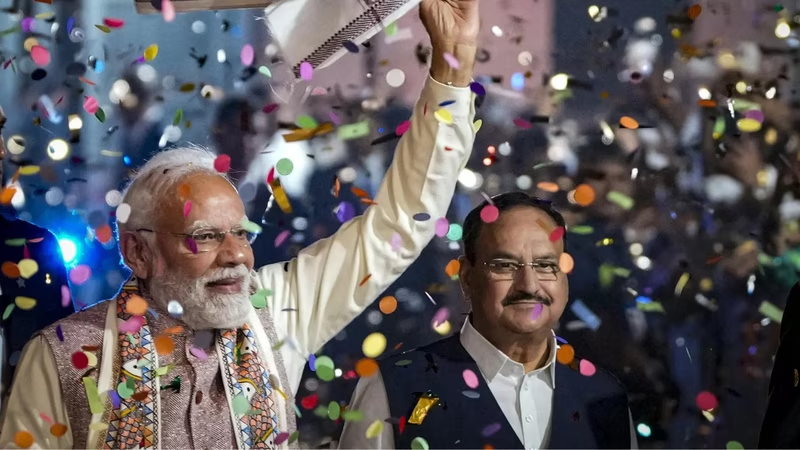
2025 was a banner year for the Bharatiya Janata Party (BJP)—but 2026 could define its political future for the rest of the decade. Fresh off a series of wins, the party now faces what many political analysts are calling its most consequential electoral test yet: holding onto power in key northern and eastern states while finally cracking the long-elusive southern fortress. The stakes? Nothing less than the BJP’s credibility as a truly national party and its path toward the 2029 general elections.
Assembly elections in West Bengal, Assam, Tamil Nadu, and Kerala—alongside high-profile Rajya Sabha and urban local body contests—will serve as a real-time stress test of the BJP’s organizational depth, ideological appeal, and leadership narrative under Prime Minister Narendra Modi. If the BJP 2026 elections go its way, it could cement one-party dominance across India. If not, it may signal the limits of its expansion and invigorate a fragmented but determined opposition.
Table of Contents
- Why 2026 Is BJP’s Inflection Point
- Defending the North: West Bengal and Assam Battlegrounds
- Cracking the South: Tamil Nadu and Kerala Challenges
- Key Strategies BJP Is Deploying Nationwide
- Opposition Alliances and Their 2026 Plans
- What 2026 Means for Modi’s 2029 Ambitions
- Conclusion: A Nationwide Referendum on BJP Hegemony
- Sources
Why 2026 Is BJP’s Inflection Point
For the BJP, 2026 isn’t just another election cycle—it’s a strategic pivot. The party has dominated national politics since 2014, but its footprint remains uneven. While it rules large swathes of North, West, and Central India, it has struggled to gain a foothold in the South, where regional identities, linguistic pride, and strong local parties have resisted nationalization of politics .
Simultaneously, West Bengal—a state with 294 assembly seats and immense symbolic value—remains a fortress held by Mamata Banerjee’s Trinamool Congress (TMC). Losing Bengal again would undermine the BJP’s claim of being India’s sole pan-Indian alternative. Hence, the BJP 2026 elections are less about seat counts and more about narrative control: Can the party truly govern from Kashmir to Kanyakumari?
Defending the North: West Bengal and Assam Battlegrounds
West Bengal is the crown jewel. The BJP came within striking distance in 2021, winning 77 seats—a historic high—but fell short against Mamata’s emotional “Ma-Mati-Manush” campaign. In 2026, the party is betting on a dual strategy: deepening its Hindutva pitch while simultaneously addressing local agrarian and economic grievances.
Key figures like Union Minister Himanta Biswa Sarma—now a national face of the party—are playing matchmaker between Assam’s success model and Bengal’s complex social matrix. In Assam, where the BJP has governed since 2016, 2026 is about consolidation. The party aims to counter the Congress-AISPF alliance by highlighting infrastructure growth and welfare schemes like “Swarna Jayanti” housing .
Cracking the South: Tamil Nadu and Kerala Challenges
The South remains BJP’s toughest frontier. In Tamil Nadu, the DMK-Congress alliance dominates, and Dravidian identity politics leaves little room for Hindutva narratives. The BJP’s local unit, led by K. Annamalai, has tried to reframe the debate around “good governance” and youth employment—but with limited traction.
In Kerala, the party faces an even steeper climb. Despite winning a Lok Sabha seat in 2019 and 2024, it holds no significant presence in the state assembly. The LDF (Left) and UDF (Congress-led) have alternated power for decades, and BJP is still seen as an “outsider.” Yet, the party is investing in grassroots cadre-building, hoping to capitalize on anti-incumbency and rising Hindu consolidation in border districts .
Key Strategies BJP Is Deploying Nationwide
To navigate this high-wire act, the BJP is deploying a multi-pronged approach:
- Leadership Localization: Promoting regional faces (e.g., Sarma in the East, Annamalai in TN) to soften the “Delhi imposition” image.
- Welfare Populism: Extending successful central schemes (PM Awas Yojana, Ujjwala) to states, creating direct voter connect.
- Digital Mobilization: Leveraging AI-driven micro-targeting on social media to reach youth and urban voters.
- Hindutva Consolidation: Using temple politics, anti-conversion bills, and cultural symbolism to build a unified Hindu vote bank.
These tactics aim to make the BJP less dependent on Modi’s personal charisma and more on institutional resilience—a crucial shift for long-term survival.
Opposition Alliances and Their 2026 Plans
The opposition isn’t sitting idle. In Bengal, Mamata Banerjee is preparing a “secular unity” front, possibly bringing Left parties into her fold. In Tamil Nadu, the DMK is doubling down on Tamil pride and federalism, framing the BJP as a threat to state autonomy. Kerala’s LDF, under Pinarayi Vijayan, is highlighting healthcare and education achievements to counter BJP’s narrative of “development deficit.”
Crucially, if these regional parties coordinate nationally—as hinted by the INDIA bloc—they could replicate the 2024 Lok Sabha strategy at the state level. But internal contradictions remain: TMC’s ambition clashes with Congress’s revival hopes, and DMK’s secularism sits uneasily with some allies’ conservative leanings.
What 2026 Means for Modi’s 2029 Ambitions
Prime Minister Modi’s eye is already on 2029. A strong showing in 2026 would not only boost his “Modi 3.0” campaign but also weaken potential leadership challengers within the BJP. Conversely, losses in Bengal or setbacks in the South could embolden rivals and fracture the party’s unity.
More broadly, 2026 will reveal whether the BJP’s model of “centralized governance + decentralized campaigning” is sustainable—or whether India’s federal fabric is too strong to be overridden by a single national ideology.
Conclusion: A Nationwide Referendum on BJP Hegemony
The BJP 2026 elections are more than just state contests—they’re a nationwide referendum on the party’s vision for India. Can it transform from a North-India-centric force into a truly national movement? Can it blend Hindutva with regional aspirations? The answers will shape not just the BJP’s fate, but India’s political trajectory for years to come. In 2026, every vote will be a verdict on the future of Indian democracy itself.
Sources
[1] Times of India: “BJP’s big 2026 test: Defending the North, cracking the South” (https://timesofindia.indiatimes.com/india/bjps-big-2026-test-defending-the-north-cracking-the-south-narendra-modi-mamata-banerjee-mk-stalin-himanta-biswa-sarma-bjp-tmc-dmk/articleshow/126284931.cms)
Election Commission of India – State Assembly Election Schedule (Official Portal): https://eci.gov.in
[INTERNAL_LINK:bjp-south-india-expansion-strategy]