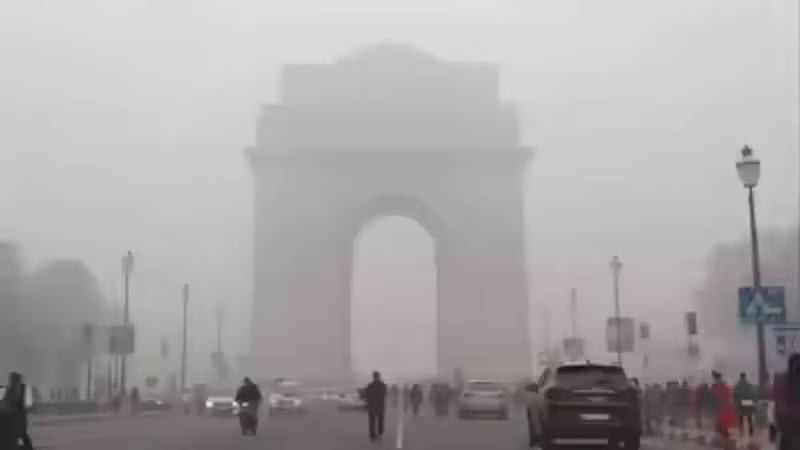
Take a breath in Delhi today—and you’re inhaling the equivalent of smoking 15 cigarettes.
That’s not hyperbole. It’s science. On Friday, January 2, 2026, Delhi’s Air Quality Index (AQI) plunged to **311**, firmly placing the national capital in the **“very poor”** category . The culprit? A toxic cocktail of vehicle emissions, industrial discharge, construction dust, and residual stubble smoke—now trapped under a suffocating blanket of cold, windless air. With a cold wave gripping North India from January 2 to 5, there’s little relief in sight. For millions, this isn’t just an inconvenience—it’s a public health emergency.
Table of Contents
- Delhi Air Pollution AQI 311: What It Really Means
- Why the Cold Wave Is Making Pollution Worse
- Who Is Most at Risk During ‘Very Poor’ Air Quality?
- Real-Time AQI Data and Forecast for Delhi (2026)
- What You Can Do: Immediate Health Protection Tips
- Why Delhi Still Has No Permanent Solution
- Conclusion: Breathing While the System Fails
- Sources
Delhi Air Pollution AQI 311: What It Really Means
An AQI between 301 and 400 is classified as “very poor” by India’s Central Pollution Control Board (CPCB). At this level:
- People with heart or lung disease, older adults, and children should **avoid all physical exertion outdoors**.
- The general public may experience **respiratory symptoms** like coughing, wheezing, and shortness of breath.
- Prolonged exposure can lead to **reduced lung function** and exacerbate asthma, bronchitis, and cardiovascular conditions .
Friday’s reading of 311—recorded by the System of Air Quality and Weather Forecasting and Research (SAFAR)—means Delhi’s air contains dangerous levels of PM2.5 (fine particulate matter under 2.5 microns), which can penetrate deep into the lungs and bloodstream .
Why the Cold Wave Is Making Pollution Worse
Winter in Delhi is a perfect storm for pollution. And this year’s cold wave—forecast to last until January 5—has intensified the crisis:
- Temperature inversion: Cold air near the ground gets trapped under a layer of warmer air above, acting like a lid on a pot. Pollutants can’t rise and disperse.
- Low wind speed: With wind speeds below 4 km/h, there’s no natural “cleansing” effect to blow away smog .
- Increased local emissions: People burn more wood and waste for warmth, while vehicles idle longer to warm up—adding to the toxic mix.
“This isn’t just seasonal—it’s systemic,” says Dr. Arun Sharma, an environmental health expert at AIIMS. “The cold wave exposes how fragile our air quality management really is.”
Who Is Most at Risk During ‘Very Poor’ Air Quality?
Not everyone experiences pollution equally. High-risk groups include:
- Children under 5: Their lungs are still developing; exposure can cause lifelong damage.
- Elderly citizens: Reduced immunity and pre-existing conditions make them vulnerable.
- Asthmatics and COPD patients: Even brief exposure can trigger life-threatening attacks.
- Pregnant women: Studies link high PM2.5 levels to low birth weight and preterm birth .
Schools in Delhi have already issued advisories to limit outdoor activities—a measure that’s become routine, not exceptional.
Real-Time AQI Data and Forecast for Delhi (2026)
According to SAFAR, the outlook remains grim:
- January 2: AQI 311 (Very Poor)
- January 3–4: AQI expected to hover between 300–330
- January 5: Marginal improvement possible if cold wave eases
Key monitoring stations like Anand Vihar (AQI 342) and ITO (AQI 328) are among the worst affected . Residents can track real-time data via the CPCB website or the “Sameer” mobile app.
What You Can Do: Immediate Health Protection Tips
While systemic change is needed, individuals can take steps to reduce harm:
- Wear N95 masks when stepping outside—cloth masks won’t block PM2.5.
- Use air purifiers with HEPA filters at home, especially in bedrooms.
- Avoid morning walks—pollution peaks between 6–10 AM.
- Keep windows closed and use wet mopping to reduce indoor dust.
- Stay hydrated and consume foods rich in antioxidants (like berries and leafy greens) to combat inflammation.
For more on protecting your family, see our guide on [INTERNAL_LINK:how-to-survive-delhi-smog-season].
Why Delhi Still Has No Permanent Solution
Despite annual Graded Response Action Plan (GRAP) measures—like odd-even car schemes and construction bans—the root causes remain unaddressed:
- Regional coordination failure: Stubble burning in Punjab and Haryana continues due to lack of affordable alternatives for farmers.
- Urban planning gaps: Delhi’s exploding vehicle population (over 12 million) and unchecked construction fuel local emissions.
- <Weak enforcement: Industrial units often bypass emission norms with impunity.
“We treat symptoms, not the disease,” says environmental lawyer Ritwick Dutta. “Until we invest in clean public transport, renewable energy, and regional cooperation, Delhi will keep choking every winter.”
Conclusion: Breathing While the System Fails
The **Delhi air pollution** crisis at AQI 311 is more than a weather event—it’s a failure of governance, planning, and collective will. As the cold wave traps toxins over the capital, citizens are left to fend for themselves with masks and air purifiers. But breathing clean air shouldn’t be a luxury. It’s a fundamental right. And until Delhi’s leaders treat it as such, the cycle of annual suffocation will continue—year after year, winter after winter.
Sources
- Times of India. (2026, January 2). Delhi air pollution: City slips into ‘very poor’ category as AQI touches 311; cold wave persists. Retrieved from https://timesofindia.indiatimes.com/city/delhi/delhi-air-pollution-city-slips-into-very-poor-category-as-aqi-touches-311-cold-wave-persists/articleshow/126296990.cms
- Central Pollution Control Board (CPCB). (2026). AQI Categories and Health Implications. Retrieved from https://cpcb.gov.in
- SAFAR – India. (2026, January 2). Delhi Real-Time Air Quality Forecast. Retrieved from https://safar.tropmet.res.in
- World Health Organization (WHO). (2021). Health Effects of Particulate Matter. Retrieved from https://www.who.int/publications/i/item/9789240034221
- Indian Institute of Tropical Meteorology (IITM). (2025). Impact of Meteorology on Delhi’s Winter Smog.