Imagine being 90 years old, bedridden, and receiving a notice to appear at a polling booth miles away—just to prove you’re still alive and eligible to vote. For too many elderly and disabled citizens in West Bengal, this wasn’t hypothetical. It was reality.
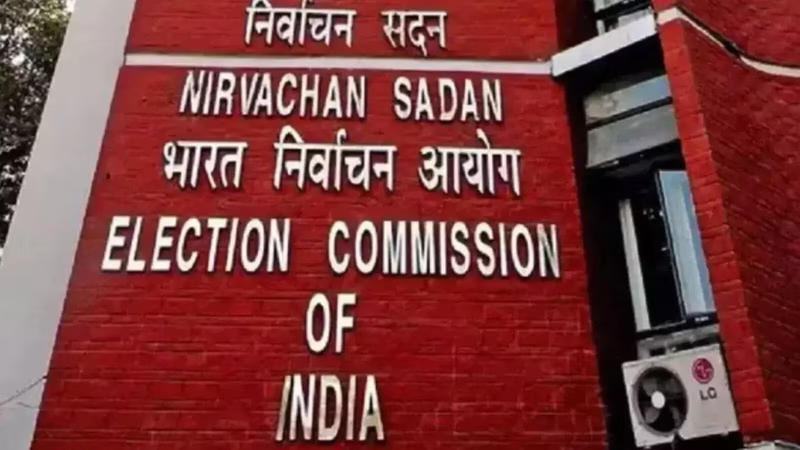
Now, the Election Commission of India (ECI) has drawn a firm line. In a decisive move to uphold the dignity of its most vulnerable electors, the Commission has issued a **strict warning**: any Booth Level Officer (BLO) or supervisor who summons voters aged 85 and above, or those who are sick, disabled, or pregnant, for in-person hearings during the ongoing **Bengal SIR** (Special Summary Revision) will face immediate disciplinary action .
Table of Contents
- What Is the Bengal SIR and Why It Matters
- The Human Cost of Bureaucratic Oversight
- ECI’s New Mandate: Home Verification for Vulnerable Voters
- Who Qualifies for Home Verification?
- Accountability: How the EC Will Enforce This Rule
- A Step Toward Inclusive Democracy
- Conclusion: Protecting the Right to Vote With Dignity
- Sources
What Is the Bengal SIR and Why It Matters
The **Bengal SIR**, or Special Summary Revision, is a critical phase in India’s electoral cycle where voter lists are updated ahead of major elections. It’s designed to add new eligible voters (like those who just turned 18), remove duplicates, and correct errors—especially names of deceased individuals.
During this process, Booth Level Officers (BLOs) verify addresses and identities. Traditionally, if a voter’s details are flagged—perhaps due to non-participation in past elections—they may be asked to appear for a brief hearing to confirm they still reside at the registered address .
While efficient in theory, this system has repeatedly failed India’s most vulnerable.
The Human Cost of Bureaucratic Oversight
Despite clear instructions from the ECI in previous cycles, reports from West Bengal in late 2025 revealed a disturbing pattern: **elderly citizens over 85, wheelchair users, bedridden patients, and even pregnant women were being summoned to polling stations** for verification .
For many, this wasn’t just inconvenient—it was physically impossible. Some families reported elders being carried on cots. Others described elderly parents breaking down in tears, feeling “accused” of being ghosts on the electoral roll.
This not only caused emotional distress but also undermined public trust in the electoral process—a core pillar of Indian democracy.
ECI’s New Mandate: Home Verification for Vulnerable Voters
Reacting swiftly, the Election Commission has now made home verification **mandatory** for specific categories of voters during the **Bengal SIR**. BLOs are no longer permitted to issue summons. Instead, they must visit the voter’s residence to complete verification.
This shift is both practical and humane. It acknowledges that voting isn’t just a right—it’s a process that must be accessible to all, regardless of age or ability.
Who Qualifies for Home Verification?
According to the ECI’s latest directive, the following groups must be verified at home without exception:
- Voters aged 85 years and above
- Persons with permanent or temporary disabilities (including visual, locomotor, or cognitive impairments)
- Individuals with chronic or critical illnesses that restrict mobility
- Pregnant women in their third trimester
- Any voter certified as housebound by a registered medical practitioner
Families can proactively inform BLOs or submit medical certificates through the ECI’s online voter portal or local election office .
Accountability: How the EC Will Enforce This Rule
The Election Commission isn’t just issuing guidelines—it’s enforcing them. The recent order explicitly states:
“Strict disciplinary action will be taken against Booth Level Officers and their supervising officers if any eligible voter from the above categories is called for physical appearance.”
Enforcement mechanisms include:
- Helpline monitoring: The ECI’s 1950 voter helpline will prioritize complaints related to SIR violations.
- Field audits: District Election Officers (DEOs) must submit weekly compliance reports.
- Public dashboards: Real-time updates on home verifications completed per booth will be published on the CEO West Bengal website.
This marks a significant upgrade from past cycles, where warnings were often ignored without consequence.
A Step Toward Inclusive Democracy
India’s electoral system has long struggled with inclusion. According to a 2022 study by the Centre for Equity Studies, nearly 18% of disabled citizens faced barriers during voter registration . The ECI’s new mandate directly addresses this gap.
Moreover, this move aligns with global best practices. Countries like Canada and the UK have long used mobile verification units for elderly and disabled voters—a model India is now embracing at scale.
For more on electoral accessibility, see our guide on [INTERNAL_LINK:inclusive-voting-in-india].
Conclusion: Protecting the Right to Vote With Dignity
The Election Commission’s firm stance on the **Bengal SIR** verification process is more than a bureaucratic update—it’s a moral imperative. By banning hearings for the elderly and vulnerable and mandating home visits, the ECI is sending a clear message: democracy must come to the people, not the other way around. As West Bengal prepares for future elections, this policy ensures that every citizen—whether 18 or 98—can exercise their franchise with dignity, safety, and respect.
Sources
- Times of India. (2026, January 1). Election Commission warns of action if 85+ WB voters called for SIR hearings. Retrieved from https://timesofindia.indiatimes.com/india/election-commission-warns-of-action-if-85-wb-voters-called-for-sir-hearings/articleshow/126294282.cms
- Election Commission of India. (2025). Guidelines for Special Summary Revision (SIR) 2025-26. Retrieved from https://eci.gov.in
- CEO West Bengal. (2026). Voter Services Portal: Home Verification Request. Retrieved from https://wbce.gov.in
- Centre for Equity Studies. (2022). Disability and Electoral Participation in India. New Delhi.
- International Institute for Democracy and Electoral Assistance (IDEA). (2023). Global Standards for Inclusive Elections. Retrieved from https://www.idea.int