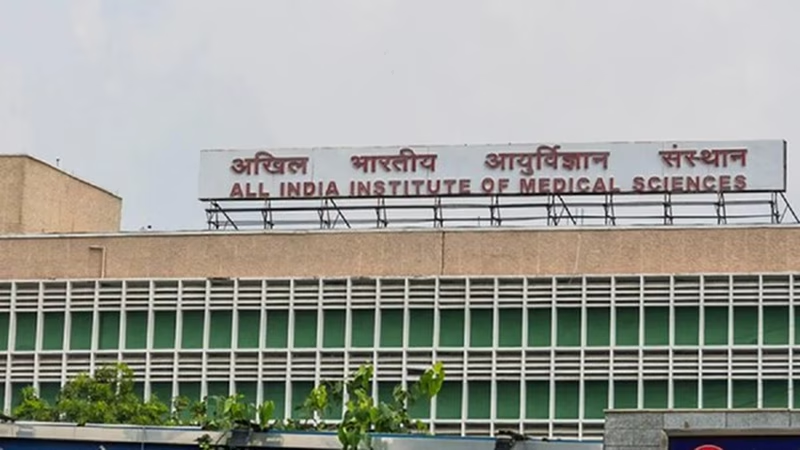
Imagine needing urgent heart surgery—but the cardiologist who should be at your hospital hasn’t been hired in two years. Or picture a young medical student trying to learn complex procedures from overworked professors handling double their normal patient load. This isn’t a dystopian fiction. It’s the reality unfolding across India’s All India Institute of Medical Sciences (AIIMS) network.
A recent Right to Information (RTI) query has laid bare a systemic crisis: **nearly 40% of all sanctioned faculty posts—roughly 4 out of every 10—are lying vacant across 11 AIIMS institutes** . This isn’t just a staffing issue—it’s a ticking time bomb for public health, medical training, and patient trust in India’s crown jewel of healthcare.
Table of Contents
- The Shocking Numbers Behind the AIIMS Faculty Shortage
- How Vacancies Are Crippling Patient Care
- The Hidden Cost: Medical Education in Peril
- Why Are Posts Remaining Vacant? Structural Barriers Explained
- Older vs. Newer AIIMS: A Crisis Without Boundaries
- What Needs to Change: Policy Recommendations
- Conclusion: A Call to Save India’s Healthcare Future
- Sources
The Shocking Numbers Behind the AIIMS Faculty Shortage
The RTI data, obtained by public health advocates, paints a grim picture. Across 11 AIIMS—including flagship Delhi, as well as newer ones in Bhopal, Jodhpur, Patna, and Raipur—only about **60% of approved faculty positions are filled** .
That translates to **hundreds of critical roles** in specialties like neurosurgery, oncology, pediatrics, and radiology sitting empty. At AIIMS Delhi alone, over 200 faculty posts remain unfilled, despite being one of the country’s most resourced medical institutions .
How Vacancies Are Crippling Patient Care
When specialists are missing, patients suffer. The consequences are immediate and severe:
- Longer wait times: Appointments for critical consultations can stretch from weeks to months.
- Overburdened doctors: Existing faculty handle 2–3 times their recommended patient load, leading to burnout and potential errors .
- Limited services: Some departments operate at reduced capacity or can’t offer advanced procedures due to lack of trained personnel.
- Delayed emergency care: In trauma or ICU units, every minute counts—staff shortages can be fatal.
For millions who rely on AIIMS as a last resort—especially the poor and rural populations—these delays aren’t inconvenient; they’re life-threatening.
The Hidden Cost: Medical Education in Peril
AIIMS isn’t just a hospital—it’s India’s top medical school. But how can students learn from teachers who aren’t there?
The **AIIMS faculty shortage** directly undermines the quality of undergraduate and postgraduate education. With fewer mentors, clinical exposure is reduced, research guidance is limited, and hands-on training suffers. This creates a dangerous cycle: poorly trained doctors enter the system, which then worsens the overall healthcare gap .
Why Are Posts Remaining Vacant? Structural Barriers Explained
This isn’t due to lack of interest. Hundreds of qualified doctors apply for AIIMS positions each year. The problem lies in the system:
- Bureaucratic delays: Recruitment involves multiple layers—interview panels, document verification, ministry approvals—that can take 12–18 months.
- Rigid pay scales: AIIMS salaries, though stable, often can’t compete with private sector or overseas offers, especially for super-specialists.
- Infrastructure gaps in new AIIMS: Doctors hesitate to join newer institutes lacking housing, labs, or even basic OPD facilities.
- Unclear career progression: Ambiguity around promotions and research support discourages long-term commitment.
As one senior physician anonymously told a health journal: “We’re not short of talent. We’re short of will.”
Older vs. Newer AIIMS: A Crisis Without Boundaries
While one might assume the problem is confined to newly established AIIMS (set up under PMSSY), the RTI shows that **even AIIMS Delhi and other older institutes are deeply affected** . This proves the issue isn’t just about scaling up—it’s about systemic mismanagement across the entire network.
Newer AIIMS in states like Nagpur and Gorakhpur struggle with both faculty and non-teaching staff vacancies, making it hard to even open all sanctioned departments. Meanwhile, older centers are stretched thin trying to compensate for national expectations.
What Needs to Change: Policy Recommendations
Fixing this won’t happen overnight—but it can start today:
- Fast-track recruitment: Create a centralized, digitized hiring portal with strict timelines.
- Offer retention incentives: Housing allowances, research grants, and clear promotion paths for faculty in remote AIIMS.
- Allow lateral entry: Permit experienced doctors from state services or private practice to join without re-clearing national exams.
- Improve infrastructure parity: Ensure all AIIMS—new or old—have comparable facilities to attract talent.
For more on strengthening public health systems, see our analysis on [INTERNAL_LINK:india-public-health-infrastructure-reforms].
Conclusion: A Call to Save India’s Healthcare Future
The **AIIMS faculty shortage** is more than a statistic—it’s a national emergency. These institutions were envisioned as beacons of equitable, high-quality care and education. But without urgent action to fill these critical posts, that vision risks fading into irrelevance. India doesn’t just need more doctors; it needs a functioning system to deploy them where they’re needed most. The time to act is now—before more lives are lost to vacancies, not viruses.
Sources
- Times of India. (2026, January 1). RTI: Four of 10 faculty posts vacant across 11 AIIMS. Retrieved from https://timesofindia.indiatimes.com/india/rti-four-of-10-faculty-posts-vacant-across-11-aiims/articleshow/126294251.cms
- Ministry of Health and Family Welfare, Government of India. (2025). AIIMS Annual Report 2024-25. Retrieved from https://www.mohfw.gov.in
- Indian Journal of Medical Ethics. (2023). Workload and Burnout Among AIIMS Faculty.
- National Medical Commission (NMC). (2024). Guidelines for Medical Education Infrastructure.
- World Health Organization (WHO). (2023). Health Workforce Requirements for Universal Health Coverage. Retrieved from https://www.who.int/publications/i/item/9789240073596