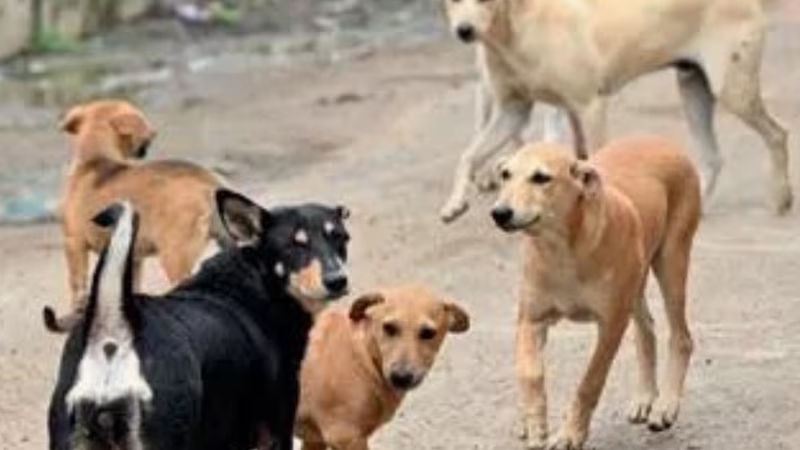
Imagine this: your child is playing near your home when a stray dog attacks. In a panic, you rush them to the nearest hospital, only to be told they’re out of a crucial, life-saving medication. This terrifying scenario is now becoming a thing of the past, thanks to a powerful new directive from the National Medical Commission (NMC). In a move that could save thousands of lives, the NMC has ordered all medical colleges across India to stock up on rabies drugs without fail.
Table of Contents
- A New Lifeline in the Fight Against Rabies
- Why Rabies Drugs Are Not Just Vaccines, But a Critical Combo
- India’s Stray Dog Crisis: By the Numbers
- What the NMC Order Really Means for Public Hospitals
- A Comprehensive Approach: Beyond Just Medicines
- Conclusion: A Bold Step Towards a Rabies-Free India
- Sources
A New Lifeline in the Fight Against Rabies
The recent order from the NMC is a direct response to a stern observation from the Supreme Court of India, which flagged the growing threat posed by stray dogs in public spaces . The court’s intervention has forced a long-overdue systemic change. Now, every medical college hospital—often the primary healthcare provider in their regions—must ensure an uninterrupted supply of both Anti-Rabies Vaccine (ARV) and Rabies Immunoglobulin (RIG) .
This isn’t just about compliance; it’s about creating a safety net for millions of citizens who are at risk every single day. The mandate aims to eliminate the agonizing wait and potential death that can occur when these critical rabies drugs are unavailable at the point of need.
Why Rabies Drugs Are Not Just Vaccines, But a Critical Combo
Many people believe that a rabies vaccine is enough. But for severe dog bites, especially those on the head, neck, or hands, that’s only half the battle. Effective post-exposure prophylaxis (PEP) requires a two-pronged approach:
- Active Immunization: The Anti-Rabies Vaccine (ARV) is given in a series of doses to help your body build its own long-term defenses against the virus.
- Passive Immunization: Rabies Immunoglobulin (RIG) provides immediate, short-term antibodies to neutralize the virus at the wound site before it can reach the nervous system. This is crucial for buying time until the vaccine takes effect .
Historically, RIG has been the Achilles’ heel of India’s rabies treatment protocol. A nationwide survey revealed that while the vaccine was available in 80% of public health facilities, RIG was shockingly present in only about 20% . This order directly targets that critical gap, ensuring that both components of the life-saving cocktail are always on hand.
India’s Stray Dog Crisis: By the Numbers
To understand the urgency of this order, one must grasp the sheer scale of India’s problem. The statistics are grim:
- India accounts for a staggering 36% of all global rabies deaths .
- Within the WHO’s Southeast Asia region, this figure jumps to a devastating 65% .
- The primary culprit? Stray dogs are responsible for an overwhelming 96.2% of all human rabies cases in the country .
These aren’t just numbers; they represent thousands of families shattered by a disease that is 100% fatal once symptoms appear, yet 100% preventable with timely and proper treatment. The NMC’s order is a direct assault on these preventable tragedies.
What the NMC Order Really Means for Public Hospitals
The directive is clear and non-negotiable. It has been sent to the principals, deans, and heads of all medical colleges, holding them personally accountable for maintaining stock . This has profound implications:
- Universal Access: It standardizes care across the country, ensuring that a victim in a remote village has the same access to life-saving drugs as someone in a metro city.
- Accountability: By placing the responsibility on institutional heads, the order creates a clear chain of accountability, making it harder for stockouts to be ignored.
- Strengthening Infrastructure: It compels hospitals to not only stock the drugs but also to have the trained staff and protocols in place for their correct administration, such as the proper infiltration of RIG around the wound site .
This move is a significant upgrade from the previous, often patchy, system. It’s a proactive step that moves the focus from reaction to preparedness.
A Comprehensive Approach: Beyond Just Medicines
While the rabies drugs mandate is a critical medical intervention, the Supreme Court’s vision is broader. Their order also includes directives for municipal authorities to manage the stray dog population more humanely and effectively . This includes:
- Establishing dedicated feeding and shelter zones for sterilized and vaccinated dogs within each municipal ward.
- Strengthening the Animal Birth Control (ABC) programs to manage the population at its source .
The strategy is now a three-legged stool: prevention (through ABC and vaccination of the dog population), preparedness (through guaranteed drug stocks in hospitals), and public awareness (on what to do after a bite). None can stand alone; they must work in concert. For more on public health strategies, see our guide on [INTERNAL_LINK:public-health-policy-in-india].
Conclusion: A Bold Step Towards a Rabies-Free India
The NMC’s order to stock rabies drugs nationwide is more than a bureaucratic directive; it’s a beacon of hope. It’s a concrete, actionable step that directly addresses a fatal flaw in India’s healthcare response to a persistent public health emergency. By ensuring that no hospital can turn away a dog-bite victim for lack of medicine, the government is finally putting its money—and its policy—where its mouth is. This bold move, backed by the highest court in the land, could be the catalyst that finally turns the tide against a disease that has plagued India for far too long.
Sources
- Times of India. (2026, January 1). NMC orders hospitals to stock rabies drugs after Supreme Court flags stray threat. Retrieved from https://timesofindia.indiatimes.com/india/nmc-orders-hosps-to-stock-rabies-drugs-after-supreme-court-flags-stray-threat/articleshow/126294063.cms
- World Health Organization (WHO). (2025). Rabies Fact Sheet. Retrieved from https://www.who.int/news-room/fact-sheets/detail/rabies
- National Centre for Disease Control (NCDC). (2019). National Guidelines for Rabies Prophylaxis.
- Krishna, N. S. (2025). A nationwide cross-sectional health facility survey on rabies PEP availability in India. Indian Journal of Public Health.
- Sudarshan, M. K. (2007). Assessing the burden of human rabies in India. Journal of Communicable Diseases.