Table of Contents
- The ‘Nominated vs Elected’ Showdown
- What’s the Special Intensive Revision (SIR) All About?
- TMC vs Election Commission: The Escalating Conflict
- Political Implications for West Bengal 2026
- What’s Next in the Constitutional Crisis?
- Conclusion
- Sources
The ‘Nominated vs Elected’ Showdown
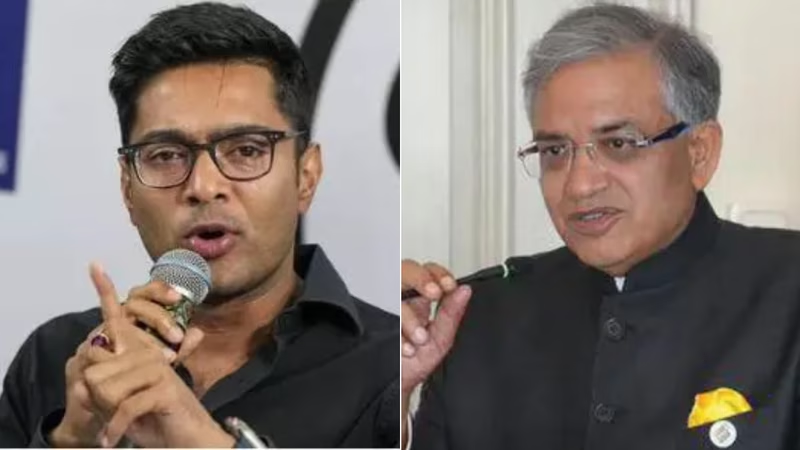
In a dramatic escalation of tensions between the ruling party and the country’s top election body, the Trinamool Congress (TMC) has launched a blistering offensive against Chief Election Commissioner (CEC) Gyanesh Kumar. The flashpoint? A now-famous retort from TMC leader Abhishek Banerjee: “You are nominated, I am elected.” This sharp, politically charged statement has become the rallying cry for a party that feels its voter base is under direct threat from the ongoing Special Intensive Revision (SIR) of electoral rolls in West Bengal.
The confrontation, which began during a heated meeting between a TMC delegation and the CEC, has quickly spiraled into a full-blown constitutional and political crisis. Abhishek Banerjee alleged that CEC Kumar “lost his cool, pointed fingers at us,” prompting his now-viral response . This isn’t just political grandstanding; it’s a direct challenge to the authority of an appointed constitutional functionary by an elected representative, a dynamic that strikes at the heart of Indian democracy.
What’s the Special Intensive Revision (SIR) All About?
For those outside the political fray, the SIR might seem like a mundane bureaucratic exercise. However, in the context of West Bengal—a state with a history of intense political rivalry and voter migration—it’s anything but. The SIR is a rigorous, door-to-door verification process mandated by the Election Commission of India (ECI) to update and clean the electoral rolls ahead of the 2026 assembly elections .
The process aims to:
- Add new eligible voters.
- Remove individuals who have migrated out of their constituencies or have passed away.
- Correct any errors in the existing voter list.
While these goals are standard and necessary for a healthy democracy, the TMC contends that the SIR in West Bengal has been weaponized. They allege a systematic effort, particularly in areas dominated by the poor and minorities, to disenfranchise their traditional support base through mass deletions from the rolls—a practice they’ve branded as “vote chori” or “vote theft” .
TMC vs Election Commission: The Escalating Conflict
The TMC vs Election Commission conflict has moved beyond press conferences and into the streets. TMC workers have reportedly disrupted SIR activities at multiple centers across the state, demanding greater transparency and oversight .
Abhishek Banerjee, the party’s national general secretary and a key strategist for the 2026 polls, has been at the forefront of this battle. He has made a series of explosive claims, including that the CEC was specifically “sent to destroy the country” and that the entire SIR operation is a targeted political maneuver orchestrated from the highest levels of the Union government .
The TMC’s narrative hinges on the contrast between its massive electoral mandate and what it sees as an unelected body, the ECI, acting with partisan intent. Abhishek’s demand for the release of the meeting’s footage is a direct challenge: if the ECI’s actions are above board, why the secrecy?
The Election Commission’s Stance
The Election Commission, for its part, maintains that the SIR is a routine, non-partisan exercise conducted under its constitutional mandate to ensure free and fair elections. It has dismissed the TMC’s allegations as a politically motivated attempt to undermine its authority and protect an inflated, potentially fraudulent, voter list. The ECI’s official communications have been firm but measured, emphasizing its independence and the technical nature of the SIR process .
Political Implications for West Bengal 2026
This clash is far more than a legal or administrative dispute; it’s a masterclass in political theater with profound implications for the 2026 West Bengal assembly elections. Here’s why:
- Mobilizing the Base: By framing the issue as an attack on democracy by an “appointed” official, the TMC is effectively rallying its core supporters. The “nominated vs elected” slogan is a powerful, easily digestible message that resonates with voters who feel their voice is being stolen.
- Setting the Narrative: The TMC is attempting to seize control of the pre-election narrative, shifting the focus from governance and development to a high-stakes battle for the very foundation of their right to vote. This puts their main opponent, the BJP, on the defensive, forcing them to either support the ECI and risk alienating potential allies or criticize it and appear anti-democratic.
- Creating a Constitutional Crisis: The direct challenge to the CEC’s authority by an elected MP like Abhishek Banerjee introduces a dangerous element of uncertainty. It pits two pillars of the Indian state—the elected legislature and an independent constitutional body—against each other, a scenario that could have long-lasting repercussions for institutional trust.
This strategy is reminiscent of past political battles in the state, but the stakes are arguably higher with a national election just on the horizon. [INTERNAL_LINK:west-bengal-political-history] For a deeper dive into the state’s political history, check out our previous analysis.
What’s Next in the Constitutional Crisis?
The immediate future is likely to be messy. We can expect more protests from the TMC on the ground, legal challenges in the courts, and a fierce war of words in the media. The central question now is whether this conflict can be de-politicized and resolved through legal and institutional channels, or if it will continue to be a primary driver of the political discourse in Bengal until 2026.
The judiciary may eventually be called upon to adjudicate on the conduct of the SIR and the limits of the ECI’s power. Until then, the shadow of this conflict will loom large over every political development in the state.
Conclusion
The “You are nominated, I am elected” row is not just a catchy headline; it’s a potent symbol of the deep mistrust and high-stakes political maneuvering defining West Bengal’s path to the 2026 elections. The TMC vs Election Commission battle over the SIR has transformed a routine administrative process into a full-scale political war. While the ECI defends its constitutional mandate, the TMC is fighting what it perceives as an existential threat to its voter base. For the average citizen of West Bengal, this conflict raises fundamental questions about the integrity of their franchise and the health of their democracy. The coming months will be a critical test for all of India’s democratic institutions.
Sources
- Times of India. “‘You are nominated, I am elected … ‘: Trinamool’s offensive against CEC sets stage for rough SIR ride.” https://timesofindia.indiatimes.com/…
- India Today. “‘You Are Nominated, I Am Elected’: Abhishek Banerjee’s Sharp Reply To Poll Body Chief On Electoral Rolls.” https://www.indiatoday.in/…
- The Hindu. “TMC protests disrupt ECI’s SIR of voter list in Bengal.” https://www.thehindu.com/…
- Election Commission of India. Official Website. https://eci.gov.in/