Table of Contents
- A Plate of Hope for Rs 5
- From Amma to Atal: The National Spread of Rs 5 Canteens
- How Do Rs 5 Canteens Actually Work?
- Real Impact or Symbolic Gesture?
- Challenges on the Ground: Supply, Crowds, and Sustainability
- The Road Ahead: Scaling Dignity, Not Just Meals
- Conclusion: More Than Just a Meal
- Sources
A Plate of Hope for Rs 5
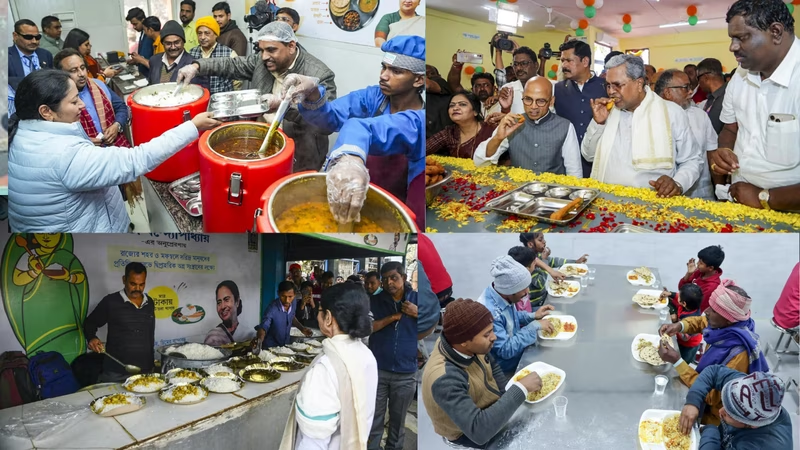
In a bustling Delhi market, a construction worker wipes sweat from his brow and hands over a five-rupee coin. In return, he receives a hot, freshly cooked meal—dal, rice, sabzi, and a piece of bread. This isn’t charity. It’s the new reality of India’s Rs 5 canteens.
Launched under the Atal Canteen scheme, Delhi’s initiative joins a growing national movement aimed at bridging the “last-mile gap” in food security for the urban poor and daily wage earners . For millions who live hand-to-mouth, this simple meal isn’t just affordable—it’s a lifeline. But beyond the symbolism, how effective are these kitchens? And can they truly deliver on the promise of dignified, nutritious food at scale?
From Amma to Atal: The National Spread of Rs 5 Canteens
The idea didn’t start in Delhi. It began in Tamil Nadu in 2013, when then-Chief Minister J. Jayalalithaa launched the now-iconic Amma Canteens. Offering meals for just Rs 1 (later raised to Rs 5), these centers became a model for inclusive urban policy .
Since then, variations have popped up across India:
- Karnataka: Indira Canteens (Rs 5–10 meals)
- Andhra Pradesh: Anna Canteens
- West Bengal: Kanyashree canteens for women
- Delhi: Atal Canteens (launched in late 2025)
Each state adapts the model to its context, but the core mission remains the same: provide a hot, subsidized meal to those who need it most. The success of Amma Canteens—serving over 300,000 meals a day at its peak—proved the concept could work .
How Do Rs 5 Canteens Actually Work?
These aren’t soup kitchens. Most Rs 5 canteens operate as government-run or public-private partnership (PPP) models with strict hygiene and nutritional standards. In Delhi, the Atal Canteens are managed by the Delhi Urban Shelter Improvement Board (DUSIB), with meals prepared in centralized kitchens and distributed across the city .
A typical menu includes:
- Steamed rice or chapati
- Dal (lentil soup)
- One vegetable sabzi
- Occasionally, a boiled egg or curd
The subsidy is massive—the actual cost per meal is estimated at Rs 30–40, with the government covering the difference . This model relies on efficient logistics, consistent funding, and community trust. The goal? To ensure no one in India’s cities goes to bed hungry simply because they can’t afford a meal.
Real Impact or Symbolic Gesture?
Critics argue these canteens are more about political optics than systemic change. And there’s some truth to that—schemes often launch ahead of elections. But the data tells a more nuanced story.
According to a World Bank report on urban food insecurity, over 65 million people in Indian cities live below the poverty line and face regular food shortages . For them, a reliable Rs 5 meal isn’t symbolic—it’s survival.
Moreover, these canteens do more than feed bodies. They restore dignity. Unlike begging or waiting in ration queues, paying even a token amount preserves a sense of agency. As one auto-rickshaw driver in Chennai told reporters: “I’m not taking alms. I’m buying my lunch like anyone else” .
Challenges on the Ground: Supply, Crowds, and Sustainability
Despite high demand, the rollout hasn’t been smooth. In Delhi’s early days, Atal Canteens faced severe bottlenecks:
- Limited seating: Long queues and crowding
- Irregular supply: Some centers ran out of food by noon
- Hygiene concerns: Reports of inconsistent cleanliness
- Staffing shortages: Affecting service speed and quality
These aren’t flaws of the idea—they’re growing pains of rapid scaling. Tamil Nadu’s Amma Canteens also faced similar issues in their first year but improved through feedback loops and better oversight . The key is treating these as living systems that evolve, not one-time photo ops.
The Road Ahead: Scaling Dignity, Not Just Meals
For Rs 5 canteens to succeed long-term, they need more than good intentions. They need:
- Digital integration: Real-time meal tracking and feedback apps
- Nutritional upgrades: Adding protein and micronutrients
- Women-led operations: Creating jobs while ensuring cultural sensitivity
- Robust monitoring: Independent audits to prevent corruption
If done right, these canteens could become a pillar of India’s urban social infrastructure—much like public libraries or bus stands. They’re not a replacement for a living wage, but they are a crucial safety net in an economy where informal workers have no cushion. For more on India’s social welfare landscape, check out our guide on [INTERNAL_LINK:government-schemes-for-urban-poor].
Conclusion: More Than Just a Meal
India’s Rs 5 canteens represent a bold, compassionate response to urban hunger. From the streets of Chennai to the lanes of Delhi, they offer not just calories, but community, consistency, and a quiet act of social justice. The challenges are real, but so is the need. In a nation of contradictions, these humble kitchens remind us that sometimes, the most revolutionary act is simply ensuring everyone gets to eat.
Sources
- Times of India: Inside India’s Rs 5 canteens: From Tamil Nadu to Delhi
- The Hindu: Amma Canteens: A decade of feeding the urban poor
- World Bank: Food Security Overview
- PRS Legislative Research: Food Security in India: Key Facts