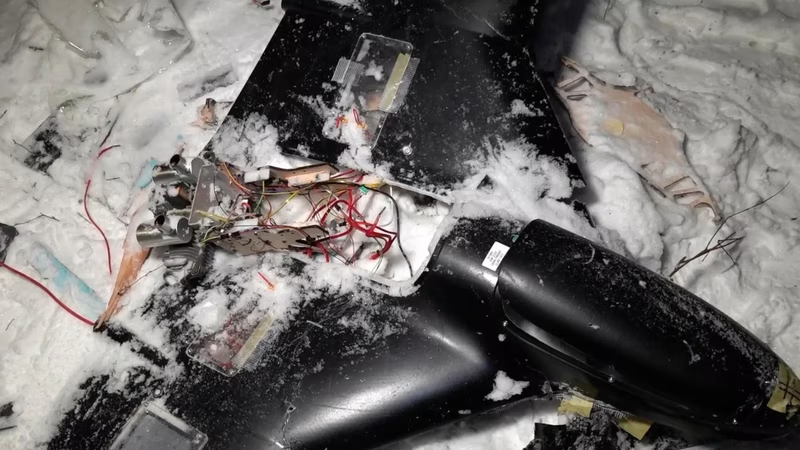
Geopolitical tensions have spiked to a dangerous new level. Russia has dropped a bombshell claim: that a Ukrainian drone recently targeted a Russian presidential residence, and that it has digital proof to back it up. Moscow says it will share this decoded data with the United States—a move that seems as much a political gambit as a security briefing. But Washington isn’t buying it. US intelligence agencies, along with Ukrainian officials, have swiftly dismissed the allegation as baseless, if not outright fabricated . Coming just days after a high-profile meeting between Donald Trump and Volodymyr Zelenskyy, this incident—whether real or staged—threatens to further destabilize an already volatile warzone and strain transatlantic alliances.
Table of Contents
- Russia’s Allegation: The Drone Data Claim
- Ukraine attack on Putin residence: US and Ukraine Response
- Which Presidential Residence Is at the Center of the Claim?
- Timing and Political Context: The Trump-Zelenskyy Factor
- History of False Flag and Disinformation in the Ukraine War
- Implications for the War and International Diplomacy
- Conclusion: Truth, Propaganda, or Escalation?
- Sources
Russia’s Allegation: The Drone Data Claim
According to the Russian Defense Ministry, its air defense systems recently intercepted a Ukrainian surveillance drone near a “federal-level protected site.” They claim forensic analysis of the drone’s onboard memory and navigation logs shows it was deliberately programmed to fly toward a presidential residence—a site they did not explicitly name but widely understood to be Novo-Ogaryovo, Putin’s primary residence outside Moscow .
“The data unequivocally indicates the target was a residence of the President of the Russian Federation,” a ministry spokesman stated. “We intend to share this evidence with our American counterparts through established military-diplomatic channels” . The move is unusual, as Russia typically accuses the West without offering to collaborate on verification.
Ukraine attack on Putin residence: US and Ukraine Response
Both Kyiv and Washington have categorically denied the claim. A senior US intelligence official told reporters, “We have seen no credible evidence to support Russia’s assertion. This appears to be a classic disinformation tactic” .
Ukrainian presidential adviser Mykhailo Podolyak was even more direct: “Russia is trying to justify further war crimes by inventing a fake ‘attack’ on Putin’s dacha. We do not target individuals, and we certainly don’t rely on drones that leave behind GPS breadcrumbs for propaganda purposes” .
This mutual rejection is significant. The US, which has provided Ukraine with intelligence and weapons, would be deeply concerned if Kyiv were conducting such high-risk operations—especially ones that could trigger direct Russian retaliation or NATO involvement.
Which Presidential Residence Is at the Center of the Claim?
While Russia hasn’t officially named the location, analysts point to Novo-Ogaryovo, Putin’s heavily fortified estate in the Odintsovo District, west of Moscow. The site is surrounded by dense forest, anti-aircraft batteries, and electronic countermeasures, making a successful drone incursion highly improbable .
Other possibilities include Putin’s Black Sea residence in Sochi or his Valdai retreat—but both are far from typical drone launch zones used by Ukraine. The choice of target, if real, would represent an extraordinary escalation, crossing a long-standing red line in the conflict.
Timing and Political Context: The Trump-Zelenskyy Factor
The allegation’s timing is deeply suspicious. It emerged just 48 hours after Donald Trump met with President Zelenskyy in New York—a meeting where the two discussed continued US military aid and potential peace frameworks .
Trump, who has previously expressed skepticism about US involvement in Ukraine, may now face renewed pressure from hardliners to withdraw support, especially if the narrative of “Ukraine provoking nuclear Russia” gains traction. Russia’s move could be an attempt to:
- Sow discord between the US and Ukraine.
- Undermine bipartisan support for Kyiv in Congress.
- Justify a new wave of domestic repression or military mobilization ahead of Russia’s 2026 elections.
History of False Flag and Disinformation in the Ukraine War
This isn’t the first time Russia has leveled dramatic claims to shift blame or justify aggression:
- 2022: Russia claimed Ukrainian biolabs were developing weapons—a narrative widely debunked by the UN and WHO.
- 2023: Moscow alleged a Ukrainian drone struck the Kremlin; Kyiv denied involvement, and independent analysts found inconsistencies in Russia’s evidence .
- 2024: Russian media falsely reported a NATO troop buildup on the Belarus border to stoke fear.
Experts at the Atlantic Council’s Digital Forensic Research Lab note that Russia often uses “plausible deniability” narratives—mixing a kernel of truth (e.g., a real drone) with fabricated intent to confuse international observers .
Implications for the War and International Diplomacy
If the claim were true—even partially—it could trigger a severe Russian response, potentially including strikes on Ukrainian leadership or energy infrastructure. But if it’s disinformation, as the US asserts, it still serves Russia’s strategic goals by:
- Eroding Western unity on Ukraine.
- Feeding isolationist sentiment in the US and Europe.
- Creating a pretext for escalating cyber or missile attacks under the guise of “self-defense.”
Either way, [INTERNAL_LINK:russia-ukraine-war-timeline-2026] is entering a more unpredictable phase, where information warfare is as deadly as artillery.
Conclusion: Truth, Propaganda, or Escalation?
The claim of a Ukraine attack on Putin residence sits at the dangerous intersection of war, propaganda, and diplomacy. While Russia promises to share its “evidence” with the US, history and intelligence suggest extreme caution is warranted. In a conflict where truth is often the first casualty, the world must demand verifiable facts—not narratives designed to inflame. For now, the burden of proof lies squarely with Moscow.
Sources
- Times of India: Russia says decoded drone data shows presidential residence was target
- Reuters: Russia claims Ukraine drones targeted Putin residence; U.S. skeptical
- BBC News: Ukraine denies targeting Putin residence after Russian claim
- Ukrainska Pravda: Podolyak: Russia’s drone story is ‘Kremlin fantasy’
- Atlantic Council DFRLab: Russian Disinformation Patterns in 2026