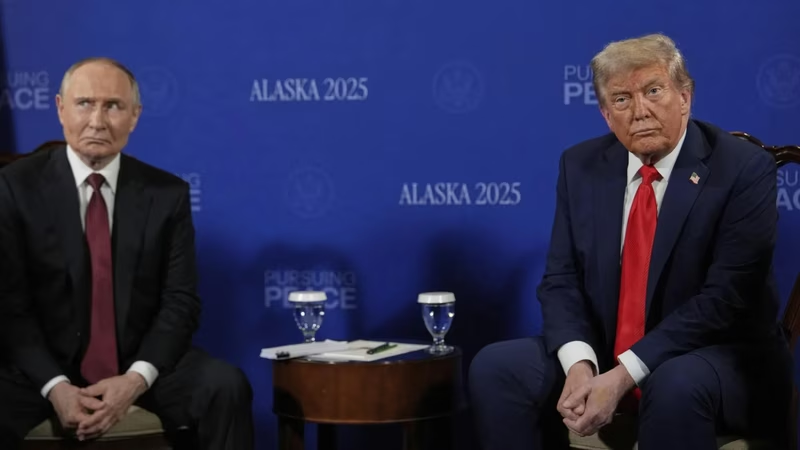
In a move that has sent shockwaves through Washington and beyond, former President Donald Trump has thrown his weight behind a hardline stance on Vladimir Putin—just as international efforts to broker peace in Ukraine appear to be crumbling. On social media, Trump shared and endorsed a sharply worded editorial titled “Turn Up the Heat,” which lambasts the Russian leader and calls for stronger U.S. action against Moscow’s aggression . This marks a notable shift in tone from a figure who once praised Putin as “strong” and “smart,” and it raises urgent questions about Trump’s evolving foreign policy posture ahead of the 2026 political cycle.
Table of Contents
- The Editorial and Trump’s Endorsement
- Failing Ukraine Peace Talks: The Broader Context
- Trump Putin Ukraine talks: A Strategic Pivot?
- Trump’s Historical Stance on Putin: From Praise to Pressure
- Republican Party Divisions on Ukraine Aid
- Geopolitical Implications for NATO and Global Order
- Conclusion: Rhetoric or Realignment?
- Sources
The Editorial and Trump’s Endorsement
Trump did not write the editorial himself, but his decision to amplify it on Truth Social—his primary communication platform—carries significant weight. The piece, originally published by a conservative policy outlet, argues that diplomatic overtures to Moscow have failed and that the U.S. must intensify sanctions, accelerate arms deliveries to Kyiv, and isolate Russia economically and diplomatically .
“They’re not negotiating—they’re stalling,” the editorial states. “Putin respects only strength. It’s time to turn up the heat.” Trump captioned his repost with a simple but telling line: “Makes sense!”—a clear signal of alignment with its message .
Failing Ukraine Peace Talks: The Broader Context
The timing of Trump’s post is no accident. Recent attempts at peace talks between Russian and Ukrainian officials, mediated by neutral parties like Turkey and the UAE, have stalled over irreconcilable demands. Russia insists on Ukrainian recognition of its annexed territories—a non-starter for Kyiv—and continues its brutal offensive in eastern Ukraine .
Meanwhile, U.S. military aid to Ukraine has faced increasing resistance in Congress, with some House Republicans blocking supplemental funding packages. This legislative gridlock has weakened America’s leverage on the global stage, creating a vacuum that Trump now appears eager to fill—even if only rhetorically.
Trump Putin Ukraine talks: A Strategic Pivot?
Is this a genuine evolution in Trump’s worldview—or a tactical maneuver for political survival?
Analysts suggest it’s likely both. On one hand, public opinion in the U.S. remains broadly supportive of Ukraine, with 68% of Americans favoring continued aid according to a recent Pew Research Center poll . On the other, Trump may be positioning himself to neutralize criticism from Democrats who have long accused him of being “soft on Putin,” especially in light of the 2016 election interference scandal.
By aligning with a tough-on-Russia editorial, Trump can simultaneously appeal to hawkish Republicans and moderate independents without committing to a specific policy platform—yet.
Trump’s Historical Stance on Putin: From Praise to Pressure
Trump’s past rhetoric on Putin has been remarkably consistent in its admiration. In 2018, he famously sided with Putin over U.S. intelligence agencies in Helsinki. In 2020, he claimed he and Putin had a “very, very good relationship.” Even in 2023, he suggested he could “end the war in 24 hours” through personal diplomacy with the Russian leader .
His latest move, therefore, represents a stark departure. While he hasn’t explicitly condemned Putin himself, amplifying a piece that calls for turning up the heat signals a recalibration—possibly acknowledging that Putin’s image as a “strongman” has been tarnished by military setbacks and global isolation.
Republican Party Divisions on Ukraine Aid
Trump’s post also reflects deep fissures within the GOP:
- The Pro-Ukraine Wing: Led by figures like Mitch McConnell and Liz Cheney, this group supports robust military and financial aid to Kyiv as a matter of national and moral interest.
- The “America First” Isolationists: Led by Marjorie Taylor Greene and J.D. Vance, they argue that U.S. resources should focus domestically, not on foreign wars.
By endorsing the editorial, Trump may be attempting to thread the needle—projecting strength without fully alienating his isolationist base. It’s a delicate balancing act with high stakes for party unity .
Geopolitical Implications for NATO and Global Order
If Trump’s rhetoric translates into policy—should he return to office in 2028—it could reshape transatlantic relations. A U.S. administration that actively pressures Russia, rather than seeking détente, would embolden NATO allies like Poland and the Baltic states. It could also pressure holdouts like Hungary’s Viktor Orbán to fall in line.
However, skepticism remains. Many foreign policy experts caution that Trump’s actions have often contradicted his words. [INTERNAL_LINK:us-foreign-policy-under-trump] remains a subject of intense debate, and allies are wary of relying on his pronouncements alone .
Conclusion: Rhetoric or Realignment?
Trump’s endorsement of a hardline editorial against Putin amid the collapse of Trump Putin Ukraine talks efforts is a political earthquake. Whether it heralds a true foreign policy realignment or is merely a strategic feint to shore up support remains to be seen. But one thing is clear: as the Ukraine war grinds on and U.S. leadership is tested, even Donald Trump is adjusting his sails to the winds of global opinion.
Sources
- Times of India: ‘Turn up the heat’: Trump shares editorial critical of Putin
- The New York Times: Trump Breaks with Past, Backs Tougher Line on Putin
- Pew Research Center: Americans’ Views on Ukraine Aid (December 2025)
- CNN: Trump shares anti-Putin editorial as Ukraine talks falter
- Brookings Institution: The Future of U.S.-Russia Relations