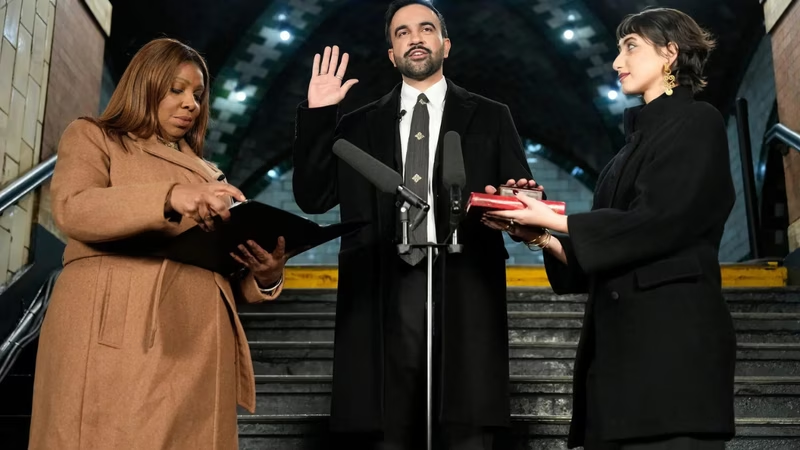
New York City has a new mayor—and a historic one at that. On a crisp January morning in 2026, Zohran Mamdani stood in the heart of the city that never sleeps, not in a grand hall or council chamber, but in the echoing tunnels of a subway station, and took his oath of office with his hand on the Quran. With that act, Mamdani became not just the leader of America’s largest city, but its first Muslim mayor—a milestone that resonates far beyond the five boroughs .
Table of Contents
- A Historic Oath at an Unlikely Venue
- Who Is Zohran Mamdani? From Activist to City Hall
- The Symbolism Behind the Subway Swearing-In
- What It Means to Be NYC’s First Muslim Mayor
- Early Policy Visions and Challenges Ahead
- National and Global Reactions
- Conclusion: A New Chapter for New York
- Sources
A Historic Oath at an Unlikely Venue
In a break from tradition, Mamdani chose the 14th Street–Union Square subway station—the nexus of transit lines and social movements—as the site of his inauguration. Surrounded by transit workers, community leaders, and everyday New Yorkers, he placed his hand on a family Quran and recited the oath administered by a New York State Supreme Court justice .
“This city runs on its people—and its trains,” Mamdani said in his inaugural address. “So where better to swear to serve it than here, where millions cross paths every single day?” The choice was a clear signal: his administration would prioritize public infrastructure, equity, and the voices of working-class New Yorkers.
Who Is Zohran Mamdani? From Activist to City Hall
Born in Kampala, Uganda, and raised in Jackson Heights, Queens, Mamdani’s journey to City Hall is a quintessential New York story. A former housing activist and NYC Council member representing Astoria, he gained prominence as a vocal advocate for tenants’ rights, climate action, and economic justice .
His 2025 mayoral campaign was built on a bold platform: universal childcare, congestion pricing reform, and a public takeover of underperforming private utilities. He defeated a crowded field in the Democratic primary and won the general election in a landslide, energizing a multiracial coalition of voters tired of status-quo politics .
The Symbolism Behind the Subway Swearing-In
Holding the inauguration in a subway station was no mere publicity stunt. It was a deliberate rebuke to decades of underinvestment in public transit. The MTA has faced chronic delays, fare hikes, and safety concerns—issues that disproportionately affect low-income and immigrant communities.
By swearing in at Union Square—a station that serves the 4, 5, 6, L, N, and Q lines—Mamdani underscored his pledge to “make the subway safe, reliable, and fare-free for all.” The location also paid homage to past grassroots movements, from labor strikes to climate protests, that have long used the subway as both a symbol and a tool of collective power.
Zohran Mamdani NYC mayor: A Watershed for Representation
As the first Muslim mayor of New York City, Mamdani’s victory carries profound cultural and political weight. In a city home to over 800,000 Muslims—the largest Muslim population in the U.S.—his election is a powerful affirmation of inclusion .
His decision to take the oath on the Quran, while not unprecedented nationally (Keith Ellison did so in Congress in 2007), is deeply significant at the municipal level in a city that has faced its share of anti-Muslim bias. Community leaders hailed the moment as “healing” and “long overdue.”
Mamdani joins a growing wave of Muslim-American elected officials, including Congresswoman Ilhan Omar and Michigan State Representative Abraham Aiyash, reflecting the community’s increasing civic engagement .
Early Policy Visions and Challenges Ahead
Mamdani’s administration faces immediate challenges: a $7 billion city budget gap, rising homelessness, and climate resilience in the wake of recent extreme weather. Yet his early actions signal a transformative agenda:
- Transit Equity Plan: Proposing a fare-free pilot on the Staten Island Railway and select bus routes.
- Housing First Initiative: Redirecting real estate tax abatements to fund 100% affordable housing developments.
- Green New Deal for NYC: Mandating city-owned buildings to be carbon-neutral by 2030.
- Community Safety Corps: Replacing armed police responses with mental health and social service teams for non-violent 911 calls.
While critics question the feasibility of such ambitious plans, supporters argue that boldness is exactly what a city in crisis needs.
National and Global Reactions
News of Mamdani’s inauguration rippled across the globe. The Organization of Islamic Cooperation issued a statement congratulating him, calling it “a victory for pluralism.” Domestically, President Kamala Harris praised his “commitment to justice and public service” .
Yet not all reactions were positive. Right-wing media outlets amplified baseless claims about his faith and policy stances—a reminder that even in 2026, religious minorities in high office still face scrutiny. Mamdani, however, remains unfazed. “My faith teaches service,” he told reporters. “And that’s exactly what I intend to do.”
Conclusion: A New Chapter for New York
Zohran Mamdani’s swearing-in as Zohran Mamdani NYC mayor is more than a political event—it’s a cultural watershed. By choosing a subway station over a courthouse and the Quran over a ceremonial bible, he has redefined what leadership looks like in 21st-century America. Whether his bold vision succeeds will depend on execution, coalition-building, and a city’s willingness to embrace change. But one thing is certain: New York will never be the same.
Sources
- Times of India: Sworn-in on the Quran: Mamdani becomes NYC mayor
- The New York Times: Mamdani Takes Oath as NYC’s First Muslim Mayor in Subway Ceremony
- NBC New York: Zohran Mamdani Sworn In as NYC’s First Muslim Mayor
- Pew Research Center: Religious Landscape of New York City (2025)
- Congressional Record: Keith Ellison’s Quran Oath (2007)