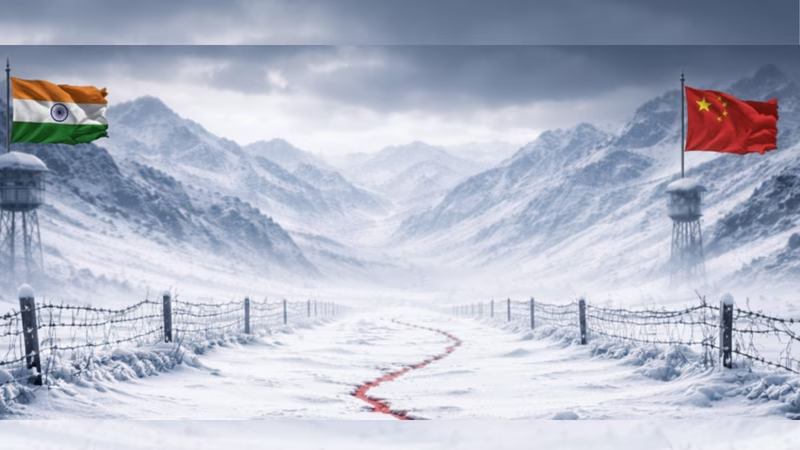
From the bloodstained rocks of Galwan to a tense but active diplomatic hotline, the relationship between the world’s two most populous nations has entered a new, uncertain phase in 2025. The so-called India-China reset is real: high-level military and diplomatic talks have resumed, key trade channels are reopening, and a surface-level calm has replaced the overt hostility of the post-2020 era .
But don’t be fooled by the diplomatic niceties. This is not a reconciliation born of newfound friendship or trust. It’s a marriage of cold, hard necessity. Both New Delhi and Beijing have their own strategic and economic imperatives that demand a temporary de-escalation. The critical question on every analyst’s mind is: how long can this fragile balance hold?
Table of Contents
- From Galwan to a Tactical Thaw
- The Drivers of the India-China Reset
- What Has Actually Changed?
- The Ghosts That Haunt the Relationship
- Can This Balance Hold? The Future Outlook
From Galwan to a Tactical Thaw
The ghost of the June 2020 Galwan Valley clash, which claimed the lives of 20 Indian soldiers and an unknown number of Chinese troops, has loomed large over the bilateral relationship for nearly five years . It marked the most serious military confrontation between the two nuclear-armed neighbors in decades, shattering any illusion of a stable peace.
The aftermath saw a complete breakdown in trust, a massive military build-up along the Line of Actual Control (LAC), a de facto ban on thousands of Chinese apps in India, and a sharp decline in bilateral trade. The relationship was in deep freeze. The current India-China reset is, therefore, a significant and deliberate shift away from that brinkmanship.
The Drivers of the India-China Reset
Why now? The thaw isn’t driven by sentiment but by stark strategic realities facing both nations:
- For India: New Delhi is keen to stabilize its northern border to fully focus its strategic energy on its primary long-term challenge: an increasingly assertive China in the Indo-Pacific. A quiet western front is essential for this. Furthermore, Indian industry has been lobbying hard to restore the flow of key electronic components and pharmaceutical intermediates from China, on which it remains heavily dependent .
- For China: Beijing is grappling with a serious economic slowdown and faces mounting international pressure, particularly from the United States. It cannot afford a two-front strategic problem. A stable relationship with India, even if temporary, frees up resources and diplomatic bandwidth to manage its more critical rivalry with Washington .
What Has Actually Changed?
The tangible outcomes of this reset are limited but significant:
- Diplomatic Engagement: Foreign ministers from both sides have held direct talks, and the Special Representatives mechanism on the border issue has been reactivated .
- Military Disengagement: While the core dispute remains, both armies have pulled back from several contentious friction points like Patrolling Point 15, reducing the immediate risk of another deadly skirmish.
- Trade Normalization: Customs clearance for a range of Indian exports (like seafood and pharmaceuticals) that were previously held up by Chinese authorities has resumed, signaling a softening on the commercial front .
However, these are tactical adjustments, not strategic concessions. Neither side has budged an inch on their core territorial claims.
The Ghosts That Haunt the Relationship
Beneath the surface calm, the fundamental drivers of the India-China rivalry remain potent and unresolved:
- The Unsettled Border: The Line of Actual Control (LAC) is still not formally demarcated. Thousands of troops remain deployed in forward positions, a constant recipe for potential escalation.
- Deep Mistrust: The betrayal felt in India after the Galwan ambush runs deep. In China, there’s a perception that India is a willing partner in the US-led containment strategy. This mutual suspicion is not easily erased.
- Strategic Competition: From infrastructure projects in the Indian Ocean to influence in South Asia and technological supremacy, the two nations are on a collision course for regional dominance. The Ministry of External Affairs has consistently highlighted this strategic challenge in its official communications .
Can This Balance Hold? The Future Outlook
The current detente is best described as a “tactical calm,” not a strategic reset . It is a pause, not a peace. Its longevity depends entirely on the external environment remaining stable.
Any significant event—a major military incident on the LAC, a sharp downturn in the Chinese economy forcing more aggressive foreign policy, or a major shift in US-India strategic ties—could easily shatter this fragile arrangement. Both nations are likely managing the relationship with their eyes firmly on their own strategic priorities, ready to pivot if circumstances change.
For a deeper analysis of India’s strategic posture in Asia, explore our feature on [INTERNAL_LINK:india-indo-pacific-strategy-2026].
Summary
The India-China reset of 2025 is a pragmatic, necessity-driven truce, not a genuine reconciliation. While high-level talks have resumed and trade is slowly normalizing, the deep-seated rivalry, unresolved border dispute, and mutual mistrust remain potent threats to this fragile calm. This tactical pause provides both nations with valuable breathing room, but its sustainability is highly uncertain and vulnerable to shifts in the broader geopolitical landscape.
Sources
- Times of India: India-China reset in 2025: From Galwan’s shadow to tactical calm
- Ministry of Commerce & Industry, Government of India: Reports on India-China Trade Data
- International Institute for Strategic Studies (IISS): Analysis on China’s Strategic Outlook
- Ministry of External Affairs, Government of India: Official Statements and Policy Documents