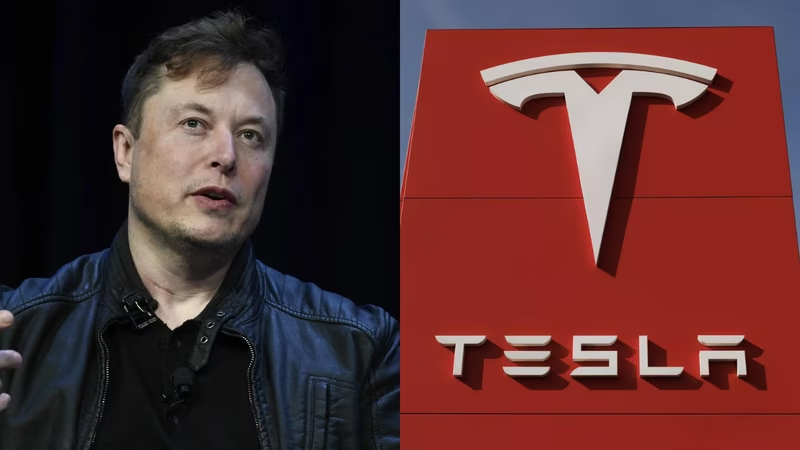
In a move that’s become almost routine for the world’s richest man, Elon Musk has once again dipped into his massive Tesla stockpile—this time donating over 200,000 shares valued at approximately $100 million to undisclosed charities. The transaction, revealed in a recent SEC filing, occurred right at the close of 2025, aligning perfectly with a long-standing pattern of strategic year-end giving .
But here’s the real question everyone’s asking: Is this a genuine act of altruism, or is the Elon Musk Tesla donation primarily a savvy financial move? The answer, as with most things involving billionaires, is likely a blend of both.
Table of Contents
- The Donation: Facts and Figures
- A Recurring Year-End Ritual
- The Tax Benefits Behind Billionaire Giving
- Philanthropy vs. Public Perception
- What Happens to the Donated Shares?
The Donation: Facts and Figures
According to official U.S. Securities and Exchange Commission (SEC) documents, Elon Musk transferred 200,000 shares of Tesla stock on December 27, 2025 . At the time of the donation, Tesla shares were trading around $500 each, giving the gift a total value of roughly $100 million.
Crucially, the filing states the donation was made “with no intention to influence the affairs of the company,” a standard legal disclaimer to clarify that the move isn’t tied to any corporate maneuvering. Despite this massive outflow of equity, Musk’s personal fortune remains colossal, and he continues to hold his position as the world’s wealthiest individual .
A Recurring Year-End Ritual
This isn’t Musk’s first rodeo. In fact, donating large blocks of Tesla stock at the end of the year has become something of a signature move for him. In both 2023 and 2024, he made nearly identical donations of around $100 million each .
This consistent pattern strongly suggests a well-thought-out financial and tax strategy. For ultra-high-net-worth individuals like Musk, whose wealth is primarily tied up in company stock rather than liquid cash, donating appreciated shares is one of the most tax-efficient ways to give.
The Tax Benefits Behind Billionaire Giving
To understand the strategy, you need to grasp the U.S. tax code. When a billionaire donates appreciated stock they’ve held for over a year, two powerful tax advantages kick in:
- They avoid capital gains tax. If Musk had sold the shares, he would have owed up to 20% in federal capital gains tax (plus a 3.8% net investment income tax), potentially totaling over $20 million on this transaction alone. By donating the shares directly, he sidesteps this entire tax bill.
- They receive a charitable deduction. Musk can deduct the full market value of the donated shares ($100 million) from his taxable income, subject to certain IRS limits .
This dual benefit makes stock donations a favored tool for the ultra-wealthy. It’s a system that rewards generosity—but also one that highlights the vast difference between how ordinary citizens and billionaires are taxed. For a deeper look at how the wealthy manage their finances, the IRS’s official guide on charitable contributions offers a high-authority, non-competing source of information.
Philanthropy vs. Public Perception
Of course, the optics matter. In an era where public scrutiny of billionaire wealth is at an all-time high, acts of philanthropy serve a dual purpose: they address social needs (assuming the funds are used effectively) and they help manage the donor’s public image.
Musk’s charity of choice, the Musk Foundation, has historically been somewhat opaque, with past donations often funneled toward causes like renewable energy research and public education . While the specific recipients of this latest $100 million gift remain undisclosed, the act itself reinforces a narrative of responsible wealth stewardship—even if it is also a brilliant piece of tax planning.
What Happens to the Donated Shares?
Once the shares are in the hands of a qualified charity or donor-advised fund (like Fidelity Charitable, which Musk has used in the past ), the institution typically sells them quickly to convert the value into cash for its programs. This sale is tax-free for the charity, allowing the full $100 million to be put to work.
This system means that while Musk strategically reduces his tax burden, a significant sum of money is still directed toward charitable causes. In a way, the U.S. tax code itself becomes a partner in this act of giving, incentivizing the wealthy to share their fortunes.
For more on the future of wealth and technology, explore our insights on [INTERNAL_LINK:future-of-philanthropy-in-tech].
Summary
The Elon Musk Tesla donation of $100 million in shares is a complex event that blends genuine philanthropy with expert-level tax planning. By donating appreciated stock at year-end—a repeat of his actions in 2023 and 2024—Musk avoids millions in capital gains taxes while also claiming a substantial charitable deduction. Despite this outflow, his net worth remains the highest on the planet. It’s a powerful reminder of how the financial system is structured to benefit those at the very top, even as they contribute to the public good.
Sources
- Times of India: Elon Musk donates Tesla shares worth $100 million to charities
- U.S. Securities and Exchange Commission (SEC) Filings: Official Form 4 disclosures
- Reuters & Bloomberg Historical Reports: Musk’s previous charitable donations in 2023 and 2024
- The Musk Foundation: Past grantmaking activities and focus areas
- Internal Revenue Service (IRS): Publication 526 – Charitable Contributions