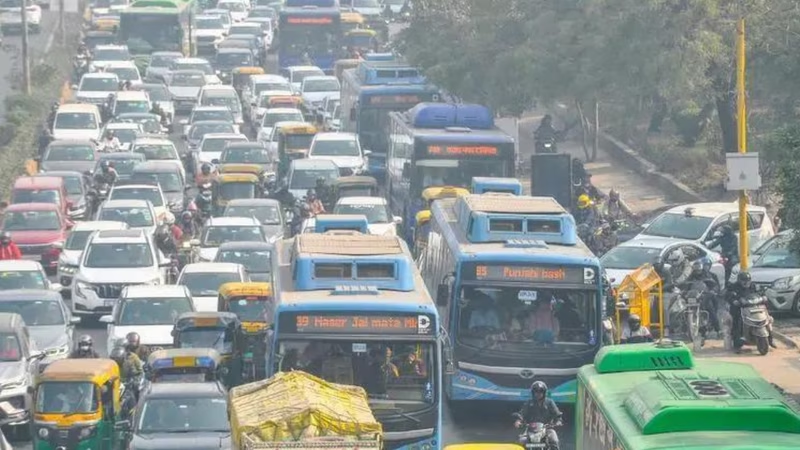
On the surface, it looks like an economic triumph. Delhi’s vehicle market is booming, with a staggering 8.16 lakh (816,000) new vehicles sold in 2025 alone . But for anyone who’s ever choked on the city’s infamous winter smog, this news is far from celebratory. The real story behind these Delhi vehicle sales is a deepening environmental crisis, fueled by a surge in private, petrol-powered cars and two-wheelers.
Table of Contents
- The Numbers Behind the Headline
- Why Petrol Cars Are the Problem
- The Pollution Price Tag
- Where Are the Electric Vehicles?
- The Way Forward for Delhi
The Numbers Behind the Headline
The data is clear and deeply concerning. While overall vehicle registrations in Delhi soared to an unprecedented high in 2025, the composition of these sales tells a bleak story. The market was “overwhelmingly dominated by private petrol vehicles” . This isn’t just about more cars on the road; it’s about more of the *wrong kind* of cars.
This surge is driven by a mix of post-pandemic economic recovery and a persistent public trust gap in the city’s mass transit system. The result? Families and individuals are turning to the perceived comfort and convenience of private vehicles, directly contradicting the city’s urgent need to reduce its carbon footprint.
Why Petrol Cars Are the Problem
Not all vehicles are created equal when it comes to their environmental impact. While diesel vehicles have long been the poster child for pollution in India, petrol vehicles are far from clean. They emit significant amounts of carbon monoxide, nitrogen oxides (NOx), and volatile organic compounds (VOCs)—all key ingredients in the formation of deadly ground-level ozone and smog.
Experts point out that this shift towards a massive fleet of private petrol vehicles exposes a critical gap in Delhi’s urban planning: a lack of a truly efficient, reliable, and safe public transport network that can serve as a genuine alternative . When the Metro feels overcrowded and last-mile connectivity is a nightmare, a personal scooter or car becomes the default choice.
The Pollution Price Tag
Delhi doesn’t need a lecture on air quality; its residents live it every day. The city’s Air Quality Index (AQI) routinely plunges into the ‘Very Poor’ and ‘Severe’ categories, with readings as high as 391 and even 491 [[15], [20]]. This isn’t just an inconvenience; it’s a public health emergency.
And the primary culprit? Vehicular emissions. A study by the Centre for Science and Environment revealed a shocking fact: vehicle pollution accounts for over 51% of Delhi’s air pollution . Adding another 800,000+ petrol vehicles to the mix in a single year is like pouring gasoline on an already raging fire. This directly translates to more respiratory illnesses, higher healthcare costs, and a lower quality of life for everyone in the National Capital Region.
Where Are the Electric Vehicles in Delhi’s Strategy?
You might be wondering about the much-touted electric vehicle (EV) revolution. Where is it in these sales figures? The reality is underwhelming. Despite a dedicated EV policy, adoption has been slow. As of late 2025, between January and October, only about 17,942 EV or hybrid four-wheelers were registered in the city, a tiny fraction compared to the 1.27 lakh+ petrol and diesel cars .
While Delhi has made some progress, achieving an estimated 11.5% EV penetration rate across segments, it has fallen far short of its ambitious 25% target for 2024 . The gap between policy goals and on-the-ground reality is stark. The government is aware of this, which is why a revamped “EV Policy 2.0” is set to launch in early 2026, promising bigger subsidies and scrappage incentives to finally tip the scales .
For a deeper dive into how India’s EV market is shaping up, check out our analysis on [INTERNAL_LINK:india-ev-market-trends-2026]. You can also review the official government guidelines on the Ministry of Road Transport and Highways website, a high-authority source for transport policy in India.
The Way Forward for Delhi
The record-breaking Delhi vehicle sales of 2025 are a flashing red warning light. The city stands at a crossroads. It can continue down the path of private vehicle dependency, condemning itself to ever-worsening air quality and traffic gridlock. Or, it can take bold, immediate action.
This requires a two-pronged strategy:
- Supercharge the EV Transition: The new EV policy must be more than just promises. It needs aggressive, well-funded incentives, a massive expansion of charging infrastructure, and a robust public awareness campaign to overcome range anxiety.
- Revolutionize Public Transport: People will only ditch their cars if they have a better option. This means a seamless, affordable, and safe integrated network of Metro, buses, and last-mile solutions that is so good, private vehicle ownership feels unnecessary.
Summary
Delhi’s record 8.16 lakh vehicle sales in 2025 are a cause for serious environmental concern, not celebration. The dominance of private petrol vehicles in these sales is a major contributor to the city’s already critical air pollution levels, which are among the worst in the world. While a new EV policy is on the horizon, its success is crucial to reversing this dangerous trend and securing a healthier, more sustainable future for the capital.
Sources
- Times of India: Why soaring vehicle sales is bad news [[1], [2], [4], [6], [10]]
- Centre for Science and Environment: Vehicle Pollution Study
- Government of NCT of Delhi: EV Policy Updates [[21], [22], [23], [24], [26]]
- Central Pollution Control Board (CPCB): Air Quality Index Data [[14], [15], [18], [20]]