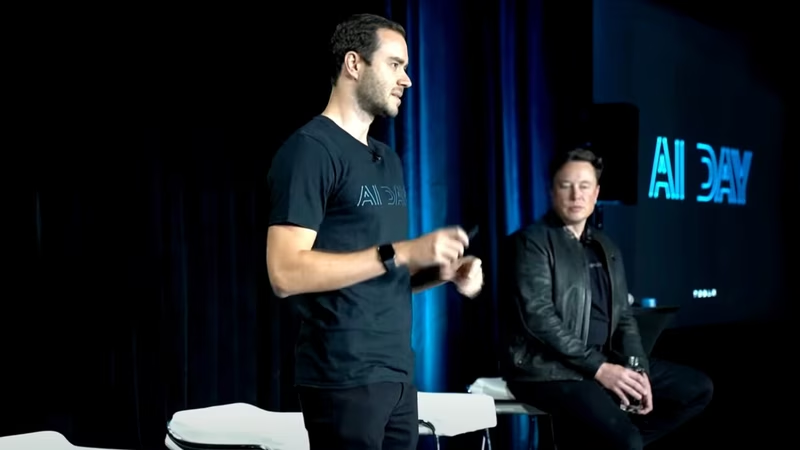
The battle for autonomous driving supremacy just got a lot more interesting. In a pointed and technically grounded statement, former Tesla AI director Andrej Karpathy has thrown down the gauntlet, asserting that Google’s Waymo—the long-reigning leader in the self-driving space—lacks the fundamental architecture to replicate Tesla’s recent, headline-grabbing coast-to-coast autonomous drive .
This isn’t just corporate rivalry; it’s a clash of two entirely different philosophies on how to build a self-driving car. And Karpathy, the architect behind Tesla’s vision-based system, is betting everything on his approach. His comments come at a fascinating time, not just as a rebuttal to Waymo’s progress, but also in the wake of public criticism from his former boss, Elon Musk, who recently called his views “dated” . Karpathy’s response? To double down on the core technology that powered Tesla’s most ambitious drive yet.
Table of Contents
- The Coast-to-Coast Drive: A Tesla Milestone
- Karpathy’s Core Argument: End-to-End vs. Modular
- Waymo’s Achilles’ Heel: The San Francisco Power Outage
- The Elon Musk Factor: A Public Fallout
- What This Means for the Future of Autonomous Driving
- Conclusion: A Fundamental Philosophical Divide
- Sources
The Coast-to-Coast Drive: A Tesla Milestone
Tesla’s recent demonstration of a vehicle driving autonomously across the United States was more than just a publicity stunt. It was a live, real-world stress test of its Full Self-Driving (FSD) software under the most unpredictable conditions—construction zones, erratic human drivers, varying weather, and complex urban and rural landscapes.
For Tesla, this drive was proof that its system, trained on a massive dataset of real-world video from its fleet of millions of cars, could handle the “long tail” of rare and difficult driving scenarios that are impossible to simulate in a lab. It was the ultimate validation of their data-driven, vision-based approach—the cornerstone of their Tesla self-driving tech.
Karpathy’s Core Argument: End-to-End vs. Modular
This is where the technical heart of the debate lies. Karpathy’s central thesis is that Tesla’s system is built as a single, unified end-to-end neural network. In this model, raw sensor data (primarily from cameras) goes in one end, and driving commands (steering, acceleration, braking) come out the other. The entire system learns as one cohesive unit, optimizing for the final goal of safe driving.
Waymo, conversely, relies on a modular system. This traditional approach breaks the problem into separate stages: perception (identifying objects), prediction (guessing what those objects will do), and planning (deciding how to drive). Each module is developed and optimized independently, and they pass information to each other in a pipeline .
Karpathy argues that the modular system is inherently brittle. An error in the perception stage (e.g., misclassifying an object) cascades through the entire pipeline, leading to a bad driving decision. The end-to-end system, however, is more robust because it can learn to make good driving decisions even from imperfect or noisy input, as it’s trained on the entire problem holistically.
Waymo’s Achilles’ Heel: The San Francisco Power Outage
Karpathy didn’t just speak in theory; he pointed to a real-world incident as evidence of the modular system’s weakness. During a recent city-wide power outage in San Francisco, Waymo’s fleet of autonomous taxis reportedly ground to a halt .
Why? Because their systems heavily rely on high-definition (HD) maps, which are a critical part of their perception and planning modules. When the power went out, the live data feeds that keep these maps updated failed. Without a perfectly synchronized map, the modular system couldn’t confidently perceive its environment or plan a safe route, so it simply shut down. Tesla’s vision-based, end-to-end system, which doesn’t depend on real-time HD map data, would have been far less affected by such an infrastructure failure.
The Elon Musk Factor: A Public Fallout
The backdrop to Karpathy’s comments is a notable public rift with his former boss. Elon Musk, in a recent interview, dismissed some of Karpathy’s past technical viewpoints as “outdated,” suggesting the company has moved on . This is a significant development, given Karpathy was the driving force behind Tesla’s AI strategy for years.
Karpathy’s detailed explanation of Tesla’s technological edge can be seen as a subtle but firm rebuttal. He’s not just defending his legacy; he’s affirming that the core philosophy he helped establish—the end-to-end neural net—is not just relevant, but is the very thing that gives Tesla its current, demonstrable lead in real-world, general-purpose autonomy.
What This Means for the Future of Autonomous Driving
This debate is not academic; it will shape the future of the industry. If Karpathy is right, the future belongs to data-rich, end-to-end learning systems that can adapt and improve in the real world, like Tesla’s. Companies like Waymo, which have invested billions in LiDAR sensors and HD mapping, may find their approach is too rigid and expensive to scale to a global, general-purpose solution.
However, the race is far from over. Waymo’s safety record in its operational zones is stellar, and its technology is incredibly sophisticated. The question is whether its modular, map-dependent system can ever achieve the kind of general intelligence needed for a true, anywhere, anytime self-driving car—the very thing Tesla claims its coast-to-coast drive proved is possible.
Conclusion: A Fundamental Philosophical Divide
The spat between Andrej Karpathy and the Waymo model, amplified by his complex history with Elon Musk, highlights a deep philosophical divide in the quest for autonomy. It’s a choice between a pre-mapped, highly controlled world and a chaotic, real-world environment navigated by a learning, adaptable brain. Karpathy’s stance is clear: for the Tesla self-driving tech to truly win, it must master the messy reality of everyday driving, and its end-to-end neural network is the only architecture capable of that monumental task.