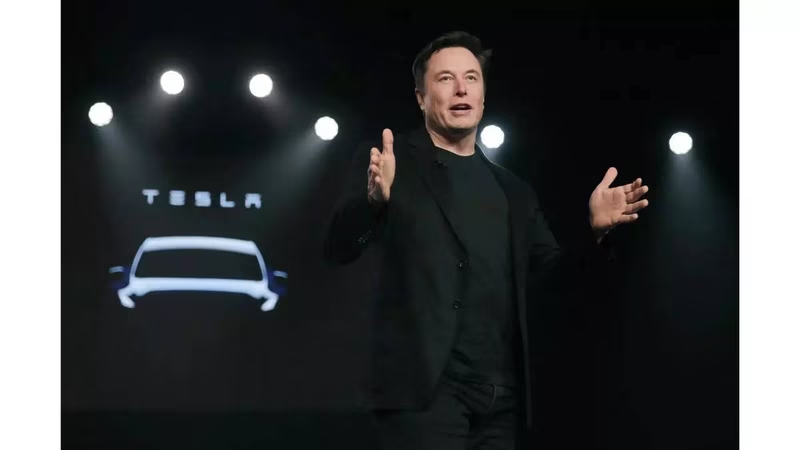
Elon Musk’s Fiery Take on California’s Wealth Tax Proposal
Elon Musk doesn’t mince words—and when California lawmakers floated a new wealth tax targeting billionaires, the world’s richest man hit back hard. In a recent statement that’s reignited a national debate, Musk emphasized that his vast fortune isn’t sitting in bank accounts or luxury assets. “That’s almost all my wealth,” he said, referring to his stakes in Tesla and SpaceX. “It’s tied to companies that create real value, jobs, and technology that moves humanity forward.”
His comments come as California legislators consider one of the most aggressive state-level wealth taxes in U.S. history—a move that could redefine how billionaire fortunes are taxed and potentially trigger a mass exodus of tech leaders from the Golden State.
Table of Contents
- What Is the Proposed California Wealth Tax?
- Elon Musk’s Argument: Wealth vs. Liquidity
- Why Tech Leaders Are Worried
- The Economic Ripple Effect
- Global Precedents and What They Teach Us
- Conclusion: A Policy at a Crossroads
- Sources
What Is the Proposed California Wealth Tax?
The proposed California wealth tax aims to levy an annual tax on residents with net worth exceeding $50 million. Early drafts suggest a rate of 1% on wealth above $50 million and 1.5% on fortunes above $1 billion. The goal? Generate an estimated $5–$10 billion annually to fund housing, healthcare, and climate initiatives.
Proponents, including progressive lawmakers and advocacy groups, argue that billionaires like Musk “pay little in taxes relative to their wealth” and that the measure would address extreme inequality. But critics—including many economists and business leaders—warn it could backfire spectacularly.
Elon Musk’s Argument: Wealth vs. Liquidity
Musk’s core rebuttal hinges on a critical distinction: paper wealth is not cash. His net worth—fluctuating between $200–$300 billion—is almost entirely in the form of equity in Tesla and SpaceX. To pay a wealth tax, he’d have to sell massive chunks of stock, which could:
- Depress share prices due to sudden large-volume sales.
- Reduce his ability to reinvest in R&D and innovation.
- Trigger capital gains taxes on top of the wealth tax—creating double taxation.
“My wealth grows only when I produce things that are useful to people,” Musk stressed. “Taxing that discourages creation. It rewards consumption, not contribution.” This perspective aligns with a broader Silicon Valley ethos: that equity-based wealth fuels future growth, not personal luxury.
Why Tech Leaders Are Worried
Musk isn’t alone. Executives from Apple, Nvidia, and venture capital firms have privately expressed alarm. Their concerns include:
- Flight Risk: California already has high income and property taxes. A wealth tax could push more founders to relocate to states like Texas, Florida, or even countries like Singapore.
- Startup Chilling Effect: Early-stage founders often hold only stock. A future wealth tax could deter risk-taking and long-term company building.
- Valuation Volatility: Tech valuations swing wildly. Being taxed on a $1B valuation one year and $300M the next creates cash-flow nightmares.
As Marc Andreessen, co-founder of Andreessen Horowitz, put it: “You don’t tax the seedlings—you nurture them. Otherwise, you get no forest.”
The Economic Ripple Effect
California’s economy is the fifth-largest in the world—and much of that engine is driven by tech. If major entrepreneurs leave, the state could lose far more than billionaire tax revenue:
- Job losses: Tesla alone employs over 25,000 people in California.
- Reduced VC funding: Many angel investors and VCs are founders themselves. If they leave, startup funding dries up.
- Lower income & sales tax revenue: High-earning employees and consumer spending would follow the companies.
Ironically, a policy designed to increase revenue might end up shrinking the state’s economic pie.
Global Precedents and What They Teach Us
Wealth taxes have been tried—and often abandoned—across Europe. France’s “exit tax” led to an exodus of millionaires, including Gérard Depardieu. Sweden scrapped its wealth tax in 2007 after it drove capital offshore and generated less revenue than projected.
According to the International Monetary Fund (IMF), wealth taxes are “administratively complex, economically distorting, and prone to capital flight” unless paired with global coordination—which is unlikely.
California, acting alone, risks becoming a cautionary tale rather than a pioneer.
Conclusion: A Policy at a Crossroads
The debate over the California wealth tax isn’t just about fairness—it’s about economic strategy. Elon Musk’s intervention has spotlighted a fundamental truth: not all wealth is spendable, and not all taxation spurs equity. If California wants to lead on innovation, it must balance social goals with the realities of how modern wealth is created and sustained. The wrong move could cost the state far more than it gains.
Sources
Times of India: Elon Musk Joins California Wealth Tax Debate
IMF Finance & Development: On Wealth Taxes and Economic Growth
[INTERNAL_LINK:tech-billionaires-relocation-trends]
[INTERNAL_LINK:california-economy-and-tech-industry]