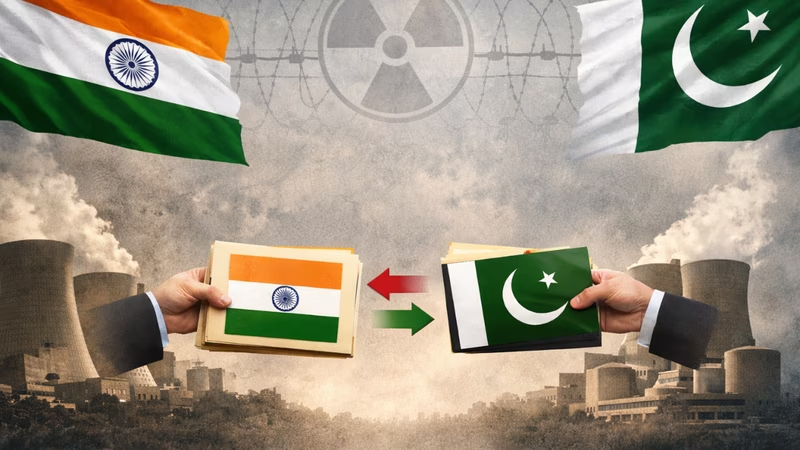
On January 1, 2026, in a quiet but profoundly significant act of diplomacy, India and Pakistan once again exchanged lists of their nuclear installations and facilities. This marked the **35th straight year** this exchange has taken place—without fail—even during wars, terrorist attacks, and full-blown diplomatic standoffs .
While it rarely makes headlines, this routine procedure is a cornerstone of one of the world’s most fragile nuclear relationships. At its heart is the **India Pakistan nuclear agreement** formally known as the “Agreement on the Prohibition of Attack against Nuclear Installations and Facilities,” signed on December 31, 1988, and in force since January 1, 1991 .
In an era of rising global nuclear risks, this decades-old pact offers a rare glimmer of predictability. But how does it work? Why does it still matter? And what would happen if it ever stopped?
Table of Contents
- What Is the 1988 India-Pakistan Nuclear Agreement?
- How the Annual Nuclear Site Exchange Actually Works
- Why This Agreement Still Matters in 2026
- Limitations and Criticisms of the Pact
- A Pact That Survived Wars and Terror Attacks
- How It Compares to Other Nuclear Confidence-Building Measures
- Conclusion: A Fragile but Vital Lifeline
What Is the 1988 India-Pakistan Nuclear Agreement?
Officially titled the “Agreement between the Government of the Republic of India and the Government of the Islamic Republic of Pakistan on the Prohibition of Attack against Nuclear Installations and Facilities,” this treaty is a **confidence-building measure (CBM)** designed for one core purpose: to prevent either country from deliberately or accidentally striking the other’s nuclear infrastructure.
Key provisions include:
- Both nations must **exchange a list of all nuclear installations and facilities** every year by January 1.
- They commit to **refraining from any attack**—conventional or nuclear—on these listed sites.
- The definition of “nuclear installations and facilities” includes power plants, research reactors, fuel fabrication units, and storage sites for nuclear material .
Crucially, the agreement doesn’t require either side to disclose sensitive operational details—just the **location and general nature** of the facilities. This balance allows transparency without compromising national security .
How the Annual Nuclear Site Exchange Actually Works
Every New Year’s Day, diplomats from both countries hand-deliver sealed envelopes across the border—one at the Wagah border near Amritsar, the other via the Pakistani High Commission in New Delhi .
The lists are not public. They’re classified documents shared only between defense and foreign ministries. But their existence creates a **mutual understanding**: if a nuclear facility is on that list, it’s off-limits in any conflict.
This simple act builds what nuclear strategists call “strategic empathy”—a recognition that an attack on a nuclear plant could trigger catastrophic radioactive fallout, harming both nations and potentially the entire region .
Why This Agreement Still Matters in 2026
In 2026, both India and Pakistan possess growing nuclear arsenals—estimated at 170 and 170 warheads respectively, according to the Stockholm International Peace Research Institute (SIPRI) . With such destructive power in close proximity, the risk of escalation is real.
The India Pakistan nuclear agreement acts as a circuit breaker. For example:
- During the 2019 Balakot airstrikes, neither side targeted nuclear sites—even though military facilities were struck.
- In the 2001–02 military standoff after the Parliament attack, the pact helped keep nuclear assets out of the crosshairs.
As Dr. Rajeswari Pillai Rajagopalan of the Observer Research Foundation notes, “This agreement may seem symbolic, but in nuclear deterrence, symbolism saves lives” .
Limitations and Criticisms of the Pact
Despite its success, the agreement isn’t foolproof:
- It **doesn’t cover military nuclear facilities**, such as weapon assembly sites or missile bases—only civilian or dual-use installations .
- There’s **no verification mechanism**. Each side takes the other’s list “on trust.”
- Critics argue it creates a false sense of security, especially as both nations develop tactical nuclear weapons like Pakistan’s Nasr missile .
Still, most experts agree: **flawed transparency is better than none**.
A Pact That Survived Wars and Terror Attacks
Perhaps the most remarkable aspect of this agreement is its **unbroken continuity**. It has held through:
- The Kargil War (1999)
- The 2001 Indian Parliament attack
- The 2008 Mumbai attacks
- The 2016 Uri attack and surgical strikes
- The 2019 Pulwama-Balakot crisis
Even when embassies were downgraded and trade halted, the nuclear lists were exchanged. This resilience shows that, at the highest levels of both governments, there’s a shared recognition: **some red lines must never be crossed**.
How It Compares to Other Nuclear Confidence-Building Measures
Globally, such bilateral nuclear transparency is rare. The U.S. and USSR had extensive treaties (like START), but those involved intrusive inspections. In contrast, the India-Pakistan model is minimalist—but functional.
It’s often cited by the International Atomic Energy Agency (IAEA) as a **regional best practice** for nuclear-armed rivals. As the IAEA states, “Even basic transparency can significantly reduce miscalculation risks” .
Conclusion: A Fragile but Vital Lifeline
The India Pakistan nuclear agreement won’t solve Kashmir or end cross-border terrorism. But it does something equally important: it keeps a catastrophic nuclear war off the table. In a region where a single spark can ignite a firestorm, this quiet annual ritual is a lifeline—not just for India and Pakistan, but for over 1.5 billion people who share this volatile neighborhood.
As long as those sealed envelopes keep crossing the border every January 1, there’s hope that reason will continue to outweigh rage.
Sources
- Times of India: India, Pak exchange list of nuke sites: What is 1988 agreement?
- Ministry of External Affairs, India: Full Text of the 1988 Agreement
- IDSA (Institute for Defence Studies and Analyses): Understanding the 1988 Nuclear Agreement
- Carnegie Endowment: India-Pakistan Nuclear Risk Reduction
- Stimson Center: CBMs Between India and Pakistan
- Bulletin of the Atomic Scientists: Nuclear Risk in South Asia
- SIPRI Yearbook 2025: Nuclear Arsenal Estimates
- ORF (Observer Research Foundation): Why the 1988 Nuclear Agreement Still Matters
- Brookings Institution: Tactical Nuclear Weapons in South Asia
- IAEA: Nuclear Safety and Security Guidelines