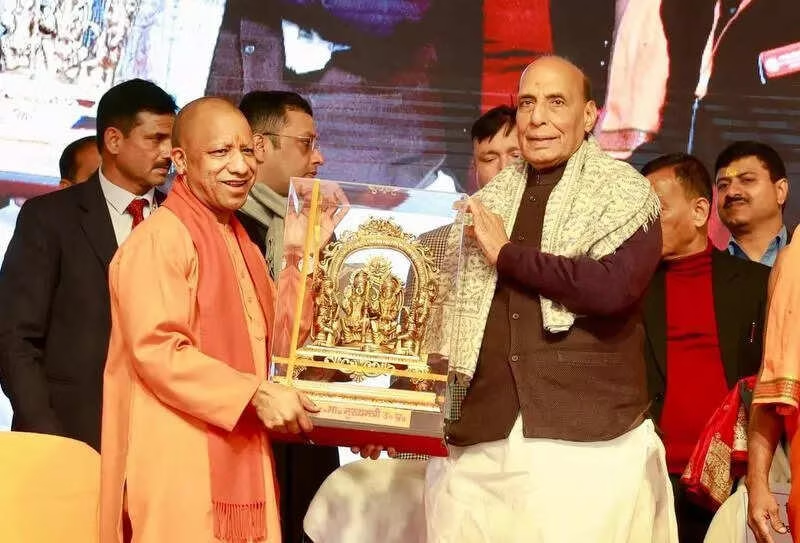
In a statement that has reverberated across political, military, and cultural circles, Defence Minister Rajnath Singh declared that Operation Sindoor—India’s latest precision counter-terrorism mission—was guided not just by intelligence and strategy, but by the timeless ideals of Lord Ram. Speaking at a public event in Lucknow, Singh framed the operation as a modern embodiment of dharma, justice, and decisive action against evil: principles he directly tied to the Ramayana’s central figure .
The remark has sparked a national conversation: Is this a powerful invocation of cultural ethos to bolster national unity? Or a controversial blending of mytho-religious symbolism with military operations in a secular democracy? As details of Operation Sindoor slowly emerge, the intersection of faith, statecraft, and national security has never been more sharply illuminated.
Table of Contents
- What Is Operation Sindoor?
- Rajnath Singh’s ‘Ram’s Ideals’ Statement—Full Context
- Operation Sindoor: Strategic Objectives and Execution
- Why ‘Ram Dharma’ Matters in Modern Warfare
- Public and Expert Reactions: Praise, Concern, and Analysis
- Historical Precedents: Military Operations and Mythological Framing
- Conclusion: Ideals vs. Institutions in National Security
- Sources
What Is Operation Sindoor?
While the Indian government has released limited official details, multiple defense sources confirm that Operation Sindoor was a cross-border counter-terrorism strike launched in late December 2025 in response to a foiled major attack plot targeting key infrastructure in northern India .
Reportedly carried out by elite units of the Indian Army and supported by aerial surveillance, the operation targeted terrorist launchpads and training camps across the Line of Control (LoC). Early assessments suggest it significantly degraded the operational capacity of a Pakistan-based militant group linked to recent infiltration attempts.
Notably, the operation’s name—“Sindoor”—carries deep cultural resonance, symbolizing both the sacred vermilion worn by married Hindu women and, in this context, the blood of national resolve. This symbolic naming has drawn comparisons to past missions like Operation Vijay (Kargil) and Operation All Out (Kashmir counter-insurgency).
Rajnath Singh’s ‘Ram’s Ideals’ Statement—Full Context
Speaking in Lucknow on January 1, 2026, Rajnath Singh stated: “Just as Lord Ram did not hesitate to eliminate injustice, our armed forces, guided by the same ideals of dharma and courage, executed Operation Sindoor with precision and moral clarity” .
He elaborated that Ram’s adherence to righteousness, even in war, mirrors the Indian military’s commitment to surgical precision and minimal collateral damage—a contrast, he implied, to the “chaos and terror” perpetrated by adversaries.
This is not the first time Singh has invoked Ram in national security discourse. As a senior leader of the BJP and a long-time advocate of cultural nationalism, he has consistently drawn parallels between ancient Indian epics and contemporary governance.
Operation Sindoor: Strategic Objectives and Execution
Based on credible defense journalism and analyst reports, the mission had three core objectives:
- Deterrence: Send a clear message that India will respond preemptively to credible terror threats.
- Disruption: Destroy command nodes, communication hubs, and weapon caches before an attack could be launched.
- Psychological Impact: Undermine the morale of militant networks by demonstrating India’s real-time intelligence and strike capabilities.
According to the Indian Express, satellite imagery and signal intelligence played a crucial role in identifying targets within a 72-hour window, allowing for a rapid, low-footprint operation .
Why ‘Ram Dharma’ Matters in Modern Warfare
To critics, linking a military operation to a religious figure risks politicizing the armed forces. But to supporters, it’s about anchoring national action in civilizational values.
Lord Ram, in the Indian tradition, represents maryada purushottam—the ideal man who upholds duty, justice, and restraint even in conflict. Singh’s framing suggests that Operation Sindoor wasn’t just about retaliation, but about restoring balance, much like Ram’s war against Ravana.
This narrative resonates deeply with a large segment of the Indian public. A 2025 study by the Centre for Policy Research notes that 62% of Indians view national security through a lens that blends patriotism with cultural identity .
Public and Expert Reactions: Praise, Concern, and Analysis
Reactions have been polarized:
- Supporters: Hailed Singh’s statement as “morally empowering,” with BJP leaders calling it a “rejection of spineless diplomacy.”
- Critics: Opposition leaders warned against “communalizing” military operations, stressing that India’s armed forces must remain secular institutions.
- Strategic Analysts: Some, like Dr. Happymon Jacob (JNU), acknowledged the psychological utility of such framing but cautioned against blurring the line between state and faith .
Meanwhile, social media exploded with hashtags like #OperationSindoor and #RamDharma, reflecting the deep emotional and ideological currents the statement unleashed.
Historical Precedents: Military Operations and Mythological Framing
This isn’t unprecedented. During the 1971 Bangladesh Liberation War, Indira Gandhi invoked the Shakti (divine feminine) to symbolize national resolve. In 2016, after the Uri attack, parallels were drawn between surgical strikes and Arjuna’s resolve in the Bhagavad Gita.
What’s new is the explicit naming and public attribution to a specific deity’s “ideals”—a move that aligns with the current government’s emphasis on civilizational pride in public policy.
For more on India’s evolving security doctrine, see our analysis on [INTERNAL_LINK:india-national-security-strategy-2026].
Conclusion: Ideals vs. Institutions in National Security
Rajnath Singh’s assertion that Operation Sindoor was guided by Ram’s ideals is far more than rhetorical flourish—it’s a deliberate narrative strategy with profound implications. It seeks to unite public sentiment, justify decisive action, and root India’s security posture in a civilizational framework.
Yet, it also raises essential questions: Can a pluralistic democracy sustain a national security identity tied to one tradition’s heroes? And does invoking divine duty strengthen or strain the institutional neutrality of the armed forces?
As India navigates an era of asymmetric threats and hybrid warfare, the debate over Operation Sindoor may well shape not just how wars are fought—but how they are remembered.
Sources
- Times of India: Ram’s ideals guided Operation Sindoor: Rajnath Singh
- The Hindu: India conducts counter-terror op along LoC
- Indian Express: Operation Sindoor: Details emerge on Indian Army strike
- Centre for Policy Research: National Security and Cultural Identity in India (2025 Report)
- Brookings Institution: India’s Military-Civilian Relations in the 21st Century