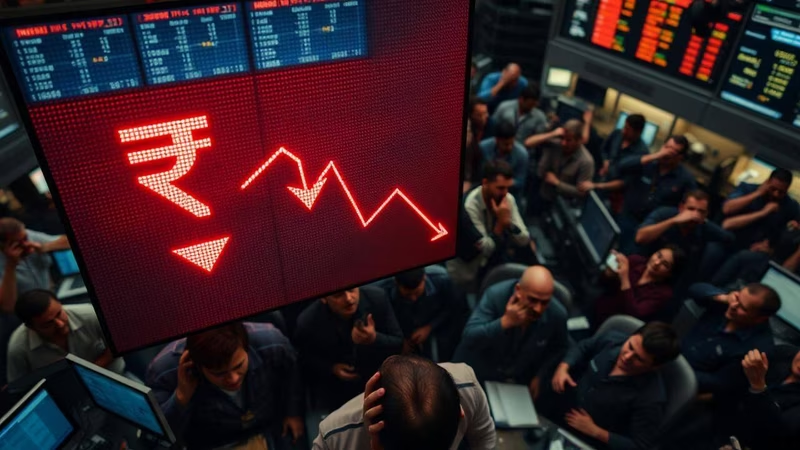
The New Year’s Eve fireworks had barely faded when the Indian financial markets were greeted with a stark reminder of global economic headwinds. On the very first trading day of 2026, the Indian Rupee stumbled, closing at a weak 89.99 against the US dollar—a drop of 11 paise from its previous close . This inauspicious start, marking the currency’s entry into the new year “in the red,” has raised serious concerns among investors, businesses, and policymakers. The big question on everyone’s mind is: what’s driving this depreciation, and is this just the beginning of a volatile 2026 for the Rupee falls against dollar narrative?
Table of Contents
- A Weak Start: What Happened on January 1, 2026?
- The Real Culprits Behind the Rupee’s Slide
- Why India’s Strong Growth Isn’t Enough
- Global Headwinds: Tariffs and Investor Caution
- What This Means for You: Your Wallet and Your Investments
A Weak Start: What Happened on January 1, 2026?
The first session of the year set a nervous tone. The rupee opened on a weak footing and continued its downward trajectory throughout the day, pressured by a combination of domestic and international factors . The interbank foreign exchange market saw heavy selling of the rupee as foreign portfolio investors (FPIs) continued their trend of pulling capital out of emerging markets, including India .
By the close, the local unit had settled at 89.99 against the greenback. This level isn’t just a number; it’s a psychological barrier that, once breached, can trigger further speculative selling and erode market confidence. Analysts at major banks had been warning of this possibility, and the market’s reaction on Day One of 2026 seems to validate their cautious outlook .
The Real Culprits Behind the Rupee’s Slide
While India boasts a robust GDP growth rate—projected to remain among the highest in the world—the rupee’s health is far more dependent on the flow of foreign capital than domestic output alone. The primary drivers of this recent weakness are clear:
- Sustained Foreign Fund Outflows: This is the single biggest factor. Foreign portfolio investors have been net sellers in the Indian debt and equity markets for several consecutive sessions. When dollars exit the country, the demand for the dollar in the local market increases relative to the rupee, pushing its value down .
- Global Risk Aversion: A cautious global investor sentiment, driven by fears of a global slowdown and geopolitical tensions, is making investors flock to safe-haven assets like the US dollar, at the expense of riskier emerging market currencies like the rupee .
- Trade Uncertainties and Tariff Disruptions: The ongoing friction in global trade, including the threat of new tariffs and supply chain disruptions, is creating a fog of uncertainty. This makes India’s export outlook less certain and, consequently, its current account balance vulnerable .
Why India’s Strong Growth Isn’t Enough
It’s a frustrating paradox for many: India’s economy is a global bright spot, yet its currency is under pressure. This disconnect highlights a crucial point about modern global finance. Strong GDP growth is a long-term, structural positive. However, short-to-medium-term currency movements are dictated by capital flows and market sentiment .
Even the most impressive domestic growth story can be overshadowed if foreign investors believe they can get better returns with less risk elsewhere. The perception of India’s macroeconomic stability, its inflation control, and its fiscal discipline all play a role in attracting and retaining that crucial foreign capital. Right now, the global “risk-off” mood is trumping India’s strong fundamentals, leaving the rupee exposed .
Global Headwinds: Tariffs and Investor Caution
The threat of a new wave of protectionism is a major concern. Recent policy shifts in key economies have reignited fears of a global trade war. If new tariffs are imposed, it could disrupt India’s export sectors, from pharmaceuticals to IT services, and widen the current account deficit—the gap between what a country earns from exports and what it spends on imports .
A wider deficit means a greater need for foreign currency, which, in turn, increases the pressure on the rupee. Analysts from major financial institutions are now forecasting a period of “continued volatility” for the Indian currency, as it remains at the mercy of these external forces . The International Monetary Fund (IMF) has repeatedly warned emerging markets to prepare for such capital flow reversals in an uncertain global environment.
What This Means for You: Your Wallet and Your Investments
The rupee’s depreciation isn’t just a headline for finance geeks; it has real-world consequences for ordinary citizens and investors:
- Cost of Imports: A weaker rupee makes everything from crude oil to smartphones more expensive. This can feed directly into higher retail inflation, eroding your purchasing power.
- Foreign Travel & Education: If you’re planning a trip abroad or sending your child to a university overseas, you’ll get fewer dollars for your rupees, making it a more expensive proposition.
- Investment Strategy: For investors, a falling rupee can be a double-edged sword. It negatively impacts returns on international funds but can boost the overseas earnings of export-oriented Indian companies. It’s a critical factor to consider in your portfolio allocation.
Staying informed is your best defense. For more on how to protect your finances in a volatile currency market, see our guide on [INTERNAL_LINK:investing-during-currency-volatility].
Conclusion: A Cautious Outlook for the Rupee in 2026
The Indian Rupee’s weak start to 2026 is a powerful signal that domestic strength alone cannot insulate an economy from the powerful currents of the global market. The persistent Rupee falls against dollar trend is being driven by a perfect storm of foreign fund outflows, a global flight to safety, and looming trade uncertainties. While India’s long-term economic story remains intact, the short-term path for the currency looks bumpy. Investors and consumers alike must brace for continued volatility and plan their finances accordingly in what promises to be a challenging, yet pivotal, year for the Indian economy.
Sources
- Times of India: Rupee falls 11 paise, currency enters New Year 2026 in red, trades at 89.99 against US dollar [[1], [2], [3], [5]]
- Analyst Reports on FPI Flows and Rupee Outlook [[6], [7], [10], [11], [13]]
- International Monetary Fund (IMF): https://www.imf.org/en/Home [[8], [9]]