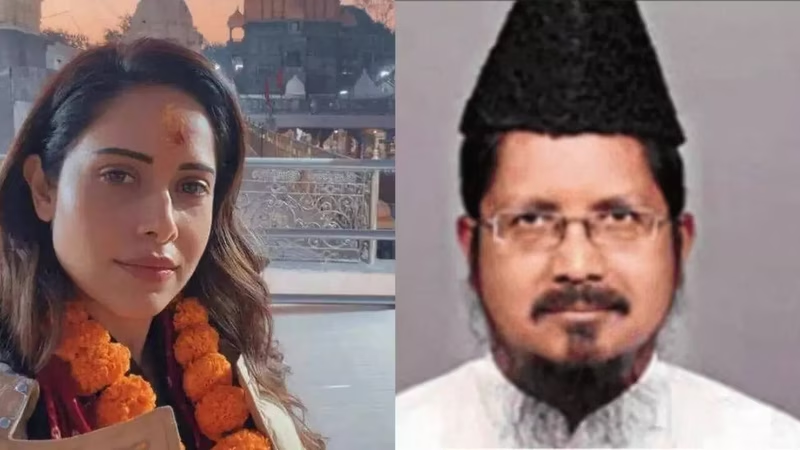
It was meant to be a personal, spiritual moment. Bollywood actress Nushrratt Bharuccha, known for her grounded persona, visited the sacred Mahakaleshwar Temple in Ujjain for the Putrada Ekadashi, marking her second darshan at the revered shrine . She performed traditional rituals, offered water to the deity, and described the experience as “beautiful” and “deeply meaningful.” But for many, this act of cross-faith reverence has crossed a sacred line, sparking a major religious controversy that’s now dominating headlines. At the heart of the storm is a stark declaration from a prominent Islamic leader: “We can’t indulge in idol worship” .
Table of Contents
- The Visit That Sparked a Storm
- The Fatwa: Nushrratt Bharuccha Mahakal Visit Declared a ‘Grave Sin’
- Understanding the Islamic Perspective on Idol Worship
- Who is Nushrratt Bharuccha and What Does She Believe?
- The Broader Conversation: Faith, Tolerance, and Public Scrutiny
The Visit That Sparked a Storm
Nushrratt Bharuccha’s trip to the Mahakaleshwar Temple, one of the twelve Jyotirlingas and a deeply significant site in Hinduism, was a seemingly private act of devotion . She participated in the temple’s rituals, including the Bhasma Aarti, and shared her serene experience with her followers . In a country where faith is often a very public and personal matter, her actions were seen by many as a beautiful example of India’s syncretic culture—a symbol of spiritual fluidity and respect across religious boundaries .
The Fatwa: Nushrratt Bharuccha Mahakal Visit Declared a ‘Grave Sin’
However, a significant section of her own community viewed it very differently. Maulana Mufti Shahabuddin Razvi Bareilvi, the president of the All India Muslim Jamaat, issued a strong statement, or fatwa, condemning her actions . He was explicit in his criticism, listing her specific acts: “Nushrratt Bharuccha went to the Mahakal Temple in Ujjain, offered prayers, poured water, and observed the rituals… all these things she has done are a sin (Gunah) in the eyes of Sharia, and the biggest sin” [[10], [11]].
His core argument, echoed in his public declaration, is a fundamental tenet of Islam: “We can’t indulge in idol worship” [[5], [9]]. For him and many conservative Islamic scholars, participating in the rituals of another faith, especially those involving a physical representation of the divine, is a direct contravention of Sharia law and a serious transgression.
Understanding the Islamic Perspective on Idol Worship
To understand the intensity of the backlash, one must grasp the centrality of monotheism in Islam. The concept of Shirk—associating partners with Allah or worshipping anything other than the one God—is considered the gravest of all sins, often described as unforgivable if not repented from before death [[15], [19]].
Idol worship is the ultimate form of Shirk, as it involves directing worship towards a created object rather than the Creator Himself [[16], [18]]. From this theological standpoint, a Muslim’s active participation in the rituals of a temple, which are centered around a deity’s idol or symbol, is not seen as a benign act of cultural appreciation, but as a fundamental betrayal of their core religious beliefs. This is the bedrock upon which the fatwa against the Nushrratt Bharuccha Mahakal visit is built .
Who is Nushrratt Bharuccha and What Does She Believe?
Bharuccha, born into a Dawoodi Bohra Muslim family, has consistently presented herself as a spiritual but liberal individual. She has previously stated, “I’m a Muslim, I’m regular with my prayers,” which adds a layer of complexity to the controversy . In past interviews, she has spoken about her personal and meaningful connection to faith, suggesting a belief system that is both rooted in her upbringing and open to broader spiritual experiences [[23], [28]].
This incident highlights the complex reality for many modern, publicly visible individuals who navigate between their personal spiritual inclinations and the rigid expectations of their religious communities. Her visit appears to be an expression of a personal spirituality that transcends traditional religious boundaries—a perspective that, while resonant with many, is deeply problematic from a strict orthodox viewpoint.
The Broader Conversation: Faith, Tolerance, and Public Scrutiny
This controversy is about more than one actress’s temple visit. It’s a flashpoint in a much larger, ongoing national conversation about the nature of faith in a diverse, modern India. It forces us to ask difficult questions:
- How much personal freedom should an individual have in their spiritual exploration, especially if it seems to contradict their birth religion?
- Where is the line between respectful cultural appreciation and religious transgression?
- Does a fatwa from a religious leader have a place in the public discourse of a secular democracy?
The online debate has been fierce, with some defending her right to her own spiritual path and others staunchly supporting the Maulana’s interpretation of Islamic law . This polarized reaction is a microcosm of the tensions that exist in a society trying to balance deep-rooted traditions with evolving, individualistic worldviews. For a deeper dive into the history of interfaith relations in India, see our feature on [INTERNAL_LINK:history-of-interfaith-harmony-in-india]. For an authoritative understanding of Islamic law, the Encyclopædia Britannica’s entry on Sharia provides a comprehensive overview.
Conclusion: A Personal Faith, A Public Firestorm
At its core, the Nushrratt Bharuccha Mahakal visit is a story of a personal spiritual quest that collided head-on with the rigid boundaries of religious orthodoxy. While she found peace and meaning in the temple’s sanctum, her actions were declared a ‘grave sin’ by a powerful voice from her own community. This incident serves as a powerful reminder that in today’s hyper-connected world, a private act of faith can quickly become a very public debate, forcing everyone to confront their own beliefs about religion, identity, and the limits of personal freedom.
Sources
- Times of India: ‘We can’t indulge in idol worship’: Actor Nushrratt Bharuccha’s Mahakal visit sparks row
- Web Search Results on Nushrratt Bharuccha’s Temple Visit [[1], [2], [3], [4], [6], [7], [8], [21], [26]]
- Statements by Maulana Mufti Shahabuddin Razvi Bareilvi [[9], [10], [11], [12], [27]]
- Explanations of Islamic views on Idol Worship [[14], [15], [16], [17], [18], [19], [20]]
- Background on Nushrratt Bharuccha’s faith and public statements [[22], [23], [24], [25], [28]]