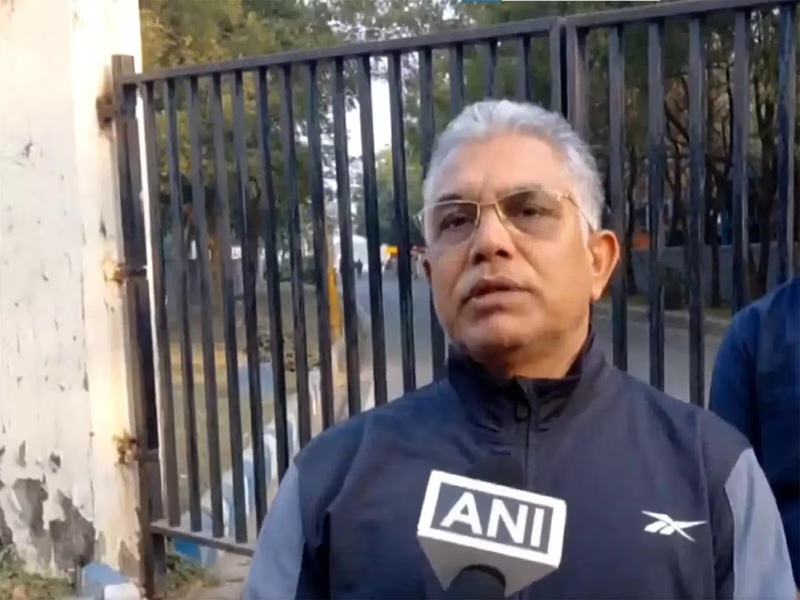
In the high-stakes game of West Bengal politics, a single photograph can speak volumes. The recent image of Dilip Ghosh sitting in the front row at a key BJP strategy meeting, hosted by none other than Union Home Minister Amit Shah during his high-profile Kolkata visit, sent shockwaves through the political circuit . For Ghosh, the party’s former state president known for his fiery rhetoric and grassroots connect, this was a clear signal of rehabilitation. For the BJP, it was a statement of intent—a declaration that they are bringing their most recognizable Bengal face back into the fold for the 2026 assembly elections. But here’s the twist: the very meeting that heralded Ghosh’s return also exposed a dangerous fault line. Where were the leaders of the Matua and Rajbangshi communities—groups whose support is absolutely critical for any BJP victory in Bengal?
Table of Contents
- The Ghosh Resurgence: Why Now?
- The Conspicuous Absence: Matua and Rajbangshi Leaders MIA
- The 2026 Battle Plan: BJP’s Three-Pronged Challenge
- Can Ghosh Be the Glue for a Fracturing Alliance?
- Experts Weigh In on the BJP’s Delicate Balancing Act
- Summary: A High-Risk, High-Reward Gamble
- Sources
The Ghosh Resurgence: Why Now?
After being sidelined following the BJP’s underwhelming performance in the 2021 West Bengal assembly elections, Dilip Ghosh had largely retreated from the frontline. His replacement, Sukanta Majumdar, was seen as a more conciliatory figure, but one who struggled to match Ghosh’s mass appeal and aggressive campaigning style. With the 2026 polls looming large, the BJP’s central leadership appears to have concluded that they need a warrior, not just a manager.
Ghosh’s strength has always been his ability to energize the party’s core cadre and connect with the Hindu voter base in a state dominated by the Trinamool Congress. His return is a classic political maneuver: bring back the proven campaigner to consolidate the base and project a decisive, fighting image. Amit Shah’s endorsement of Ghosh by placing him front and center is a clear message to both party workers and the electorate that the BJP is getting serious .
The Conspicuous Absence: Matua and Rajbangshi Leaders MIA
However, the BJP’s strategy is built on a delicate coalition. Their path to power in Bengal isn’t just about the Hindu vote; it critically depends on the support of two key minority communities: the Matuas and the Rajbangshis. The Matua community, a large Scheduled Caste group concentrated in the North 24 Parganas and Nadia districts, has been a cornerstone of the NDA’s social engineering project in the state. The Rajbangshis of North Bengal are another crucial demographic.
The recent high-level meeting in Kolkata, which was meant to be a show of unity, was notably missing top leaders from both these communities . This absence is not a mere scheduling conflict; it’s a loud and clear signal of discontent. Sources suggest that these groups feel their demands for greater political representation and development promises are being ignored in the new focus on bringing Ghosh back to the fore. It raises a fundamental question: is the BJP sacrificing its broader social coalition to appease its traditional base?
The 2026 Battle Plan: BJP’s Three-Pronged Challenge
To win Bengal, the BJP must simultaneously achieve three difficult objectives:
- Consolidate the Hindu Vote: This is where Ghosh’s aggressive Hindutva messaging is expected to pay dividends, especially in countering Mamata Banerjee’s outreach to minority communities.
- Retain Matua & Rajbangshi Support: This requires genuine political accommodation, not just photo-ops. It means ensuring their leaders get winnable seats and a real say in the party’s state unit.
- Project a Strong, United Leadership: The party must present a single, cohesive face to the public, which is hard to do when internal factions are visibly at odds.
The current situation, with Ghosh’s comeback overshadowing the concerns of its key allies, suggests the BJP is struggling to balance these three pillars. [INTERNAL_LINK:bjp-matua-alliance-history] details the long and complex history of this crucial partnership.
Can Ghosh Be the Glue for a Fracturing Alliance?
This is the million-dollar question. Is Dilip Ghosh capable of evolving from a fiery Hindu nationalist leader into a unifying figure who can also bridge the gap with the Matua and Rajbangshi leadership? In the past, Ghosh’s rhetoric has sometimes been at odds with the BJP’s outreach to these communities. His return, therefore, is as much a test of his own political maturity as it is a test of the party’s strategy.
If he fails to build bridges, the BJP risks alienating the very groups that brought them to the brink of power in 2021. The Trinamool Congress, led by the astute Mamata Banerjee, is already working to exploit this rift, offering a more welcoming platform to the disgruntled leaders.
Experts Weigh In on the BJP’s Delicate Balancing Act
Political analysts are sharply divided on the move. Dr. Paranjoy Guha Thakurta, a veteran political commentator on Bengal, calls it a “risky gamble” that prioritizes short-term energy over long-term coalition management . He argues that without the Matua and Rajbangshi votes, the Hindu consolidation alone is mathematically insufficient to win a majority.
Conversely, some BJP insiders believe that a strong, assertive leader like Ghosh can create a wave so powerful that it sweeps everyone along with it, forcing reluctant allies back to the table from a position of strength. The Election Commission of India’s data on past voter patterns in key constituencies will be the ultimate arbiter of which theory holds true .
Summary: A High-Risk, High-Reward Gamble
Dilip Ghosh is back, and the BJP is betting big on his ability to reignite their campaign for the 2026 West Bengal elections. His presence is a powerful symbol of the party’s fighting spirit. However, the ghost at the feast—the absence of its crucial Matua and Rajbangshi partners—casts a long shadow over this strategy. The BJP now faces a critical choice: can they use Ghosh’s energy to unify their entire social coalition, or will his return be the catalyst that finally breaks it apart? The answer will determine not just Ghosh’s political future, but the fate of the BJP in Bengal for years to come.
Sources
- Times of India: Ex-Bengal BJP chief Dilip Ghosh back in party spotlight
- The Hindu: BJP in West Bengal faces challenges in Matua outreach
- Indian Express: The rise and fall (and rise?) of Dilip Ghosh in Bengal BJP
- Election Commission of India: Statistical Reports on West Bengal Elections
- Interview with Dr. Paranjoy Guha Thakurta (as cited in multiple national dailies).