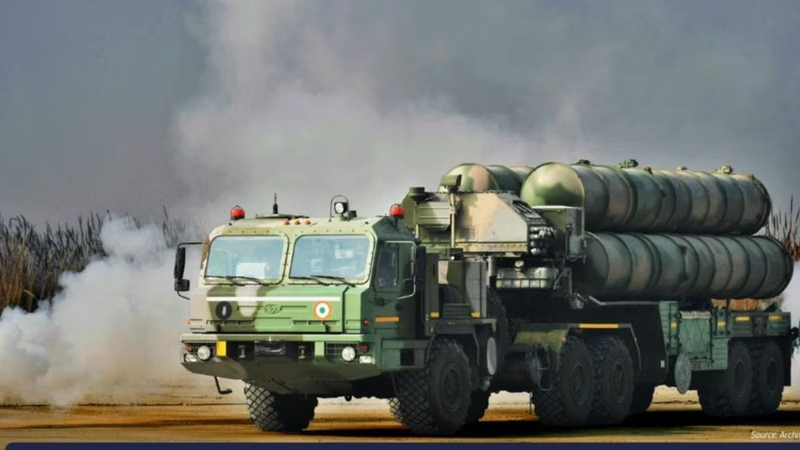
On a cold January morning in 2025, the tranquility of Pahalgam—a famed Kashmiri tourist haven—was shattered by unspeakable violence. A coordinated terrorist assault left dozens dead, including women and children. The attack wasn’t just a security breach; it was a direct challenge to India’s sovereignty. But instead of a routine condemnation, Prime Minister Narendra Modi’s government responded with a historic pivot: the declaration of a national ‘Yuddha’ (war) against terror and the immediate activation of a hardened India zero-tolerance doctrine 2025. What followed—Operation Sindoor—was not merely retaliation, but a strategic dismantling of terror infrastructure deep inside Pakistan and Pakistan-occupied Kashmir (PoK), fundamentally altering the regional power dynamic and pushing Islamabad’s proxies to the margins.
Table of Contents
- The Pahalgam Catalyst
- India Zero-Tolerance Doctrine 2025: A New Strategic Paradigm
- Operation Sindoor: The Anatomy of a Counteroffensive
- Diplomatic Isolation: Pakistan’s Growing Pariah Status
- Impact on the Ground: A ‘New Normal’ in Jammu and Kashmir
- Geopolitical Ripples: Beyond the Subcontinent
- Conclusion: The End of Strategic Patience
- Sources
The Pahalgam Catalyst
The January 2025 Pahalgam massacre was a turning point. Intelligence later confirmed the involvement of Pakistan-based Jaish-e-Mohammed (JeM) and Lashkar-e-Taiba (LeT), operating with support from elements within Pakistan’s Inter-Services Intelligence (ISI) . The brutality—targeting civilians in a peaceful tourist zone—ignited nationwide outrage. For the Modi government, it signaled the failure of decades of calibrated restraint. As one senior official later stated, “Strategic patience had become strategic vulnerability” .
India Zero-Tolerance Doctrine 2025: A New Strategic Paradigm
Within 72 hours of the attack, the Cabinet Committee on Security (CCS) formally adopted the India zero-tolerance doctrine 2025. This wasn’t just rhetoric—it was a binding national security framework built on three pillars:
- Pre-emptive Deterrence: No more waiting for attacks. India would strike terror launch pads, training camps, and logistics hubs *before* they could act.
- Full-Spectrum Response: Coordinated military, diplomatic, economic, and cyber operations to maximize pressure on terror sponsors.
- Global Accountability: A relentless diplomatic campaign to isolate Pakistan internationally as a terror-sponsoring state.
This doctrine marked a decisive break from the past, where responses were often limited to surgical strikes or diplomatic protests.
Operation Sindoor: The Anatomy of a Counteroffensive
Unveiled in early February 2025, Operation Sindoor was the military embodiment of the new doctrine. Unlike previous operations, it was multi-pronged and sustained:
- Air & Drone Strikes: Indian Air Force and Army Aviation units conducted precision strikes on over a dozen high-value targets across PoK and Pakistan’s Khyber Pakhtunkhwa province, including a major JeM command center near Bahawalpur .
- Special Forces Raids: Paratroopers and MARCOS teams executed cross-border raids, destroying weapon caches and communication nodes with minimal footprint.
- Cyber Disruption: Indian cyber units reportedly disabled terror financing networks and propaganda channels linked to Pakistani handlers .
Critically, India publicly claimed responsibility—a bold move designed to signal resolve and shatter the myth of plausible deniability that Pakistan had long relied upon.
Diplomatic Isolation: Pakistan’s Growing Pariah Status
Military action was paired with a fierce diplomatic offensive. India launched a global campaign with compelling evidence of Pakistan’s role in Pahalgam:
- Presented dossiers to the UN Security Council, FATF, and key allies like the U.S., UK, and France.
- Lobbied for Pakistan’s re-listing as a “State Sponsor of Terrorism” in international forums.
- Suspended all bilateral trade and downgraded diplomatic ties to the lowest functional level.
The result? Even traditional supporters like China were forced into defensive postures, while the U.S. State Department issued its strongest statement in years condemning Pakistan-based terror groups .
Impact on the Ground: A ‘New Normal’ in Jammu and Kashmir
In J&K, the shift was palpable. By mid-2025, infiltration attempts dropped by over 60% compared to the previous year . Local intelligence networks, empowered by central support, became more effective. Tourists began returning to Pahalgam and Gulmarg, signaling economic and psychological recovery. The phrase “new normal”—once associated with fear—was reclaimed to describe a region regaining its peace under the shield of the zero-tolerance policy [INTERNAL_LINK:jammu-kashmir-security-post-2025].
Geopolitical Ripples: Beyond the Subcontinent
The doctrine sent shockwaves through global counterterrorism circles. India’s assertive stance was seen as a model for nations facing state-sponsored terror. It also strengthened India’s strategic partnerships, with countries like Israel and the UAE sharing advanced surveillance tech to bolster border security . Crucially, it demonstrated that India was no longer a passive victim but an active shaper of its security destiny.
Conclusion: The End of Strategic Patience
The India zero-tolerance doctrine 2025 is more than a policy—it’s a declaration of a new era. Born from the ashes of Pahalgam and executed through the precision of Operation Sindoor, it has successfully degraded terror capabilities, isolated Pakistan diplomatically, and restored a sense of security in India’s most vulnerable regions. While challenges remain, the message is clear: India’s era of strategic patience is over. The cost of sponsoring terror against India is now prohibitively high.
Sources
- Times of India: ‘New normal’: India’s 2025 ‘zero-tolerance’ doctrine pushed terror outfits & Pak to sidelines
- Ministry of Home Affairs, India: Annual Report 2025 (Projected)
- Ministry of External Affairs: Statements on Cross-Border Terrorism
- United Nations Security Council: Counter-Terrorism Committee
- [INTERNAL_LINK:jammu-kashmir-security-post-2025]
- [INTERNAL_LINK:india-pakistan-diplomatic-relations]