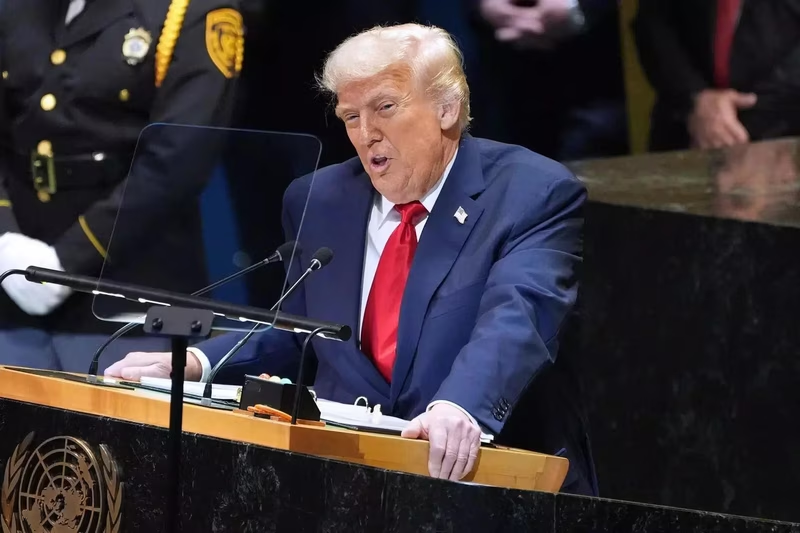
In a move that has sent shockwaves through the political landscape, President Donald Trump has ordered the full withdrawal of National Guard troops from Chicago, Los Angeles, and Portland, effective immediately. This decision, announced on the final day of 2025, is a direct consequence of a string of significant legal setbacks that have crippled his administration’s aggressive deployment strategy. However, in a characteristic display of defiance, Trump left the door wide open for a future return, cryptically stating, “We will come back when…” .
This isn’t just a simple troop pullback; it’s a major pivot in the President’s high-profile campaign against urban crime and civil unrest. For months, the deployment of federalized National Guard units into these Democrat-led cities has been a lightning rod for controversy, sparking fierce legal battles and constitutional debates. Now, with the courts firmly against him, Trump has been forced to retreat—but his promise suggests this is far from over.
Table of Contents
- The Legal Battle That Forced a Retreat
- Trump National Guard Withdrawal and the Strategic Message
- Impact on the Ground in Chicago, LA, and Portland
- What Does ‘We Will Come Back When…’ Really Mean?
- Conclusion: A Tactical Pause in a Larger War
- Sources
The Legal Battle That Forced a Retreat
The Trump National Guard withdrawal didn’t happen in a vacuum. It was the inevitable result of a coordinated legal offensive from state and city governments that successfully argued the President overstepped his constitutional authority.
In Chicago, the State of Illinois and the City itself filed a lawsuit that resulted in a federal district court granting a preliminary injunction, effectively blocking the deployment . This legal victory was then cemented at the highest level when, on December 23, 2025, the U.S. Supreme Court denied the federal government’s emergency request to lift the injunction . This was a monumental blow, as it was the first of Trump’s Guard deployments to reach the nation’s highest court .
Similarly, in Portland, a Trump-appointed federal judge issued a final ruling in November 2025, declaring the administration’s federalization and deployment of National Guard troops unlawful and granting a permanent injunction . Los Angeles faced its own legal hurdles, with a federal court granting a preliminary injunction in early December 2025 that blocked the federalization orders for hundreds of California National Guard troops .
These weren’t isolated incidents but part of a “pattern of other federal courts issuing injunctions against National Guard deployments,” as noted by legal observers . The courts consistently found that the President’s use of Title 10 to federalize state Guard units for domestic law enforcement purposes was a profound overreach of executive power.
Trump National Guard Withdrawal and the Strategic Message
While the legal defeats were the catalyst, Trump’s public framing of the withdrawal is a masterclass in political messaging. He chose to announce the pullout not as a concession to the judicial branch, but as a temporary, strategic move. In his official statement, he boasted about the achievements of the troops in “reducing the crime and chaos” in these cities , positioning their presence as a success before their mandated departure.
His now-famous line, “We will come back when…”, is a deliberate and potent message to his base. It implies that the withdrawal is not a policy failure, but a necessary pause. The unspoken condition is clear: if crime rates surge or civil unrest returns to the levels seen earlier in his term, he will have a powerful political justification to attempt a new deployment, potentially under different legal pretenses or with new executive orders.
Impact on the Ground in Chicago, LA, and Portland
The immediate impact of the Trump National Guard withdrawal is a return to local control for law enforcement in these major cities. For the mayors of Chicago, Los Angeles, and Portland, who had been locked in a very public and bitter fight with the White House, this is a significant political and legal victory.
The presence of federal troops had been deeply unpopular with large segments of the local populations, who viewed it as an occupation force rather than a security asset. Their removal is likely to ease community tensions that had been exacerbated by the federal intrusion. However, city officials are now on notice: the President has publicly tied their local crime statistics to the potential return of federal forces. This creates a complex and high-stakes environment where local crime policy is now directly linked to a national political narrative.
What Does ‘We Will Come Back When…’ Really Mean?
This is the multi-billion-dollar question. Trump’s vague threat is a strategic ambiguity designed to serve multiple purposes:
- Political Leverage: It keeps pressure on Democratic mayors to maintain low crime rates, or else face the return of a deeply unpopular federal presence.
- Base Mobilization: It reassures his supporters that his hardline stance on crime and urban unrest is not abandoned but merely on hold.
- Legal Re-calibration: It buys his administration time to craft new legal arguments or seek new authority from a potentially more sympathetic Congress to circumvent the judicial roadblocks they just faced.
In essence, the Trump National Guard withdrawal is less a full stop and more a comma in a much longer sentence. The battle over the role of the federal military in domestic policing has been a cornerstone of his presidency, and this retreat is a tactical maneuver, not a surrender.
Conclusion: A Tactical Pause in a Larger War
The withdrawal of National Guard troops from Chicago, LA, and Portland marks a significant moment in the ongoing conflict between federal executive power and state/local autonomy. While President Trump has been forced to comply with the rulings of the judicial branch, his promise to return ensures that this issue will remain a central pillar of his political platform. For now, the cities celebrate a legal and political win, but they do so under the shadow of a very clear and present threat from the White House. The phrase “We will come back when…” is not just a statement; it’s a warning.
Sources
- The Times of India: ‘We will come back when…’: Trump pulls National Guard troops from Chicago, LA and Portland
- Supreme Court Order List (Dec. 23, 2025)
- California Department of Justice: Attorney General Bonta Secures Permanent Injunction Against Trump
- NPR: Trump Withdraws National Guard From Cities After Legal Losses
- [INTERNAL_LINK:trump-crime-policy-analysis]
- [INTERNAL_LINK:constitutional-law-and-federal-troops]