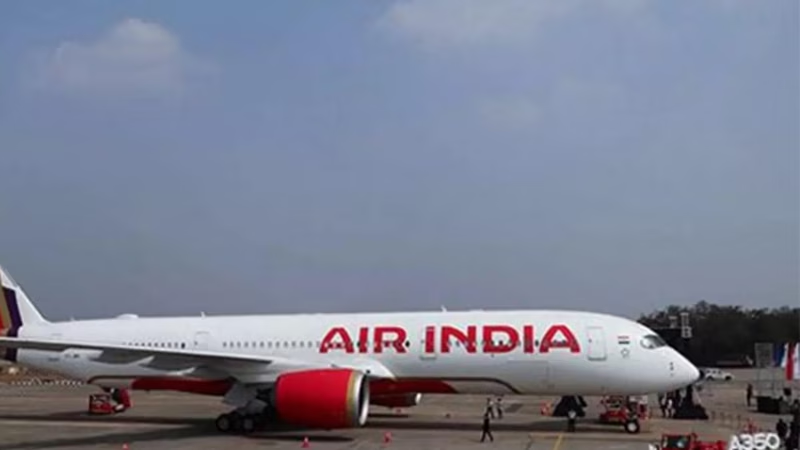
It was supposed to be a routine long-haul flight from Vancouver to Delhi. Passengers had checked in, bags were loaded, and the crew was prepping for departure on Christmas Eve—a day meant for celebration, not scandal. But everything came to a halt when the captain of the Air India flight was found to be under the influence of alcohol during a mandatory pre-flight breathalyzer test. The Air India pilot detained incident has since sent shockwaves through the aviation industry, raising urgent questions about safety oversight, crew accountability, and whether this was an isolated lapse or a symptom of a deeper problem.
Table of Contents
- What Happened at Vancouver Airport?
- Air India Pilot Detained: Official Response
- Aviation Alcohol Rules: Strict, But Are They Enforced?
- Past Incidents of Pilots Flying Under Influence
- Impact on Passengers and Flight Operations
- Why This Case Is Different
- What Happens Next to the Pilot and Air India?
- Conclusion
- Sources
What Happened at Vancouver Airport?
According to Canadian authorities and airline sources, the incident occurred on December 24, 2025, at Vancouver International Airport (YVR). The Air India flight AI-172, scheduled to depart for Indira Gandhi International Airport in Delhi, was delayed when airport security and Transport Canada officials conducted a routine pre-departure screening of the flight crew.
During the mandatory alcohol breath test—a standard procedure for all international flight crews departing from Canadian soil—the captain registered a blood alcohol concentration (BAC) above the legal limit of 0.04%. The pilot, whose identity has not been officially released, was immediately detained by airport police and removed from duty .
Air India swiftly arranged for a replacement crew, and the flight eventually departed over 10 hours late, arriving in Delhi on Christmas Day.
Air India Pilot Detained: Official Response
Air India issued a brief statement acknowledging the incident, calling it a “serious breach of protocol.” The airline confirmed that the pilot has been “suspended pending a full internal investigation” and emphasized its “zero-tolerance policy toward alcohol consumption within 12 hours of flight duty” .
Transport Canada, the federal agency overseeing aviation safety, also confirmed the detention and stated that the pilot could face criminal charges under Canada’s Aeronautics Act, which prohibits operating an aircraft while impaired. Penalties can include fines up to CAD $25,000 and up to 18 months in prison.
Aviation Alcohol Rules: Strict, But Are They Enforced?
Globally, aviation regulations are unequivocal: pilots must abstain from alcohol for at least 8–12 hours before flying. In India, the Directorate General of Civil Aviation (DGCA) mandates a 12-hour “bottle-to-throttle” rule. Canada enforces a 12-hour window with a BAC limit of 0.04%—half the legal driving limit.
Despite these strict rules, enforcement varies. Random testing is standard in countries like the U.S., UK, and Canada, but in some regions, it’s less consistent. This incident in Vancouver—a high-compliance jurisdiction—shows that even with robust protocols, human error and misconduct can still occur.
Past Incidents of Pilots Flying Under Influence
This isn’t the first time an Air India pilot has faced alcohol-related discipline:
- 2019: Two Air India pilots were suspended after one failed a breath test in London before a Mumbai-bound flight.
- 2017: A captain was removed from duty in Frankfurt for smelling of alcohol.
- 2015: An Air India Express pilot was arrested in Kerala for attempting to fly under the influence.
Globally, major airlines have also faced similar scandals. In 2023, a Lufthansa pilot was jailed in South Korea for trying to board a flight drunk. In 2019, a United Airlines crew was grounded in Scotland after three members failed alcohol tests .
Impact on Passengers and Flight Operations
The delayed flight left nearly 300 passengers stranded on Christmas Eve—a particularly distressing experience for those traveling to celebrate the holidays with family. Many took to social media to express frustration, with some calling for greater transparency from the airline.
While Air India provided meals and hotel accommodations, the psychological impact of learning your pilot was allegedly intoxicated can’t be overstated. As one passenger tweeted: “I didn’t just lose time—I lost trust.”
Why This Case Is Different
What makes the Air India pilot detained incident stand out is the timing and location. Occurring on Christmas Eve in a Western country with stringent aviation oversight, it’s harder for the airline to attribute the lapse to “local oversight failures.” This happened under the watchful eye of Transport Canada—a gold standard in aviation safety.
Moreover, Air India is currently undergoing a massive fleet and service upgrade under Tata Group ownership. Incidents like this threaten its rebranding efforts and could impact its eligibility for key international safety certifications like IATA’s Operational Safety Audit (IOSA).
What Happens Next to the Pilot and Air India?
The detained pilot is likely to face:
- Criminal prosecution in Canada.
- Permanent revocation of his Airline Transport Pilot License (ATPL) by DGCA.
- Potential civil lawsuits from affected passengers.
For Air India, the DGCA may initiate a safety audit of its crew management and alcohol compliance systems. Frequent violations could lead to operational restrictions or fines. The airline must now reassure both regulators and the flying public that this was a rare exception—not a pattern.
For more on aviation safety standards, see our in-depth guide on [INTERNAL_LINK:global-pilot-alcohol-regulations].
Conclusion
The Air India pilot detained at Vancouver Airport is more than a Christmas Eve scandal—it’s a stark reminder that aviation safety hinges on human discipline as much as technical precision. While protocols exist, they are only as strong as the individuals who follow them. For Air India, rebuilding passenger trust will require more than a suspension; it demands a transparent, systemic review of its culture of compliance. After all, when you’re 35,000 feet in the air, there’s no room for compromise—especially not with a pilot who’s been drinking.
Sources
- Times of India: Smelling of liquor, AI pilot detained at Vancouver airport on Xmas Eve before operating Delhi flight
- Air India Official Press Statements
- Transport Canada: Aviation Safety Regulations
- Directorate General of Civil Aviation (DGCA), India
- Reuters: Global Incidents of Pilots Flying Under Influence