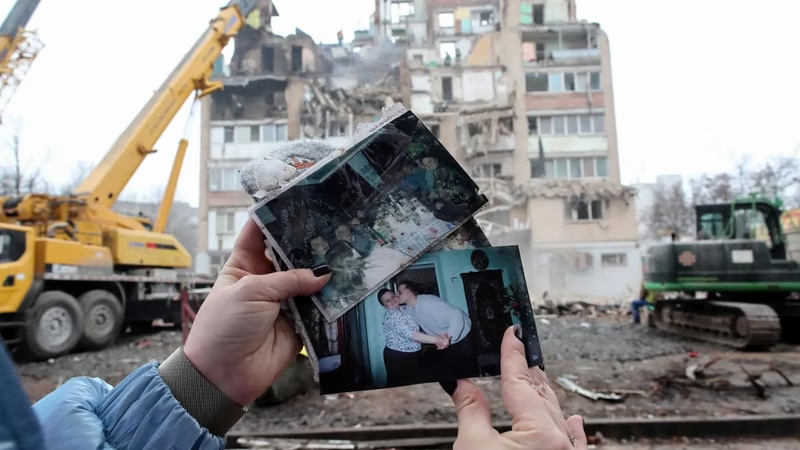
Forget resolutions for fitness or career goals. For millions of Ukrainians, the only wish for 2026 is stark, simple, and heartbreaking: “May this hell end.” These aren’t dramatic words—they’re the quiet, repeated pleas of people who’ve lived through nearly four years of relentless bombing, displacement, and loss. In interviews and social media posts, Ukrainian citizens from Kyiv to Kharkiv, from frontline villages to refugee communities in Europe, have shared their hopes for the new year. And almost universally, they converge on one desire: peace. This isn’t just news—it’s a human cry echoing across a war-torn nation.
Table of Contents
- What Ukrainians Are Saying About 2026
- Ukrainians’ 2026 Wish: A Nation United by Grief and Hope
- The Human Toll Behind the Headlines
- Children of War: The Most Heartbreaking Wishes
- From Frontline Soldiers to Refugees: Diverse Voices, Same Prayer
- Why the World Can’t Look Away
- What Peace Really Means for Ukraine
- Conclusion
- Sources
What Ukrainians Are Saying About 2026
In raw, unfiltered interviews captured by international media and local journalists, Ukrainians have opened up about their deepest hopes. A grandmother in Lviv, whose son died defending Mariupol in 2022, said: “I don’t need presents. I just want to hear birds again, not air raid sirens.” A teenage girl in a basement shelter in Odesa wrote on social media: “My 2026 wish? To finish school without hiding under my desk.”
Others are more direct. “Stop the war,” “Bring our boys home,” and “Let us sleep through the night” are recurring themes. These aren’t political statements—they’re human necessities long denied.
Ukrainians’ 2026 Wish: A Nation United by Grief and Hope
What’s striking about the Ukrainians’ 2026 wish is its universality. It cuts across age, region, and political affiliation. Whether they’re in government-held territories, occupied zones, or abroad as refugees, the core desire remains the same: an end to violence. This shared longing has become a unifying force in a country fractured by war.
Even President Volodymyr Zelenskyy, in his New Year address, echoed this sentiment—not with triumphalism, but with somber resolve: “Peace is not surrender. Peace is victory for every mother who wants her child back.”
The Human Toll Behind the Headlines
Beyond the wishes, the statistics paint a grim picture:
- Over 10,000 civilians killed, per UN estimates—with actual numbers likely much higher .
- Nearly 4 million Ukrainians displaced internally, and over 6 million living as refugees across Europe.
- More than 30% of Ukraine’s energy infrastructure destroyed, leaving millions without heat or light during winter.
- An entire generation of children—5.3 million—exposed to severe psychological trauma .
These numbers aren’t abstract. They’re the reason a baker in Dnipro wishes only “to open his shop without fear,” or why a nurse in Zaporizhzhia prays “for no more amputations.”
Children of War: The Most Heartbreaking Wishes
Perhaps the most moving accounts come from children. In a UNICEF-led initiative, Ukrainian kids were asked to draw their “wish for 2026.” The results were devastating: crayon drawings of broken houses, tanks, and stick-figure families holding hands under a single word: “PEACE.”
One 8-year-old from Kherson wrote: “I want my dog back. He ran away when the bombs fell.” Another, now in a Polish school, said: “I miss my dad. He’s at the front. I just want him to come home and tuck me in.” These aren’t grand geopolitical demands—they’re the basic needs of childhood, stripped away by conflict.
From Frontline Soldiers to Refugees: Diverse Voices, Same Prayer
The wish for peace extends even to those fighting the war. Soldiers on rotation in the Donbas region have shared that their New Year hope isn’t victory in a specific battle, but “to survive and see my daughter grow up.”
Meanwhile, Ukrainian refugees in Germany, Romania, and Poland express guilt for being safe while their families endure shelling. “My 2026 wish is to go home,” said a software engineer now living in Berlin, “even if the apartment is gone, as long as my street is quiet.”
Why the World Can’t Look Away
The Ukrainians’ 2026 wish matters beyond Ukraine’s borders. It’s a moral mirror for the international community. As war fatigue sets in among Western allies, these personal pleas remind us that this isn’t a distant conflict—it’s an ongoing humanitarian catastrophe.
Organizations like the International Committee of the Red Cross warn that funding gaps are growing, even as needs intensify. Ignoring these wishes isn’t just indifference—it’s complicity in prolonging suffering.
What Peace Really Means for Ukraine
For Ukrainians, “peace” doesn’t mean capitulation. It means security, sovereignty, and the chance to rebuild. Many emphasize they want a peace that ensures such aggression never happens again—through strong defense guarantees and international accountability for war crimes.
As one Kyiv-based journalist put it: “We don’t dream of utopia. We dream of normalcy. Of coffee shops, school plays, and weekend traffic jams. Is that too much to ask for in 2026?” For context on Ukraine’s post-war vision, see our feature on [INTERNAL_LINK:ukraine-reconstruction-challenges].
Conclusion
The Ukrainians’ 2026 wish is not a demand for miracles—just for an end to the unbearable. In their simplicity, these wishes carry immense power. They remind us that behind every geopolitical strategy and military update are real people clinging to the most basic human hope: to live without fear. As the world charts its course in 2026, it would do well to listen to these voices. Because peace isn’t just a policy outcome—it’s a promise to the human spirit.