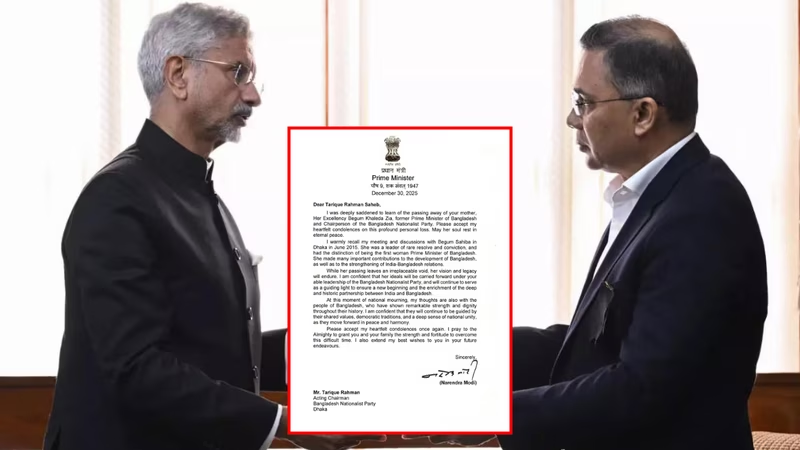
In the tightly scripted world of international diplomacy, a single phrase can carry the weight of policy—or provoke a storm of speculation. That’s exactly what happened when Prime Minister Narendra Modi, in a personal letter to Tarique Rahman—the son of Bangladesh’s former Prime Minister Khaleda Zia—described her as a “leader of rare resolve.” The letter, released publicly by Rahman’s Bangladesh Nationalist Party (BNP), has sent ripples through South Asian political circles, raising eyebrows in Dhaka, Delhi, and beyond. Is this a genuine tribute, a strategic diplomatic nudge, or something more nuanced? Let’s unpack the message behind the words.
Table of Contents
- What Did PM Modi’s Letter Say?
- PM Modi Letter to Tarique Rahman: Context and Timing
- Who Is Khaleda Zia—and Why Does She Matter?
- Tarique Rahman and the BNP’s Current Struggle
- India’s Diplomatic Tightrope with Bangladesh
- Why a Letter Carries More Than Words
- Reactions from Dhaka and Delhi
- Conclusion
- Sources
What Did PM Modi’s Letter Say?
Addressed to Tarique Rahman, who lives in exile in London, PM Modi’s letter expressed condolences on the passing of Rahman’s wife, Zubaida Rahman. While the primary tone was one of personal sympathy, the most quoted line was this: “Your mother [Khaleda Zia] has been a leader of rare resolve who has contributed immensely to the democratic journey of Bangladesh.”
The letter went on to recall Khaleda Zia’s tenure as Prime Minister and her role in regional cooperation. Though brief, the phrasing was deliberate—calling her not just a “leader,” but one of “rare resolve,” a term loaded with moral and political weight.
PM Modi Letter to Tarique Rahman: Context and Timing
The timing of the letter is crucial. Bangladesh is nearing a pivotal political juncture. The ruling Awami League, led by Prime Minister Sheikh Hasina, has consolidated power over the past decade, while the main opposition BNP—founded by Khaleda Zia—has been systematically marginalized. Khaleda herself is under house arrest, and her son Tarique, the de facto BNP leader, remains barred from returning to Bangladesh .
India has historically maintained close ties with the Awami League, seen as a stable, secular partner. Openly praising the opposition’s iconic leader—even in a condolence letter—is a notable departure from this cautious neutrality. It raises the question: Is India signaling a recalibration of its Bangladesh policy?
Who Is Khaleda Zia—and Why Does She Matter?
Khaleda Zia, widow of Bangladesh’s military ruler turned president Ziaur Rahman, served as Prime Minister three times (1991–1996, 2001–2006). She is one of the most powerful women in South Asian political history and the arch-rival of current PM Sheikh Hasina.
Her legacy is complex: credited with economic liberalization and women’s empowerment, yet also associated with political violence and alleged corruption. In 2018, she was sentenced to prison in a graft case widely condemned by international human rights groups as politically motivated .
To many in Bangladesh’s opposition, she remains a symbol of resistance. Modi’s acknowledgment of her “resolve” is thus not just biographical—it’s deeply political.
Tarique Rahman and the BNP’s Current Struggle
Tarique Rahman, once seen as Khaleda’s political heir, has led the BNP from exile since 2008. The party has boycotted recent elections, calling them a “farce,” and has struggled to mobilize mass protests amid severe state repression.
Receiving a letter from India’s Prime Minister—even a private one—offers the BNP a rare moment of international legitimacy. They quickly published it on party platforms, framing it as global recognition of their cause. For Rahman, this is more than a condolence; it’s a diplomatic lifeline.
India’s Diplomatic Tightrope with Bangladesh
India’s relationship with Bangladesh is one of its most vital in South Asia. Dhaka is a key partner on trade, counter-terrorism, and connectivity projects like the BBIN (Bangladesh-Bhutan-India-Nepal) initiative. The Modi government has invested heavily in this partnership, especially under Sheikh Hasina’s leadership.
However, over-reliance on one political faction carries long-term risk. If the Awami League’s dominance weakens—or if a political transition occurs—India could find itself isolated from a new ruling elite. Modi’s letter may be a subtle hedge, ensuring India maintains channels with all major political forces in Dhaka, not just the current incumbents.
This aligns with India’s broader “neighborhood first” policy, which emphasizes engagement beyond just ruling governments. For more on India’s evolving neighborhood diplomacy, see our analysis on [INTERNAL_LINK:india-bangladesh-strategic-partnership].
Why a Letter Carries More Than Words
In diplomacy, personal letters from heads of state are never casual. They are vetted by foreign ministries and carry implicit signals. By choosing to highlight Khaleda Zia’s “resolve” and “democratic contribution,” Modi is doing more than offering condolences—he’s affirming her place in Bangladesh’s democratic narrative, a narrative the current regime has sought to rewrite.
Importantly, Modi stopped short of criticizing the Hasina government or calling for Khaleda’s release. The message is calibrated: respectful, non-confrontational, yet unmistakably supportive of political pluralism.
Reactions from Dhaka and Delhi
Unsurprisingly, Bangladesh’s Foreign Ministry has not issued an official response. But pro-government media in Dhaka have dismissed the letter as “routine diplomatic courtesy,” downplaying its significance .
In India, the move has been praised by some as statesmanlike and criticized by others as meddling. However, the Ministry of External Affairs has maintained that the letter was “personal and humanitarian,” not a comment on Bangladesh’s internal affairs.
Conclusion
The PM Modi letter to Tarique Rahman may seem like a small gesture, but in the high-stakes arena of South Asian politics, it speaks volumes. By honoring Khaleda Zia as a “leader of rare resolve,” Modi has reaffirmed India’s respect for democratic opposition—even in allied nations. Whether this evolves into a broader strategic shift remains to be seen, but one thing is clear: India is no longer betting on a single horse in Dhaka. And that, in itself, is a significant message.
Sources
- Times of India: ‘Leader of rare resolve’: What PM Modi wrote to Khaleda Zia’s son Tarique Rahman
- BBC News: Bangladesh’s Khaleda Zia: From PM to prisoner
- Human Rights Watch: Bangladesh: Former PM Khaleda Zia Sentenced to 5 Years in Jail
- The Daily Star: PM Modi’s letter to Tarique Rahman draws attention