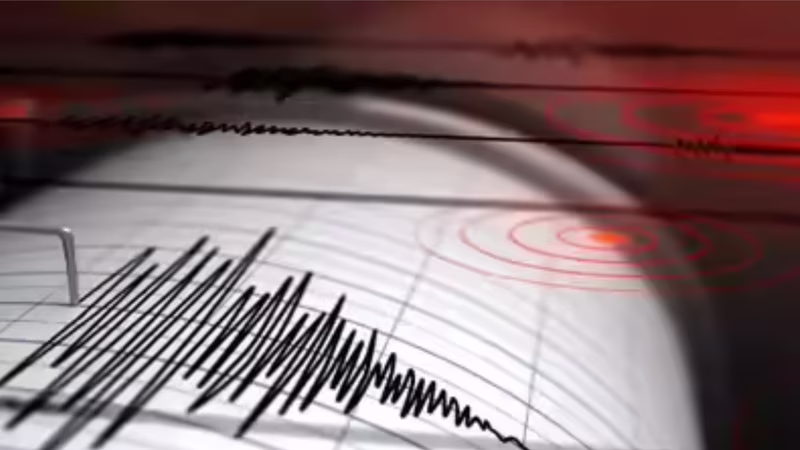
Early on the morning of January 1, 2026, the ground shook beneath eastern Japan as a magnitude 6.0 earthquake in Japan struck approximately 35 kilometers east of Noda City in Chiba Prefecture. The quake, which hit at 5:47 a.m. local time, sent tremors rippling across the Greater Tokyo Area, waking residents and briefly halting train services—but remarkably, authorities have confirmed no immediate injuries or significant structural damage .
Japan, one of the most seismically active nations on Earth, is no stranger to quakes. Yet every major tremor serves as a stark reminder of the country’s precarious position on the Pacific Ring of Fire and the razor-thin margin between preparedness and catastrophe. This latest event—while moderate by Japan’s high standards—has once again spotlighted the nation’s world-class early warning systems, resilient infrastructure, and the ever-present risk that a larger disaster could be just around the corner.
Table of Contents
- Earthquake Details: Magnitude, Location, and Impact
- Japan’s Early Warning System in Action
- Why Japan Is So Prone to Earthquakes
- No Casualties—but a Wake-Up Call
- What to Do During an Earthquake in Japan
- Conclusion: Living on the Edge of the Ring of Fire
- Sources
Earthquake Details: Magnitude, Location, and Impact
According to the Japan Meteorological Agency (JMA), the earthquake in Japan registered at a depth of 40 kilometers, classifying it as an intermediate-depth quake—a factor that likely helped mitigate surface damage . The epicenter was located in the Pacific Ocean off the coast of Chiba Prefecture, a region densely populated and economically vital due to its proximity to Tokyo.
Shaking was felt as far as central Tokyo, with the JMA assigning a maximum seismic intensity of 5-lower on its 7-point scale—a level that can cause unsecured furniture to topple and make walking difficult, but rarely results in building collapse in modern structures .
Key impacts included:
- Temporary suspension of local train lines, including the JR Sobu Line and Keisei Main Line.
- No disruptions reported at Narita or Haneda airports.
- No abnormalities detected at nearby nuclear power facilities, including the Fukushima Daiichi site .
Japan’s Early Warning System in Action
Within seconds of the initial tremor, Japan’s Earthquake Early Warning (EEW) system issued alerts to millions of smartphones and broadcast networks across the Kanto region. This system, considered one of the most advanced in the world, detects primary (P) waves—less damaging but faster-moving—and uses them to predict the arrival of destructive secondary (S) waves .
For residents, this can mean 10–30 seconds of critical lead time to take cover, stop elevators, or halt bullet trains. In this instance, the EEW functioned flawlessly, showcasing why Japan remains a global model for seismic resilience—even as scientists warn that the country remains overdue for a “megaquake” along the Nankai Trough .
Why Japan Is So Prone to Earthquakes
Japan sits at the volatile intersection of four tectonic plates: the Pacific, Philippine Sea, Eurasian, and North American plates. This geological crossroads makes it part of the Pacific Ring of Fire, a horseshoe-shaped zone responsible for over 90% of the world’s earthquakes .
On average, Japan experiences over 1,500 perceptible quakes annually. While most are minor, major events like the 2011 Tōhoku earthquake (magnitude 9.0) serve as grim reminders of the nation’s vulnerability. The current quake near Noda, while significant, is considered routine in this high-risk context—but it underscores the constant need for vigilance.
No Casualties—but a Wake-Up Call
The absence of injuries is a testament to Japan’s strict building codes, public education, and disaster drills. Since the 1995 Kobe earthquake, Japan has mandated base-isolation technology and reinforced concrete standards that allow skyscrapers to sway rather than shatter .
However, experts caution against complacency. “Every moderate quake like this is a stress test—and a reminder that the next one could be far worse,” says Dr. Kenji Satake, a seismologist at the University of Tokyo . With Japan’s population aging and some rural areas underprepared, the human cost of a future megaquake remains a serious concern.
What to Do During an Earthquake in Japan
For residents and travelers alike, knowing how to respond can save lives. Japanese authorities recommend the following steps:
- Drop, Cover, and Hold On: Get under a sturdy table and protect your head.
- Stay Indoors: Do not run outside—falling glass and debris are major hazards.
- After the Shaking Stops: Check for gas leaks, open doors to prevent jamming, and listen to official alerts via NHK or the Y!防災速報 app.
- Know Your Evacuation Route: Every neighborhood has designated evacuation centers—familiarize yourself in advance .
For more on staying safe in disaster-prone regions, see our guide on [INTERNAL_LINK:Travel-Safety-in-Japan].
Conclusion: Living on the Edge of the Ring of Fire
The magnitude 6.0 earthquake in Japan near Noda was a powerful, yet controlled, demonstration of nature’s force—and human resilience. While Thursday’s tremor caused alarm, it also reaffirmed why Japan leads the world in earthquake readiness. Still, as scientists continue to monitor rising stress along major fault lines, the message is clear: preparedness isn’t optional. It’s a way of life. And in a nation where the earth never truly sleeps, that vigilance could mean the difference between life and death.
Sources
- Times of India: Earthquake in Japan: Magnitude 6 quake jolts East of Noda
- Japan Meteorological Agency (JMA): Earthquake Information and Early Warning
- NHK World: Magnitude 6.0 Quake Hits Off Chiba Prefecture
- US Geological Survey (USGS): M 6.0 – 35 km E of Noda, Japan
- National Research Institute for Earth Science and Disaster Resilience (NIED): Real-time Earthquake Data
- UN Office for Disaster Risk Reduction: Japan: A Global Leader in Disaster Risk Reduction
- The Guardian: Japan on High Alert for Imminent Megaquake