The quiet streets of Nagpur were thrust into the national spotlight this week after police arrested a local Christian priest and 11 members of his congregation during a routine prayer meeting. The incident, which occurred in a residential neighborhood, has since spiraled into a major political and constitutional crisis, with the Indian National Congress denouncing it as a blatant attack on religious freedom and a symptom of a deeper, state-endorsed agenda of intolerance. At the heart of the controversy is the Nagpur Christian priest arrest—a moment that has reignited fierce debate over minority rights, the role of vigilante groups, and the health of India’s secular democracy in 2026.
Table of Contents
- What Happened in Nagpur: The Arrest That Sparked Outrage
- Congress’s Fury and Its Demands for Justice
- The Bajrang Dal Connection: Allegations of Vigilantism
- Broader Patterns: Religious Freedom Under Pressure
- Legal and Constitutional Implications
- Conclusion: A Test for India’s Secular Fabric
- Sources
What Happened in Nagpur: The Arrest That Sparked Outrage
According to local reports, police in Nagpur raided a private home where a small group of Christians—including Father John D’Silva—were holding a prayer meeting. The authorities cited complaints from neighbors, allegedly instigated by members of the right-wing group Bajrang Dal, claiming the gathering was “illegal” and involved “forced conversions” .
Despite no evidence of coercion and the priest’s insistence that the meeting was peaceful and consensual, all 12 individuals were taken into custody. The FIR (First Information Report) filed under controversial anti-conversion laws has been widely criticized by legal experts as a misuse of legislation meant to prevent fraud, not to criminalize private worship .
Congress’s Fury and Its Demands for Justice
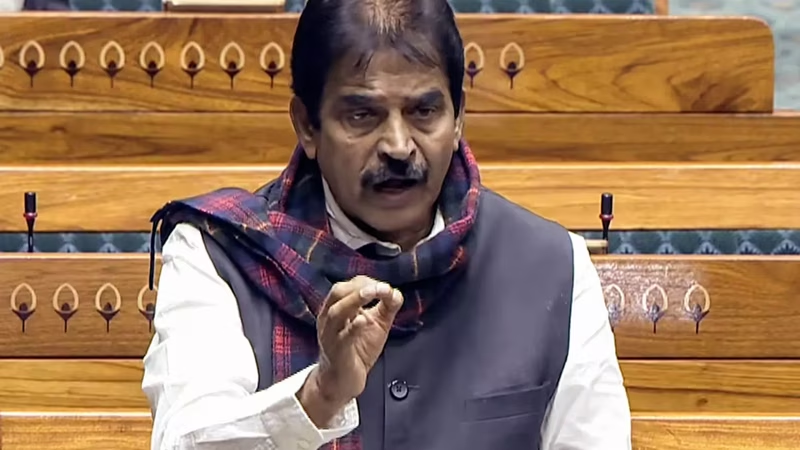
The Congress party responded swiftly and forcefully. Senior leader and MP KC Venugopal condemned the arrests as “shameful” and “an assault on the soul of the Constitution.” Kerala Leader of Opposition VD Satheesan echoed this sentiment, calling the incident “state-sponsored bigotry” and demanding that the FIR be immediately withdrawn .
The party has issued a three-point demand:
- Immediate withdrawal of the FIR against the priest and attendees.
- Disciplinary action against the police officers who authorized the raid without due cause.
- Legal and administrative action against Bajrang Dal activists who allegedly pressured authorities to act .
“This is not just about one priest in Nagpur,” Venugopal stated. “This is about whether a Christian, a Muslim, or any minority can practice their faith in peace in today’s India.”
The Bajrang Dal Connection: Allegations of Vigilantism
Multiple eyewitnesses and local church leaders allege that Bajrang Dal members had been monitoring the prayer group for weeks, spreading misinformation and pressuring local authorities to intervene. The group, known for its aggressive stance on religious conversions, has a documented history of such actions across Maharashtra and other states .
Critics argue that the police’s swift compliance—with no prior warning or attempt at mediation—suggests a troubling alignment between law enforcement and right-wing pressure groups. This pattern, they say, is part of a larger strategy to intimidate minority communities and normalize their marginalization.
Broader Patterns: Religious Freedom Under Pressure
The Nagpur Christian priest arrest is not an isolated event. According to the U.S. Commission on International Religious Freedom (USCIRF), incidents of harassment against religious minorities in India have risen significantly since 2020, with anti-conversion laws being weaponized in at least 10 states .
Human rights organizations like Amnesty International have repeatedly warned that these laws create a “chilling effect,” discouraging interfaith dialogue and enabling mob vigilantism under the guise of legal compliance . In Maharashtra, civil society groups report a 40% increase in complaints related to religious intimidation over the past two years.
Legal and Constitutional Implications
Article 25 of the Indian Constitution guarantees all citizens “the right to freely profess, practice and propagate religion.” Legal scholars argue that the Nagpur arrests directly violate this fundamental right. The Supreme Court has previously ruled that “propagation” includes the right to share one’s faith, provided it is not coercive—a standard clearly met in this private prayer setting .
The misuse of anti-conversion statutes, often vaguely worded, sets a dangerous precedent. It shifts the burden of proof onto the accused and empowers local officials to act on flimsy or malicious complaints—a recipe for systemic injustice.
Conclusion: A Test for India’s Secular Fabric
The arrest of a priest during a peaceful prayer meeting should be unthinkable in a democracy that prides itself on pluralism. Yet, the Nagpur Christian priest arrest forces us to confront an uncomfortable reality: that for many minorities, the promise of constitutional freedom is increasingly under threat. The Congress’s strong stance reflects a growing national anxiety about the erosion of secular norms. How the Maharashtra government responds—whether with accountability or silence—will signal whether India’s democratic institutions can still protect its most vulnerable. For more on the state of civil liberties in India, see our in-depth report on [INTERNAL_LINK:Religious-Freedom-in-India].
Sources
- Times of India: Cong slams arrest of Nagpur Christian priest; demands action against Bajrang Dal
- The Hindu: Congress leaders condemn Nagpur priest arrest
- Indian Express: Nagpur: Christian priest arrested during prayer meeting
- NDTV: Congress demands action against Bajrang Dal over Nagpur priest arrest
- Human Rights Watch: India: Events of 2025
- U.S. Commission on International Religious Freedom (USCIRF): India Country Report 2025
- Supreme Court of India: Judgments on Religious Freedom (Stanislaus v. State of Madhya Pradesh)