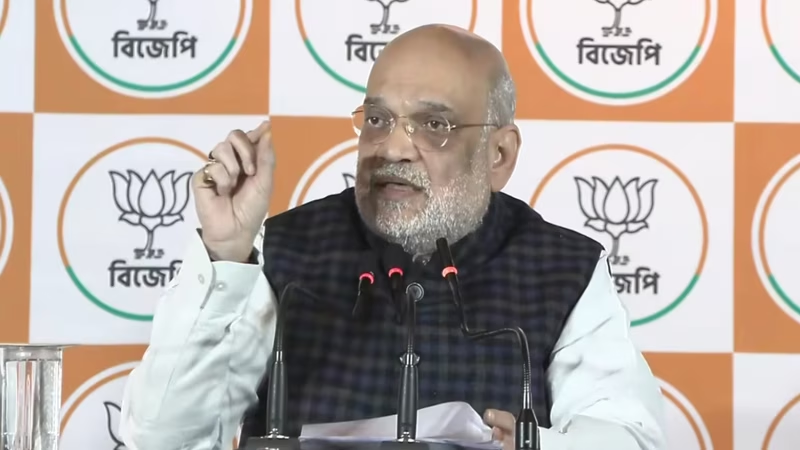
The battle for West Bengal has officially begun—and Union Home Minister Amit Shah isn’t leaving anything to chance. In a high-stakes meeting with BJP leaders and workers, Shah dropped a political bombshell: from now on, every party representative must spend at least four days a week in their constituencies, hold daily street-corner meetings, and prove their grassroots muscle—or risk being denied a ticket in the Bengal polls 2026. This isn’t just a pep talk; it’s a full-scale operational overhaul designed to break the Trinamool Congress’s decade-long stronghold by embedding the BJP into the very fabric of Bengali society.
Table of Contents
- Shah’s New Ground Rules for BJP Cadre
- The Dilip Ghosh Factor: A Strategic Comeback
- Why Grassroots Matters in West Bengal
- BJP’s 2021 Failure and the 2026 Redemption Quest
- What This Means for Trinamool Congress
- Conclusion: The Streets Will Decide Bengal Polls 2026
- Sources
Shah’s New Ground Rules for BJP Cadre
Amit Shah, known for his ruthless organizational discipline, has laid down a crystal-clear mandate: performance will be the sole criterion for ticket distribution. Gone are the days of loyalty-based nominations. Now, every BJP worker must demonstrate tangible results on the ground .
The new protocol includes:
- Four-day weekly field presence: Leaders must be physically present in their constituencies for a minimum of four days every week.
- Daily street-corner meetings: Small, hyper-local gatherings to address citizen grievances and build personal rapport.
- Door-to-door outreach: Systematic voter contact programs targeting unengaged and swing households.
- Performance dashboards: Digital tracking of outreach metrics to ensure accountability .
This move signals a dramatic shift from the BJP’s 2021 campaign, which relied heavily on top-down rallies and national messaging but failed to connect at the booth level .
The Dilip Ghosh Factor: A Strategic Comeback
Perhaps the most telling sign of the BJP’s recalibration is the renewed prominence of former West Bengal state chief Dilip Ghosh. Once sidelined after the 2021 electoral setback, Ghosh is now being positioned as a key architect of the party’s ground game .
Known for his sharp tongue and deep organizational knowledge of rural Bengal, Ghosh’s return isn’t just symbolic—it’s tactical. His understanding of local caste dynamics, community pain points, and grassroots networks is seen as indispensable for penetrating TMC’s village-level strongholds. Shah’s implicit message is clear: if anyone can turn the BJP into a truly local force, it’s Ghosh.
Why Grassroots Matters in West Bengal
West Bengal’s political landscape is uniquely resistant to national wave elections. Here, power flows from the panchayat (village council) upward, not the other way around. The Trinamool Congress has mastered this bottom-up model, using a vast network of local leaders to deliver services, settle disputes, and secure votes .
According to a Princeton University study on subnational politics in India, parties that fail to institutionalize local presence in Bengal consistently underperform, regardless of national sentiment . Shah’s directive is a direct acknowledgment of this reality. The BJP isn’t just campaigning—it’s attempting to build a parallel governance ecosystem.
BJP’s 2021 Failure and the 2026 Redemption Quest
In 2021, the BJP threw everything it had at Bengal: massive rallies, national leaders, and a relentless media blitz. Yet, it won only 77 seats against TMC’s 213. Post-mortems revealed a critical flaw: the party had a loud voice but no ears on the ground. It spoke at voters, not with them .
The Bengal polls 2026 strategy is a direct course correction. By forcing its cadre into daily, unglamorous street work, the BJP hopes to cultivate trust, not just noise. It’s a long game—but Shah knows that in Bengal, patience and persistence win elections.
What This Means for Trinamool Congress
Mamata Banerjee’s TMC is not standing still. Already, the party has launched counter-mobilization drives and is leveraging its existing panchayat networks to inoculate voters against BJP’s new outreach. However, Shah’s move puts immense pressure on TMC’s local machinery, which has grown complacent in many areas .
If the BJP can successfully replicate even 30% of TMC’s grassroots density, it could dramatically alter seat calculations—especially in the southern and western districts where margins are thin.
Conclusion: The Streets Will Decide Bengal Polls 2026
Amit Shah’s directive marks a pivotal moment in the BJP’s Bengal journey. The party is betting that relentless, disciplined, and personal grassroots engagement—not just big speeches—will be the key to unlocking power in 2026. With Dilip Ghosh back in the fold and a performance-based ticket system, the BJP is signaling that it’s ready to fight for every vote, on every street corner. The Bengal polls 2026 will not be won in stadiums, but in the soil of Bengal’s villages and neighborhoods. For more on India’s evolving electoral map, explore our analysis on [INTERNAL_LINK:Indian-Election-Strategies].
Sources
- Times of India: Bengal polls 2026: Shah sets ground rules for BJP cadre
- The Hindu: Dilip Ghosh returns to BJP Bengal front
- India Today: BJP’s Bengal 2026 strategy: Amit Shah’s grassroots push
- Scroll.in: Why BJP lost West Bengal elections 2021
- Business Standard: BJP learns from 2021 Bengal defeat for 2026 battle
- NDTV: TMC counters BJP grassroots push ahead of 2026 polls
- Economic and Political Weekly: The Political Economy of West Bengal’s Panchayats
- Princeton University: Local Governance and Electoral Outcomes in India