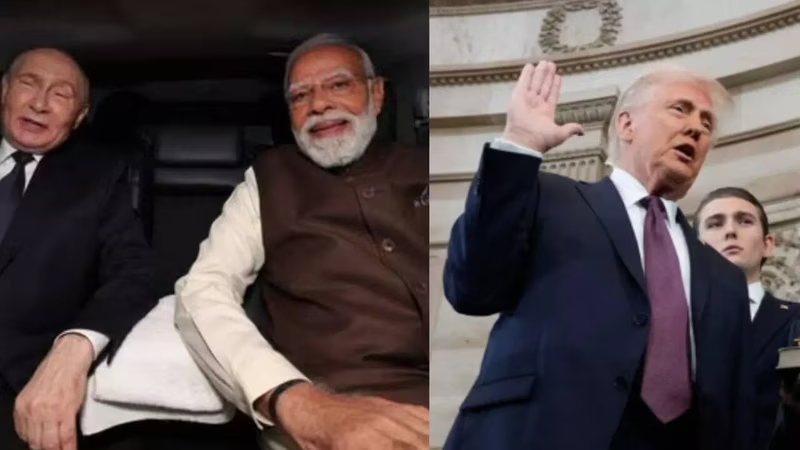
If a picture is worth a thousand words, then 2025 screamed its story from every newsfeed. It was a year of comebacks, resignations, unlikely alliances, and surreal symbolism. From the frosty January morning when Donald Trump raised his hand on the Capitol steps to the viral image of India’s Prime Minister Narendra Modi casually carpooling with a yellow Pikachu plushie on his dashboard, world politics 2025 played out in a series of visually arresting moments that transcended headlines. These weren’t just photographs—they were cultural artifacts that defined a tumultuous, transformative year on the global stage.
Table of Contents
- Trump Takes Back the White House
- Modi’s Carpool Diplomacy Goes Viral
- Trudeau’s Shock Resignation and Its Aftermath
- Hostages Freed and Nepal Protests Ignite Change
- Why These Images Matter in World Politics 2025
- Conclusion: A Year Written in Pixels and Power
- Sources
Trump Takes Back the White House
The single most dominant image of world politics 2025 was undoubtedly Donald Trump’s inauguration on January 20. After a fiercely contested election and years of legal battles, his return to the presidency sent shockwaves across the globe. The photo of him taking the oath of office, flanked by a mix of loyalists and unexpected new allies, wasn’t just a political event—it was a cultural reset .
This moment immediately reshaped U.S. foreign policy, with Trump moving swiftly to renegotiate trade deals and challenge long-standing NATO commitments. His first diplomatic handshake—with a visibly cautious European leader—became an instant meme, symbolizing the uncertainty that his second term injected into international relations .
Modi’s Carpool Diplomacy Goes Viral
In a year full of gravitas, one of the most talked-about images was also the most whimsical: Prime Minister Narendra Modi, during a low-key commute in New Delhi, was photographed with a Pikachu plushie sitting in the passenger seat of his official car. The image, initially shared by a local journalist, exploded online, sparking millions of shares and endless speculation .
Was it a gift from his grandniece? A subtle nod to Japan’s pop culture ahead of a state visit? Or just a humanizing moment for a world leader often seen as austere? Regardless of the reason, the photo became a global sensation, showcasing a softer, more relatable side of diplomacy in the social media age. It was dubbed “carpool diplomacy” and even inspired a wave of similar photos from other leaders trying to seem approachable .
Trudeau’s Shock Resignation and Its Aftermath
Canada’s political landscape shifted dramatically in mid-2025 when Justin Trudeau announced his resignation, citing “personal reasons and a need for renewal.” The image of him stepping down at Rideau Cottage, surrounded by a somber cabinet, marked the end of an era .
His departure came amid growing internal party dissent and declining approval ratings, but the timing caught many off guard. The power vacuum quickly ignited a leadership race that has since redefined the Liberal Party’s direction and Canada’s role in global climate and trade negotiations .
Hostages Freed and Nepal Protests Ignite Change
2025 also delivered moments of profound relief and resistance. A widely circulated photo showed a group of international hostages—held for months in a conflict zone—being greeted by tearful families upon their release. The image, captured by a Reuters photographer, became a symbol of fragile hope in a year often defined by division .
Meanwhile, in Nepal, a new wave of youth-led protests—sparked by frustrations over corruption and digital rights—filled the streets of Kathmandu. One iconic photo showed a young demonstrator holding a smartphone displaying a pixelated image of the national flag, standing firm against a line of riot police. This visual encapsulated the Gen Z political awakening that swept across multiple continents in 2025 .
Why These Images Matter in World Politics 2025
These five defining photos share a common thread: they capture the duality of modern politics—its raw power and its human vulnerability. In an age of deepfakes and information overload, authentic, unscripted images cut through the noise. They:
- Humanize distant leaders (Modi’s Pikachu)
- Signal major geopolitical shifts (Trump’s return)
- Document democratic transitions (Trudeau’s exit)
- Amplify citizen resistance (Nepal protests)
- Offer global catharsis (hostage release)
According to media scholars at the Brookings Institution, visual storytelling has become the primary language of 21st-century political communication, with Gen Z and Millennials consuming news primarily through image and video snippets .
Conclusion: A Year Written in Pixels and Power
2025 will be remembered not just for what happened, but for how it looked. The resurgence of Trump, the quiet charm of Modi’s commute, the solemn end of Trudeau’s tenure—these moments, frozen in time, tell the story of a world in flux. As we move into 2026, these images serve as both a mirror and a warning: in world politics 2025, perception is power, and a single frame can alter the course of history. For more on how visual media is reshaping democracy, check out our feature on [INTERNAL_LINK:Visual-Politics-and-Democracy].
Sources
- Times of India: Trump’s return, PM Modi’s carpool & Pikachu: Images that defined world politics in 2025
- Al Jazeera: Gen Z protests in Nepal, 2025
- The New York Times: Trump Inaugurated as 47th U.S. President
- Reuters: International Hostages Released After Months in Captivity
- Canadian Broadcasting Corporation (CBC): Justin Trudeau Announces Resignation as Prime Minister
- Foreign Policy: Trump 2.0: The Foreign Policy Shakeup Begins
- The Hindu: PM Modi’s Pikachu Photo Goes Viral
- Brookings Institution: The Rise of Visual Politics in the Digital Age