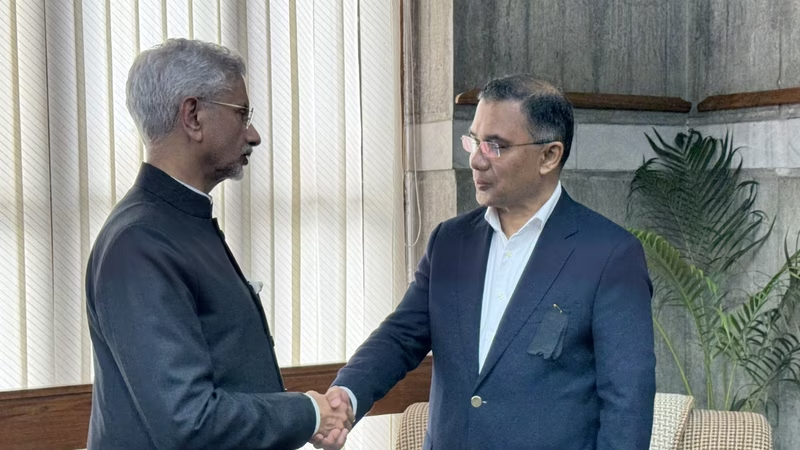
In a significant diplomatic development, India and Bangladesh are signaling a reset in their relationship—one that’s being described by Dhaka’s top envoy as the beginning of a “new chapter.” The upbeat tone comes on the heels of External Affairs Minister Dr. S. Jaishankar’s high-stakes visit to Dhaka in late December 2025, his first official trip to Bangladesh since the country’s political transition earlier this year.
Speaking to Indian media, Bangladesh’s High Commissioner to India, Mustafizur Rahman, emphasized that both nations are moving beyond past complexities to forge a future grounded in mutual trust, economic synergy, and regional stability. “This is not just another visit—it’s a strategic recalibration,” he noted, underscoring the depth of ongoing dialogue .
But what exactly is changing? And why does this “new chapter” matter not just for the two neighbors, but for the entire Indo-Pacific region? Let’s unpack the key dimensions of this evolving partnership.
Table of Contents
- The Context Behind Jaishankar’s Dhaka Visit
- India Bangladesh Relations: A Historic Yet Complex Bond
- Key Areas of Collaboration in the ‘New Chapter’
- Addressing Legacy Issues with New Maturity
- Geopolitical Significance in a Shifting South Asia
- What Experts Say About the Future of Bilateral Ties
- Conclusion: Toward a Shared Destiny
The Context Behind Jaishankar’s Dhaka Visit
Jaishankar’s trip to Dhaka took place against a backdrop of major political change in Bangladesh. Following national elections and the formation of a new government in 2025, both New Delhi and Dhaka have been keen to reaffirm their commitment to a stable, forward-looking partnership.
Discussions reportedly covered over a dozen strategic domains—from connectivity and trade to security and climate resilience. Notably, the visit was marked by warmth and substantive outcomes, including agreements to accelerate the BBIN (Bangladesh-Bhutan-India-Nepal) Motor Vehicles Agreement and deepen cooperation in renewable energy.
As the Ministry of External Affairs confirmed, the two sides also agreed to hold the next round of Foreign Office Consultations in early 2026, signaling institutional continuity .
India Bangladesh Relations: A Historic Yet Complex Bond
The relationship between India and Bangladesh is rooted in shared history—most notably India’s support during Bangladesh’s 1971 Liberation War. But like any long-term partnership, it has seen its share of friction: water-sharing disputes (notably over the Teesta River), border management challenges, and occasional trade imbalances.
Yet, the last decade has witnessed remarkable progress. Land boundary agreements were finalized, power and rail connectivity expanded, and defense cooperation deepened. Today, Bangladesh is one of India’s largest development partners in the neighborhood, with over $10 billion in credit lines and infrastructure projects underway.
Key Areas of Collaboration in the ‘New Chapter’
According to both official statements and expert analysis, the “new chapter” focuses on four pillars:
- Economic Integration: Boosting bilateral trade beyond the current $12 billion through simplified customs, digital payments, and MSME linkages.
- Connectivity: Finalizing rail and road corridors like the Akhaura–Agartala line and enhancing port access via Chittagong and Mongla for India’s Northeast.
- Security & Counter-Terrorism: Strengthening intelligence-sharing and joint exercises to combat transnational threats.
- Climate & Blue Economy: Partnering on flood forecasting, coastal resilience, and sustainable fisheries in the Bay of Bengal.
Notably, both nations are also exploring joint ventures in AI, space tech, and digital governance—areas where India’s tech prowess can complement Bangladesh’s youthful, digital-native population.
Addressing Legacy Issues with New Maturity
While the Teesta River water-sharing pact remains pending, diplomats on both sides stress that it’s no longer a “deal-breaker.” Instead, technical committees are working on interim solutions, including better water management and monsoon data sharing.
Similarly, migration and border concerns are being handled through regular Border Haat (market) expansions and upgraded infrastructure along the 4,096-km frontier—proving that even thorny issues can be managed with sustained dialogue.
Geopolitical Significance in a Shifting South Asia
In an era of great-power competition, a strong India-Bangladesh axis serves as a stabilizing force. With China expanding its footprint in the Bay of Bengal through port projects and loans, Dhaka’s reaffirmed partnership with New Delhi sends a clear message about regional agency.
Moreover, closer ties bolster India’s “Neighborhood First” policy and support Bangladesh’s aspiration to graduate from Least Developed Country (LDC) status by 2026—a goal India has pledged to assist through capacity building and market access .
What Experts Say About the Future of Bilateral Ties
“This isn’t just diplomacy—it’s strategic alignment,” says Dr. Anjali Bhardwaj, a South Asia scholar at the Observer Research Foundation. “Both countries recognize that their futures are intertwined, whether it’s managing the Brahmaputra-Meghna river systems or countering climate displacement.”
Others point to cultural soft power—shared language, cinema, and cuisine—as an underutilized asset. With over 20 million Bengalis on both sides of the border, people-to-people ties remain the bedrock of this relationship.
Conclusion: Toward a Shared Destiny
The “new chapter” in India Bangladesh relations isn’t just diplomatic rhetoric—it’s a pragmatic, forward-looking roadmap built on mutual respect and shared aspirations. As EAM Jaishankar and Bangladesh’s leadership deepen engagement, the region stands to benefit from enhanced stability, prosperity, and cooperation.
In a world of fragmentation, this partnership offers a rare model of how neighbors can move beyond history to co-create a better future. And that’s a story worth watching closely in 2026 and beyond.
Sources
- Interview with Bangladesh High Commissioner: Times of India – https://timesofindia.indiatimes.com/india/new-chapter-ahead-bangladesh-envoy-on-eams-dhaka-visit-signals-positive-tone-for-bilateral-ties/articleshow/126274174.cms
- Ministry of External Affairs (India): https://mea.gov.in/
- UNDP Bangladesh LDC Graduation Support: https://www.bd.undp.org/