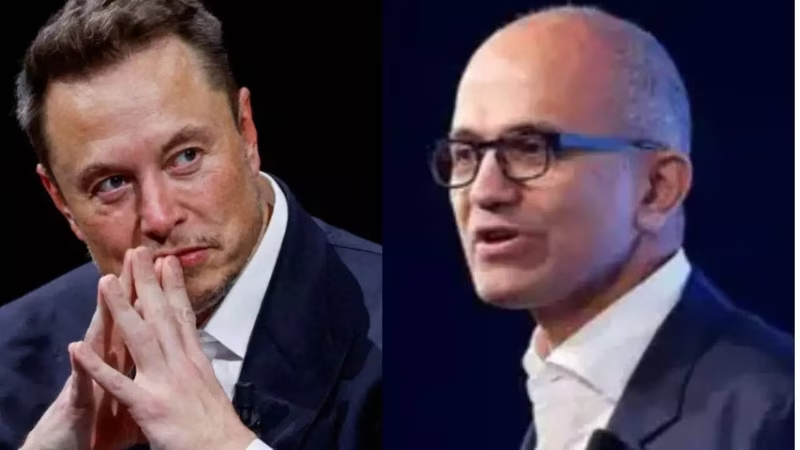
Remember when CEOs signed off on strategy decks while engineers did the real work? That era is over. In 2025, the biggest names in tech—Satya Nadella, Sergey Brin, Elon Musk, Mark Zuckerberg, and Brian Chesky—are going back to basics. They’re not just overseeing AI initiatives; they’re coding, debugging, restructuring teams, and personally shaping product roadmaps. This radical shift has a name: Founder Mode.
Coined to describe leaders who re-immerse themselves in the technical and creative DNA of their companies, Founder Mode represents a survival tactic in the breakneck AI arms race. With generative AI reshaping everything from search to social media to travel, these executives aren’t delegating—they’re leading from the trenches. And the stakes couldn’t be higher.
Table of Contents
- What Is Founder Mode?
- Founder Mode: Why Now? The AI Inflection Point
- How Five Tech CEOs Embraced Founder Mode in 2025
- The Risks and Rewards of Hands-On Leadership
- What This Means for the Future of AI Innovation
- Conclusion: Founder Mode as a Competitive Edge
What Is Founder Mode?
Founder Mode isn’t just nostalgia—it’s a strategic reset. It happens when a company’s top leader, often the original founder or a long-tenured CEO, steps away from purely managerial duties and dives back into product development, engineering, and core innovation. This contrasts with “Manager Mode,” where executives focus on scaling, process, and delegation.
In the context of 2025’s AI explosion, Founder Mode means CEOs are personally involved in:
- Writing or reviewing critical AI model code
- Directing research priorities (e.g., agentic AI vs. multimodal systems)
- Restructuring teams to remove bureaucratic layers
- Setting ethical and safety guardrails for deployment
As AI moves from experimental to existential, these leaders believe only deep technical engagement can ensure their companies don’t fall behind—or worse, ship something dangerous.
Founder Mode: Why Now? The AI Inflection Point
The shift isn’t arbitrary. 2024–2025 marked a turning point: AI went from being a feature to the *entire product*. Google’s search, Meta’s feeds, Microsoft’s cloud—all are now AI-native. One misstep could mean irrelevance.
According to a McKinsey 2025 AI report, companies with founder-led AI strategies are 2.3x more likely to achieve breakthrough innovation compared to those with purely delegated efforts . When billions in market cap hinge on latency, accuracy, and user trust, CEOs are realizing they can’t afford to be several degrees removed from the action.
How Five Tech CEOs Embraced Founder Mode in 2025
Here’s how the biggest names are walking the walk:
1. Satya Nadella (Microsoft)
Nadella, though not a founder, has fully adopted Founder Mode by embedding himself in Microsoft’s AI integration across Azure, Copilot, and GitHub. He’s been spotted in late-night engineering huddles and personally approved the architecture for Microsoft’s new agentic AI framework .
2. Sergey Brin (Google/Alphabet)
After years in semi-retirement, Brin returned to Google’s AI labs in early 2025, working alongside Demis Hassabis on next-gen Gemini models. He’s reportedly coding again and pushing for “bolder, riskier” architectures to counter OpenAI and Microsoft .
3. Elon Musk (xAI & Tesla)
Musk is the poster child for hands-on leadership. He’s not only tweeting about Grok-3 but reviewing pull requests and demanding real-time model improvements. At Tesla, he’s overseeing the AI training for Full Self-Driving v13 himself .
4. Mark Zuckerberg (Meta)
Zuck has made AI his “year of the engineer” priority. He’s restructured Meta into AI-first product teams, scrapped middle management layers, and holds weekly technical reviews on Llama 4 development and AI agent deployment in WhatsApp and Instagram .
5. Brian Chesky (Airbnb)
Less expected but equally committed, Chesky is leading Airbnb’s “AI concierge” initiative, personally testing prototypes and insisting the AI feels “human, not robotic.” He’s even delayed non-AI features to focus all resources on this pivot .
The Risks and Rewards of Hands-On Leadership
Founder Mode isn’t without peril. On one hand, it accelerates decision-making and ensures strategic alignment. On the other, it risks CEO burnout, bottlenecks, and over-centralization.
But in a winner-takes-most AI market, speed and vision trump process. As venture capitalist Marc Andreessen noted, “In platform shifts, the CEO *is* the product manager.” That mindset is now mainstream in Silicon Valley.
What This Means for the Future of AI Innovation
This trend signals a broader truth: AI isn’t just another tech cycle—it’s a renaissance of founder-led innovation. Expect more CEOs to follow suit, especially as open-source models and regulatory scrutiny demand deep technical fluency at the top.
For startups, the message is clear: if your CEO isn’t steeped in your AI stack, you’re already behind.
Conclusion: Founder Mode as a Competitive Edge
The return to Founder Mode isn’t about ego—it’s about urgency. In the AI race, theoretical leadership won’t cut it. Satya, Sergey, Elon, Mark, and Brian understand that the future belongs to those who are willing to get their hands dirty in the code, the data, and the design. As the lines between CEO and chief engineer blur, one thing is certain: the next era of tech won’t be managed—it will be built, line by line, by the leaders themselves.
Sources
- McKinsey Global AI Survey 2025: https://www.mckinsey.com/industries/technology/our-insights/the-state-of-ai-in-2025
- Times of India – “Tech CEOs in Founder Mode 2025”: https://timesofindia.indiatimes.com/technology/tech-news/microsofts-satya-nadella-googles-sergey-brin-and-3-ceos-who-went-into-founder-mode-in-2025-and-how/articleshow/126272090.cms