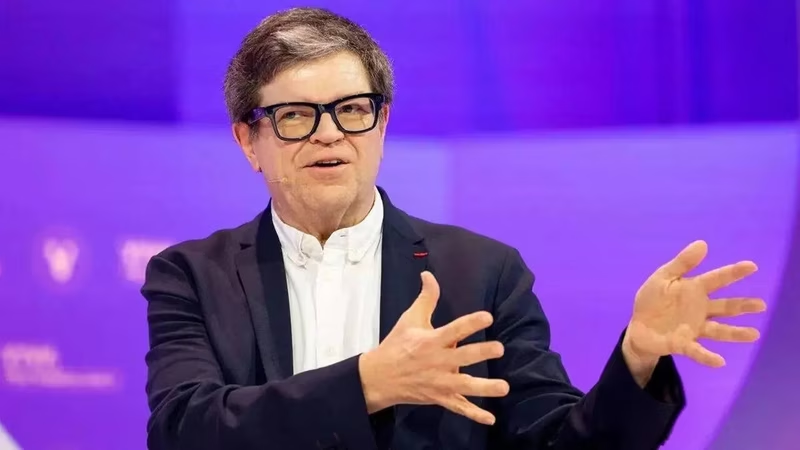
In a move that’s sent shockwaves through Silicon Valley, Yann LeCun—the Turing Award-winning chief AI scientist at Meta—is leaving the company after 12 years to launch his own startup. And what’s his mission? To build an artificial intelligence system capable of reasoning, planning, and understanding the physical world… the very kind of AI that Elon Musk once declared he would “never” pursue.
This isn’t just a career shift—it’s a philosophical rebellion. While Musk warns of “superintelligence” as an existential threat, LeCun believes the path to safe, useful AI lies *through* advanced cognitive capabilities, not around them. Now, free from corporate constraints and backed by what insiders say is significant early-stage funding, LeCun is betting his legacy on proving Musk wrong.
Table of Contents
- Why Yann LeCun Quits Meta
- The AI Musk Said He’d “Never” Build
- Meta Shifts AI Strategy: ScaleAI and New Leadership
- LeCun’s New Vision: Advanced Machine Intelligence
- Implications for the Future of AI
- Conclusion: A New Chapter in the AI Race
- Sources
Why Yann LeCun Quits Meta
LeCun didn’t leave because of money—he was Meta’s highest-paid employee, with a reported $16M+ annual package. Nor was it due to lack of influence; as Chief AI Scientist, he shaped Meta’s foundational research in deep learning for over a decade.
Instead, sources close to the matter say LeCun grew frustrated with Meta’s recent pivot toward short-term, product-driven AI—especially after the company acquired ScaleAI and appointed its founder, Alexandr Wang, to lead key infrastructure efforts. While Wang excels at scaling data pipelines, LeCun’s focus has always been on long-term, architecture-level innovation: building AI that *thinks*, not just predicts.
“He felt the window for foundational research was closing,” said one former colleague. “Meta wants AI that boosts ad relevance today. Yann wants AI that understands causality tomorrow.”
The AI Musk Said He’d “Never” Build
Back in 2023, during a high-profile debate on AI safety, Elon Musk told LeCun point-blank that building AI systems with reasoning and agency was “playing with fire.” Musk, who advocates for strict AI regulation and even a six-month pause on advanced development, argued that such systems could spiral out of control.
LeCun disagreed. He contended that AI without reasoning is just “stochastic parrots”—glorified autocomplete engines incapable of true understanding. In his view, the way to *prevent* dangerous AI isn’t to avoid building smart systems, but to build them with robust safety mechanisms from the ground up.
Now, with his new venture, LeCun is putting his theory into practice. His startup, tentatively named “Advanced Machine Intelligence” (AMI), aims to develop AI with four core pillars: world modeling, memory, causal reasoning, and hierarchical planning.
Meta Shifts AI Strategy: ScaleAI and New Leadership
Meta’s acquisition of ScaleAI wasn’t just a talent grab—it signaled a strategic realignment. ScaleAI specializes in data labeling and training infrastructure, the “plumbing” that powers today’s large language models (LLMs).
By bringing in Alexandr Wang—a young entrepreneur who built ScaleAI into a $7.3B unicorn—Meta signaled it’s doubling down on scaling existing architectures (like Llama) rather than inventing new ones. This shift prioritizes speed-to-market over scientific exploration.
For LeCun, a scientist who once called LLMs “fundamentally flawed,” this direction was untenable. His departure marks the end of an era where blue-sky AI research had a seat at the executive table.
LeCun’s New Vision: Advanced Machine Intelligence
So what will AMI actually build?
Based on LeCun’s recent papers and talks, the startup will likely focus on “world models”—AI systems that construct internal simulations of how objects interact in space and time. Unlike today’s LLMs, which predict the next word, these models would predict the next *state* of the world.
Key capabilities include:
- Episodic Memory: Remembering past interactions and outcomes.
- Causal Inference: Understanding “why” things happen, not just “what” follows.
- Goal-Directed Planning: Breaking complex tasks into sub-goals and executing them.
- Physical Commonsense: Knowing that water flows downhill or glass breaks when dropped.
This isn’t sci-fi. LeCun believes such systems can be built within 5–10 years—and crucially, they’ll be more controllable because their reasoning is transparent, not hidden in billions of opaque parameters.
Implications for the Future of AI
LeCun’s exit is a bellwether moment. It highlights a growing rift in the AI world:
- The Scaling Camp (Meta, OpenAI, Anthropic): Optimize existing models with more data and compute.
- The Architecture Camp (LeCun, Demis Hassabis at DeepMind): Invent new cognitive architectures from first principles.
If LeCun succeeds, he could render today’s LLMs obsolete—much like deep learning did to expert systems a decade ago. If he fails, it may validate Musk’s caution. Either way, the stakes couldn’t be higher.
For a deeper look at next-gen AI architectures, see our analysis on [INTERNAL_LINK:future-of-ai-beyond-llms].
Conclusion: A New Chapter in the AI Race
Yann LeCun quits Meta not to retire, but to wage an intellectual war—one for the soul of artificial intelligence. His mission is audacious: to build AI that reasons like a human but scales like a machine. And in doing so, he’s taking direct aim at the fear-driven narrative championed by Elon Musk. The world will be watching.
Sources
- Times of India: How Meta’s highest-paid employee made its chief scientist do what he told Elon Musk he will ‘never’
- Yann LeCun’s Official Blog: On the Path Towards Autonomous Machine Intelligence
- MIT Technology Review: The Debate Over AI’s Future Direction
- Scale AI: Company Profile and Acquisition News