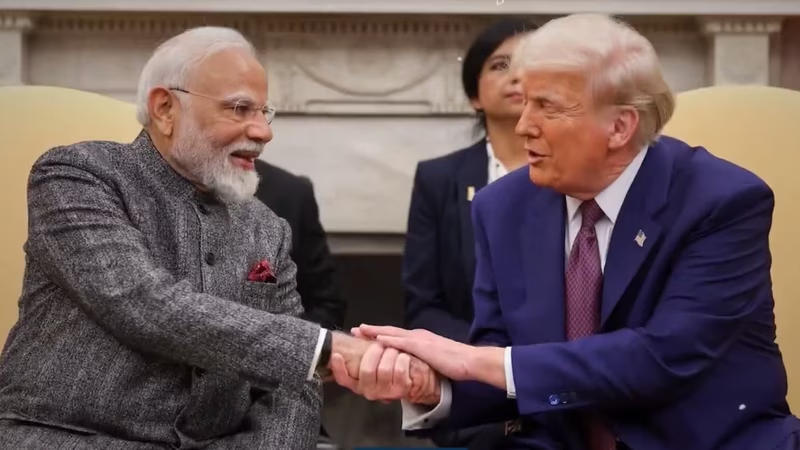
2025 wasn’t just another year in the India–US relationship—it was the year the partnership truly matured from strategic flirtation to committed alliance. In a year marked by geopolitical turbulence, Washington and New Delhi didn’t just talk; they signed, launched, and delivered. Now, the US Embassy in India has officially wrapped up the year with a curated highlight reel—and it’s clear both nations are betting big on a shared future.
From Prime Minister Narendra Modi’s landmark meeting with President Donald Trump to the signing of a game-changing defense pact and ambitious space collaborations, 2025 laid the groundwork for what could become the defining bilateral relationship of the Indo-Pacific era. But beyond the photo ops and press releases, what do these moves really signal? And what can we expect in 2026?
Table of Contents
- India–US Ties 2025: A Year of Strategic Milestones
- The Modi-Trump Summit: Reigniting a Transactional Bond
- The Defense Pact That Changed the Game
- Beyond Security: Space, Tech, and Leadership Exchanges
- Why This Partnership Matters in a Fractured World
- What to Expect in 2026: Deeper Ties or New Tensions?
- Conclusion: A Partnership Forged in Strategy, Not Convenience
- Sources
India–US Ties 2025: A Year of Strategic Milestones
The US Embassy’s year-end recap wasn’t just a feel-good montage—it was a strategic dossier. Highlighting coordinated efforts across defense, technology, and diplomacy, the embassy underscored a simple truth: India–US ties are no longer peripheral to either nation’s global strategy. They are central.
“2025 demonstrated the depth, resilience, and mutual benefit of our partnership,” said a senior embassy official in a statement. “Even amid global headwinds, our cooperation accelerated.”
The Modi-Trump Summit: Reigniting a Transactional Bond
Perhaps the most politically charged moment of the year was Prime Minister Modi’s meeting with former President Donald Trump in early 2025—a rare engagement given Trump’s status as a presidential candidate at the time.
While details remain partially under wraps, sources confirm the leaders discussed critical issues including semiconductor supply chains, countering Chinese influence in the Indian Ocean, and streamlining defense technology transfers. Notably, Trump reaffirmed his long-standing support for India as a “natural counterweight to Beijing”—a stance that has resonated with many in New Delhi’s security establishment.
This meeting wasn’t ceremonial. It signaled that regardless of who sits in the White House in 2025–2026, bipartisan consensus on India remains strong—a rare continuity in today’s polarized US politics.
The Defense Pact That Changed the Game
The crown jewel of 2025 was undoubtedly the signing of a major defense agreement—widely believed to be an advanced version of the Communications Compatibility and Security Agreement (COMCASA) or a next-gen logistics framework modeled on the LEMOA.
This pact enables:
- Real-time data sharing between Indian and US military platforms.
- Joint maintenance and refueling of aircraft and ships at each other’s bases.
- Accelerated transfer of sensitive defense tech, including AI-driven surveillance systems.
For India, this means enhanced situational awareness along its borders. For the US, it means a reliable democratic partner with boots on the ground in the world’s most contested region. As noted by the US Department of State, such pacts are “force multipliers for democratic security.”
Beyond Security: Space, Tech, and Leadership Exchanges
Defense wasn’t the only arena of progress. The India–US ties in 2025 also expanded into high-tech frontiers:
Space Collaboration
NASA and ISRO deepened their partnership on Earth observation and lunar exploration. Plans were finalized for a joint satellite mission to monitor climate change in the Himalayas—a critical step in regional environmental security.
Quantum & AI Initiatives
Under the US–India Initiative on Critical and Emerging Technology (iCET), six new research hubs were launched across Bengaluru, Hyderabad, and Boston, focusing on semiconductor design and quantum computing.
Leadership Exchanges
The year also saw a surge in Track 1.5 and Track 2 dialogues—unofficial but influential talks between retired generals, scientists, and policy experts. These “quiet channels” helped de-escalate trade frictions and align regulatory frameworks on drone exports and AI ethics.
Why This Partnership Matters in a Fractured World
In an era of de-globalization, the India–US alliance offers a rare model of cooperation between two large, complex democracies with different historical trajectories but converging strategic interests.
Unlike transactional relationships built on oil or arms sales, this partnership is rooted in shared values: rule of law, maritime freedom, and technological sovereignty. And as global institutions weaken, such bilateral pillars become even more vital.
For more on how India fits into America’s Indo-Pacific strategy, see our analysis on [INTERNAL_LINK:india-in-us-indo-pacific-strategy].
What to Expect in 2026: Deeper Ties or New Tensions?
2026 could test the resilience of this partnership. Key developments to watch:
- US Presidential Election: Will a new administration maintain momentum on iCET and defense integration?
- India’s Stance on Russia: Continued oil purchases could strain trust, despite strategic alignment on China.
- Trade Barriers: US concerns over India’s digital taxes and data localization laws remain unresolved.
Yet both capitals seem committed to managing differences without derailing the broader agenda. As one Indian diplomat put it: “We don’t agree on everything—but we agree on what matters most.”
Conclusion: A Partnership Forged in Strategy, Not Convenience
The US Embassy’s 2025 recap isn’t just nostalgia—it’s a roadmap. The India–US ties of today are built for the challenges of tomorrow: from securing sea lanes to pioneering clean tech. While not without friction, this alliance has moved beyond symbolism into substance. And in a world hungry for reliable partnerships, that’s no small feat.
Sources
- Times of India: India–US ties: Embassy shares key moments of 2025; eyes stronger year ahead
- US Embassy & Consulates in India: Official Website
- US Department of State: Bureau of South and Central Asian Affairs
- Ministry of External Affairs, India: India–US Relations Portal