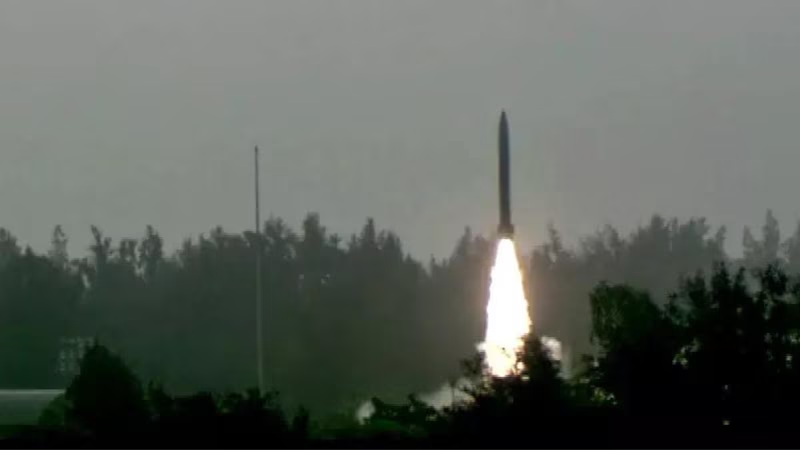
In a powerful demonstration of its growing indigenous defense capabilities, India has successfully executed a complex salvo launch of two Pralay missiles from a single launcher off the Odisha coast. This isn’t just another routine test; it’s a definitive signal that India’s next-generation tactical missile system is now fully primed for active combat duty.
The test, conducted by the Defence Research and Development Organisation (DRDO) at approximately 10:30 AM on December 31, 2025, marks a critical final step before the missile’s formal induction into the Indian Armed Forces . This successful launch in quick succession validates the system’s reliability, launcher robustness, and the military’s ability to execute rapid, coordinated strikes—a crucial capability in any modern battlefield scenario.
Table of Contents
- What is the Pralay Missile?
- The Significance of the Salvo Launch
- Pralay Missile Technical Muscle
- Strategic Impact on India’s Defense
- Conclusion: The Road Ahead
- Sources
What is the Pralay Missile?
Developed by India’s DRDO, the Pralay missile is not your conventional ballistic missile. It’s a state-of-the-art, quasi-ballistic missile designed specifically for conventional warfare, filling a critical gap in the Indian military’s arsenal . Positioned between the long-range strategic Agni series and short-range battlefield rockets, Pralay offers a unique blend of range, precision, and flexibility.
Its primary role is to engage and destroy a variety of strategic land-based targets, including enemy command and control centers, airfields, and crucial logistics hubs. Unlike its strategic cousins that carry nuclear warheads, the Pralay is a conventionally armed powerhouse, giving military planners a precise and powerful option for tactical operations without escalating to the nuclear threshold .
The Significance of the Salvo Launch
While previous tests validated the performance of a single Pralay missile, this salvo launch is a completely different beast. Firing two missiles in quick succession from the same mobile launcher is a far more realistic and demanding simulation of an actual combat scenario.
This test proves several key capabilities:
- System Reliability: The launcher and its complex fire-control systems can handle the immense stress and rapid cycling required for multiple launches.
- Operational Readiness: It demonstrates that the Indian Army’s missile regiments can execute coordinated, high-tempo strikes on command, a core tenet of modern warfighting doctrine.
- Deterrence Credibility: A salvo launch presents a much more formidable and harder-to-intercept threat to any adversary, significantly amplifying its deterrent value.
This successful trial is the final green light before full-scale induction, as confirmed by the Ministry of Defence .
Pralay Missile Technical Muscle
The Pralay is a technological marvel of Indian engineering. At its core is a powerful solid-propellant rocket motor, which allows for quick launch preparation and high mobility—a key advantage for a tactical weapon that needs to “shoot and scoot” to avoid counter-battery fire.
Its guidance system is a masterpiece of modern avionics, featuring a sophisticated Ring Laser Gyro-based Inertial Navigation System (RINS) for mid-course navigation . As it approaches its target, a millimeter wave (MMW) seeker takes over for terminal homing, ensuring exceptional accuracy even against moving or relocatable targets .
Here’s a quick look at the Pralay’s key specifications:
| Feature | Specification |
|---|---|
| Type | Short-Range Quasi-Ballistic Missile |
| Range | 150 – 500 km (mission-dependent) |
| Warhead | Conventional, 350-700 kg |
| Propulsion | Solid Fuel |
| Launcher | Road-mobile, capable of salvo fire |
Strategic Impact on India’s Defense
The induction of the Pralay missile is a cornerstone of India’s evolving multi-layered defense strategy. It provides the Indian Army and Air Force with a credible, long-range, and precise conventional strike capability that has been a known gap in their inventory .
Large orders have already been placed, with the IAF ordering 120 units and the Army a massive 250 units in recent years, signaling immense confidence in the platform . This weapon system is designed to be a key component of India’s “Integrated Rocket Force,” aimed at conducting effective strikes at lower levels of conflict without crossing the nuclear red line .
Its quasi-ballistic trajectory—lower and more maneuverable than a traditional ballistic arc—makes it significantly more challenging for existing enemy air defense systems to intercept. This enhances its survivability and ensures it can reliably deliver its payload. For our deep dive on India’s integrated air defense network, see our analysis on [INTERNAL_LINK:india-integrated-air-defence-system].
Conclusion: The Road Ahead
The successful salvo test of the Pralay missile on December 31, 2025, is far more than a technical achievement; it’s a strategic milestone. It confirms that India now possesses a potent, home-grown, and highly reliable tactical missile system that is ready to be deployed on its borders. This development not only strengthens India’s deterrence posture but also showcases the DRDO’s maturity in delivering complex, world-class weapon systems that meet the exacting demands of the modern battlefield.
Sources
- Times of India: Pralay missile test: India conducts successful salvo launch off Odisha coast – watch
- PRESS INFORMATION BUREAU: DRDO conducts successful salvo launch of two Pralay missiles
- The Hindu: India successfully tests Pralay missile in salvo launch
- Janes: India concludes first phase tests of Pralay missiles