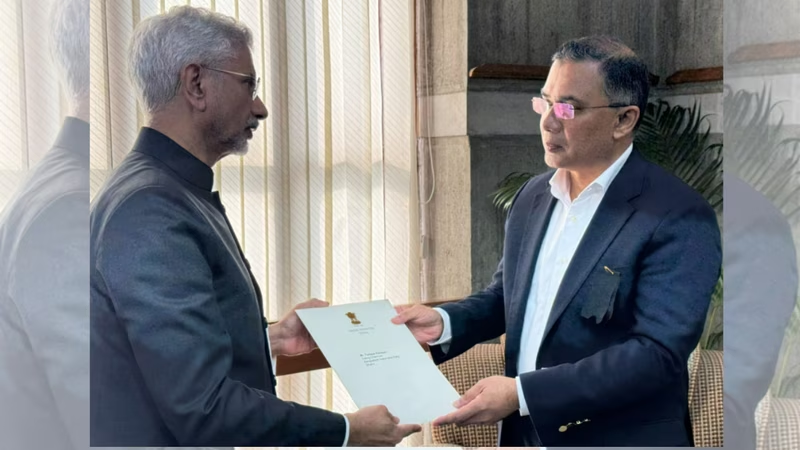
The air in Dhaka hung heavy with grief and history on Wednesday, December 31, 2025. As news of the passing of former Prime Minister **Khaleda Zia** spread, a sea of black-clad mourners began converging on the city’s central mosque, their presence a powerful testament to the enduring legacy of a woman who defined Bangladeshi politics for over three decades. The **Khaleda Zia funeral** was not just a personal farewell—it was a national reckoning with the end of an era .
At 79, Zia’s death closes a pivotal chapter in South Asia’s political narrative. Once the arch-rival of Sheikh Hasina in a bitter, often volatile two-woman power struggle, her absence now leaves a void that no single figure appears ready to fill. In a move widely seen as a final gesture of respect, the Government of Bangladesh declared a public holiday and three days of state mourning—a protocol usually reserved for heads of state .
Table of Contents
- The Funeral Day in Dhaka
- Khaleda Zia Funeral: International Response
- The Life and Legacy of Khaleda Zia
- Political Vacuum and the BNP’s Future
- Summary
- Sources
The Funeral Day in Dhaka
From the early hours of the morning, roads leading to the Baitul Mukarram National Mosque were packed with mourners from all walks of life—party loyalists, ordinary citizens, students, and families who remembered her tenure with a mix of admiration and nostalgia . The Bangladesh Nationalist Party (BNP) described the turnout as “unprecedented,” with estimates running into the tens of thousands .
The funeral prayers were held shortly after noon, followed by a burial at the Zia family graveyard in Dhaka’s Banani area. Security was at its highest, with thousands of police and Rapid Action Battalion (RAB) personnel deployed across the capital to manage the crowds and ensure a peaceful ceremony . Despite her years of house arrest and political marginalization, Khaleda Zia’s symbolic power remained undiminished.
Khaleda Zia Funeral: International Response
The geopolitical significance of Zia’s passing was underscored by the high-level foreign attendance. Most notably, India’s External Affairs Minister **S. Jaishankar** represented his country at the funeral—a clear signal of New Delhi’s desire to maintain diplomatic engagement across Bangladesh’s political spectrum .
Other dignitaries included envoys from Pakistan, Turkey, and several Gulf nations, reflecting Zia’s foreign policy legacy of strengthening ties with Muslim-majority countries while navigating a complex relationship with India. The presence of these international figures added a layer of solemn gravitas to the proceedings, transforming the event from a national mourning into a regional moment of reflection .
The Life and Legacy of Khaleda Zia
Born in 1946, Khaleda Zia entered politics not by choice but by tragedy—following the 1981 assassination of her husband, President Ziaur Rahman, the founder of the BNP. What began as a reluctant foray into public life soon evolved into a formidable political career.
A Turbulent but Influential Career
- First Term (1991–1996): She became Bangladesh’s first female Prime Minister, restoring parliamentary democracy after years of military rule.
- Second Term (2001–2006): Her coalition government focused on infrastructure and economic liberalization, though it was marred by growing political violence.
- Rivalry with Sheikh Hasina: The bitter feud between the two women dominated Bangladesh’s political landscape for over 25 years, often leading to nationwide strikes and civil unrest.
- Legal Troubles & Exile: Convicted in multiple corruption cases (which her supporters claim were politically motivated), she spent years under house arrest and was barred from elections.
Her legacy is deeply polarizing. To her supporters, she was a symbol of resistance and democratic struggle. To her critics, she represented a bygone era of dynastic politics and institutional decay .
Political Vacuum and the BNP’s Future
With Khaleda Zia’s death, the BNP faces an existential crisis. For years, the party’s identity was inextricably linked to her persona. Now, without its iconic leader, questions loom large: Who will succeed her? Can the party reinvent itself as a credible democratic opposition in a landscape increasingly dominated by Sheikh Hasina’s Awami League?
While her son, Tarique Rahman, remains the party’s senior vice chairman, his exile in London and legal ineligibility to run for office complicate the succession. The BNP must now decide whether to rally around a new face or double down on its legacy—a decision that will shape Bangladesh’s political trajectory for years to come .
As the nation processes this monumental loss, one thing is certain: the Bangladesh that Khaleda Zia helped build will never be the same again. For deeper insights into the country’s evolving democracy, explore our [INTERNAL_LINK:Bangladesh political history] archive.
Summary
The **Khaleda Zia funeral** on December 31, 2025, was a historic event that transcended partisan lines, drawing immense crowds and international dignitaries to Dhaka. Marked by a three-day state mourning and a national holiday, the ceremony honored a towering figure whose life and career were central to Bangladesh’s modern political identity. While her passing closes a defining chapter, it also opens a period of profound uncertainty for the BNP and the nation’s democratic future.
Sources
- Times of India. “Khaleda Zia’s funeral: Thousands gather in Dhaka to pay last respects — live updates.” https://timesofindia.indiatimes.com/…
- Al Jazeera. “Bangladesh declares state mourning after death of ex-PM Khaleda Zia.” https://www.aljazeera.com/…
- BBC News. “Khaleda Zia: The life and legacy of Bangladesh’s former PM.” https://www.bbc.com/…
- Ministry of External Affairs, India. “EAM Dr S Jaishankar to attend funeral of former Bangladesh PM Khaleda Zia.” https://mea.gov.in/…
- Human Rights Watch. “Bangladesh: Events of 2024 – Political Repression and the BNP.” https://www.hrw.org/…