Introduction: A Community Consumed by Fear
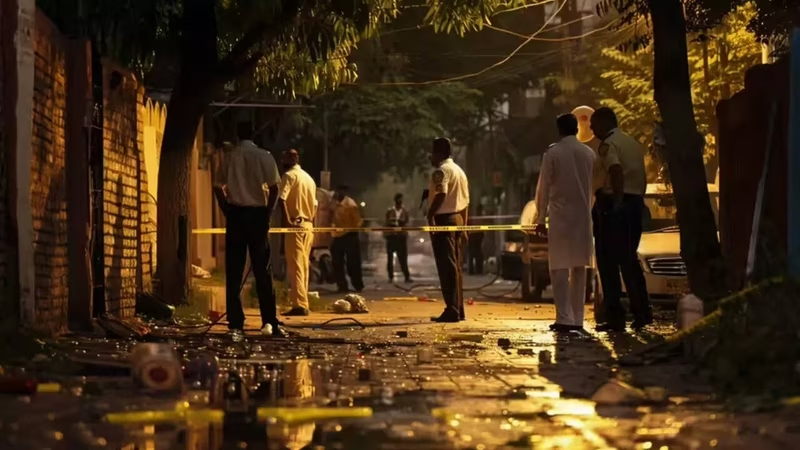
In the quiet village of Karbi Anglong, Assam, a chilling event unfolded that has once again thrust India into the global spotlight for all the wrong reasons. A couple was brutally burnt alive inside their own home, their lives extinguished over a terrifying and archaic accusation: witchcraft . This isn’t a scene from a medieval history book—it happened in the 21st century, in December 2024. The incident is a stark, horrifying reminder that the deadly scourge of the witch hunt is not a relic of the past but a present-day nightmare for many in rural India.
Table of Contents
- The Karbi Anglong Tragedy: What Happened?
- Deep Roots: The History of Witch-Hunting in Northeast India
- Assam’s Legal Armor: The Prevention of Witch Hunting Act
- Why Do Witch Hunts Persist? The Psychology of Superstition
- Beyond the Laws: The Fight Against a Deep-Seated Evil
- Summary
- Sources
The Karbi Anglong Tragedy: What Happened?
The details are harrowing. A group of villagers, driven by suspicion and fear, targeted a local couple, accusing them of practicing dark magic and causing harm to the community . With no trial, no evidence, and no mercy, they set the couple’s home ablaze, trapping them inside. The police are now investigating this horrific crime, which is a clear and brutal violation of human rights and the law .
Local police officials have indicated that the attack was fueled by rampant superstition and the spread of rumors, a toxic combination that has claimed many lives before . This act of mob violence highlights the dangerous power of collective hysteria in areas where education and legal awareness are still catching up.
Deep Roots: The History of Witch-Hunting in Northeast India
The belief in witchcraft is not new to Assam and the greater Northeast. Historical accounts and anthropological studies point to practices of identifying and ostracizing “witches” that date back hundreds of years . The region, with its rich tapestry of indigenous cultures and folklore, has long had its own narratives around spiritual power, both benevolent and malevolent.
However, the modern-day witch hunt has evolved into something far more sinister. In recent decades, it has become a tool for social control, property grabbing, and the settling of personal vendettas, often targeting the most vulnerable—elderly women, widows, and those who are social outcasts .
The scale of the problem is staggering. Since 2010, reports suggest that at least 77 people have been killed and 60 more wounded in witch-hunt-related attacks in Assam alone . Another source estimates that almost 200 people, mostly women, have been murdered in the state on these grounds . These aren’t just numbers; they represent lives brutally cut short because of ignorance and fear.
Assam’s Legal Armor: The Prevention of Witch Hunting Act
Recognizing the gravity of the situation, the Assam state government took a significant step forward by enacting The Assam Witch Hunting (Prohibition, Prevention and Protection) Act, 2015 . This landmark legislation was designed to be a powerful shield against this barbaric practice.
Here’s a breakdown of its key provisions:
- Legal Definition: The Act criminalizes the act of identifying, calling, or accusing someone of being a witch.
- Severe Penalties: It classifies witch-hunting as a cognizable, non-bailable, and non-compoundable offence. Conviction can lead to imprisonment ranging from three to seven years, along with a fine .
- <Comprehensive Protection: The law aims to eliminate not just the killing, but also the torture, oppression, and public humiliation that often precede a murder .
Despite this strong legal framework, the Karbi Anglong incident proves that having a law on the books is only the first step. Enforcement, community education, and a fundamental shift in social attitudes are equally critical.
Why Do Witch Hunts Persist? The Psychology of Superstition
So, why, in an age of smartphones and space exploration, do these primitive beliefs hold such sway? The answer is complex and deeply rooted in social and economic factors:
- Lack of Education and Healthcare: In remote villages, when a disease spreads or crops fail, people often lack access to scientific explanations. Superstition fills the void, providing a simple, albeit false, scapegoat.
- Social and Economic Vulnerability: Accusing someone of witchcraft can be a convenient way to drive them off their land or seize their property, especially if they are poor and have no one to defend them.
- Deep-Seated Cultural Beliefs: Generations of folklore and oral tradition have normalized the idea of witches, making it a part of the community’s collective consciousness that is hard to shake .
Beyond the Laws: The Fight Against a Deep-Seated Evil
Combating the witch hunt requires a multi-pronged approach that goes far beyond the courtroom.
- Grassroots Activism: Brave individuals like Ms. Birubala Rabha, who has been campaigning against witch-hunting since 1996, are on the front lines, providing shelter and legal aid to victims . Their work is invaluable but needs far greater support.
- Government Policy: The Assam government has shown its commitment with its 2015 Act and a more recent policy announced in May 2025 aimed at combating both human trafficking and witch-hunting . The success of these policies will depend on their on-the-ground implementation.
- Education and Awareness: The most powerful long-term weapon is education. School curricula that promote scientific temper and community workshops that debunk myths are essential to break the cycle of fear and violence.
For more on social justice issues in India, see our coverage on [INTERNAL_LINK:human-rights-in-rural-india].
Summary
The brutal burning of a couple in Karbi Anglong is a national shame and a tragic indictment of how deeply superstition can fester in the absence of education and strong social safeguards. While The Assam Witch Hunting Act of 2015 provides a crucial legal framework, this horrific event shows that laws alone cannot change hearts and minds. A sustained, collective effort involving the government, civil society, and local communities is needed to finally exorcise this dark ghost of the past from India’s present.
Sources
- Times of India. “Assam couple burnt alive on witchcraft suspicion; villagers claim they caused harm.” https://timesofindia.indiatimes.com/…
- Al Jazeera. “Hunting down witches in northeast India.” https://www.aljazeera.com/features/2015/9/3/hunting-down-witches-in-northeast-india
- The Assam Witch Hunting (Prohibition, Prevention and Protection) Act, 2015. https://www.assam.gov.in/
- Amnesty International. “Witch-hunts in India: A human rights crisis.” https://www.amnesty.org/