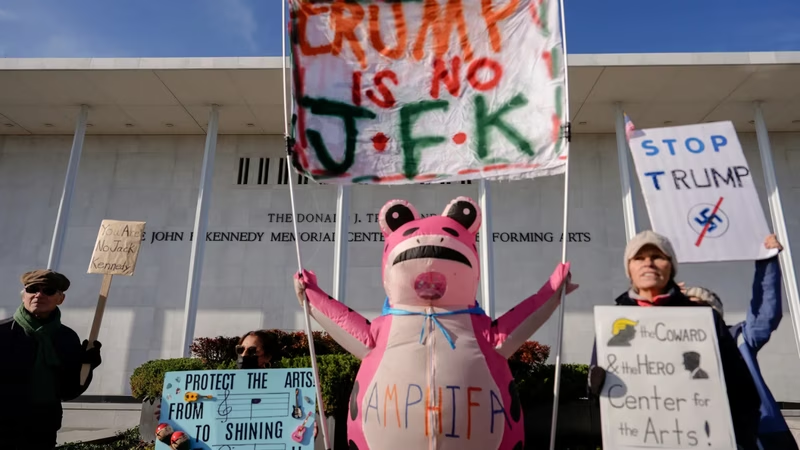
In one of the most politically charged cultural clashes of 2025, the John F. Kennedy Center for the Performing Arts is at the center of a national uproar after a controversial decision to rename the iconic institution to include Donald Trump’s name. The move—orchestrated by newly appointed Trump allies now controlling the Kennedy Center’s board—has triggered immediate backlash from artists, historians, and civil society groups, with several high-profile performers canceling scheduled concerts in protest.
Jazz legends The Cookers were the first to pull out, calling the renaming “a desecration of democracy and art.” Others followed swiftly, citing concerns over racism, political weaponization of cultural spaces, and the erasure of President Kennedy’s enduring legacy. As tensions escalate, the debate has become far more than a naming dispute—it’s a referendum on who gets to shape America’s cultural memory.
Table of Contents
- What Happened at the Kennedy Center?
- Kennedy Center Name Change: The Controversial Decision
- Artists Pull Out in Protest
- Why Is the Kennedy Center Named After JFK?
- Legal and Ethical Objections
- Trump Allies’ Response
- Broader Implications for U.S. Cultural Institutions
- Conclusion: Legacy, Politics, and the Future of Arts
- Sources
What Happened at the Kennedy Center?
In early December 2025, the Kennedy Center’s Board of Trustees—recently reconstituted with a majority of Trump appointees—voted to rename the institution the “John F. Kennedy and Donald J. Trump Center for the Performing Arts.” The decision, made without public consultation, was announced via press release and framed as honoring “two transformative American leaders.”
Within 48 hours, the jazz ensemble The Cookers canceled their January 2026 performance, stating: “We cannot perform in a space that equates the legacy of JFK with a man who has repeatedly undermined democratic norms and marginalized communities of color.”
Kennedy Center Name Change: The Controversial Decision
The Kennedy Center name change has stunned Washington’s cultural establishment. Originally established by an Act of Congress in 1959 and dedicated in 1971, the Center was explicitly named to honor President John F. Kennedy’s commitment to the arts and humanities—a rare bipartisan consensus in American history.
Legal experts, including scholars from Georgetown Law, argue the renaming may violate the original congressional charter, which designates the Center as a “living memorial” to JFK alone. “This isn’t just a rebranding—it’s potentially unlawful,” said constitutional law professor Elena Ruiz in an interview.
Artists Pull Out in Protest
Since The Cookers’ announcement, a growing list of artists and organizations have withdrawn:
- Mezzo-soprano Joyce DiDonato – Canceled a masterclass series, citing “moral incompatibility.”
- The Alvin Ailey American Dance Theater – Postponed its spring residency “until the Center reaffirms its founding values.”
- Composer Caroline Shaw – Withdrew her commissioned piece, calling the move “cultural vandalism.”
- Several Broadway touring productions – Reportedly exploring alternative D.C. venues.
Many cite Trump’s history of inflammatory rhetoric, attacks on the press, and policies targeting immigrants as irreconcilable with the Center’s mission of “artistic excellence and inclusion.”
Why Is the Kennedy Center Named After JFK?
John F. Kennedy was a passionate advocate for the arts. In a famous 1962 speech at Amherst College, he declared: “I look forward to an America which will not be afraid of grace and beauty… which will steadily raise the standards of artistic accomplishment.”
After his assassination, Congress unanimously voted to create a national cultural center in his honor—not as a political monument, but as a symbol of unity, creativity, and democratic ideals. For over 50 years, the Kennedy Center has hosted legends from Duke Ellington to Yo-Yo Ma, embodying that vision.
[INTERNAL_LINK:history-of-us-cultural-institutions] Adding a second name—especially one as polarizing as Trump’s—breaks that singular narrative, critics argue.
Legal and Ethical Objections
Beyond symbolism, opponents raise serious legal concerns:
- The original 1959 law refers exclusively to “John F. Kennedy.”
- No subsequent congressional approval was sought for the name alteration.
- Federal institutions named by Congress cannot be unilaterally renamed by executive-appointed boards.
Advocacy groups like the ACLU are reviewing the decision for potential legal action, while historians warn the move sets a dangerous precedent for politicizing national memorials.
Trump Allies’ Response
Board members appointed by Trump, including new chair Linda McMahon (former WWE CEO and ex-SBA head), have dismissed the backlash as “performative outrage from the liberal elite.”
“President Trump revitalized American pride and supported the arts through tax incentives and deregulation,” McMahon stated. “This recognition is long overdue.”
Supporters argue that Trump’s 2019 executive order expanding arts funding justifies the honor—a claim critics call “revisionist,” noting the same administration proposed eliminating the National Endowment for the Arts multiple times.
Broader Implications for U.S. Cultural Institutions
This controversy reflects a deeper national struggle over who controls cultural narrative. From museum exhibitions to school curricula, America’s institutions are battlegrounds for historical memory.
If the Kennedy Center name change stands, it could open the door for future politicized renamings—turning memorials into partisan trophies rather than unifying symbols. As one Smithsonian curator noted: “Once you start rewriting foundational dedications, you risk turning heritage into propaganda.”
Conclusion: Legacy, Politics, and the Future of Arts
The fight over the Kennedy Center is not really about a name. It’s about whose values America chooses to enshrine in its most sacred cultural spaces. JFK’s legacy was built on idealism, global diplomacy, and belief in art as a bridge across divides. Trump’s presidency, for many, represents the opposite.
As artists withdraw and legal challenges mount, the Kennedy Center faces an existential question: Will it remain a beacon of artistic unity—or become a monument to political division? The answer will shape U.S. cultural policy for decades to come.