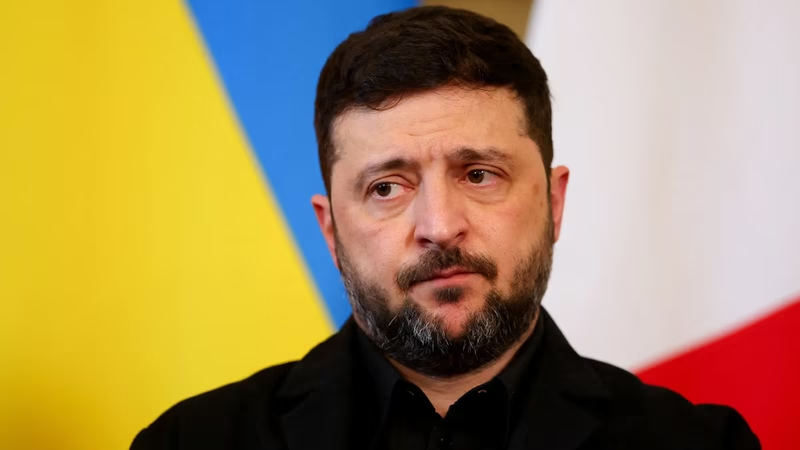
Zelenskyy’s Bold Claim: The Attack on Putin’s Home Was Staged
In a high-stakes move that could reshape the trajectory of Europe’s deadliest conflict in generations, Ukrainian President Volodymyr Zelenskyy has publicly challenged the Kremlin’s narrative. Following Russian claims of a Ukrainian drone attack on President Vladimir Putin’s secluded residence in Valdai, Zelenskyy declared the incident a complete fabrication—a “fake” designed to manipulate ongoing peace negotiations .
His message was clear and direct: Ukraine’s Western allies possess the intelligence and surveillance capabilities to independently verify that Kyiv was not behind the alleged strike. “Regarding the attack on Valdai, our negotiating team connected with the American team, they went through the details, and we understand that it’s fake,” Zelenskyy stated . This assertion isn’t just a defense; it’s an accusation that Moscow is resorting to old, dangerous tactics to gain an upper hand at the negotiating table.
Table of Contents
- The Kremlin’s Claims vs. Zelenskyy’s Denial
- False Flag Operations: Russia’s Historical Playbook
- How This Alleged Hoax Impacts Peace Negotiations
- What Can Western Allies Actually Verify?
- Conclusion: A Dangerous Game of Blame
- Sources
The Kremlin’s Claims vs. Zelenskyy’s Denial
The controversy erupted after Russia claimed that Ukrainian forces had launched a daring drone assault on Putin’s residence. In response, Zelenskyy was unequivocal, stating there was “no ‘plausible’ evidence” to support the Russian allegations . He framed the entire episode as a deliberate falsehood, a strategic lie peddled by Moscow to justify a shift in its diplomatic stance.
Zelenskyy went further, arguing that the Russian military retains full control over its retaliatory actions. “The Russian army has chosen ‘how, when and where’ to retaliate against Ukraine,” he noted, implying that any Russian escalation following the alleged attack would be pre-meditated and not a genuine response to Ukrainian aggression . This sets the stage for a critical question: is this a genuine security breach or a calculated political maneuver?
False Flag Operations: Russia’s Historical Playbook
Zelenskyy’s accusation of a staged event, or a “false flag operation,” is not without historical precedent. A false flag is a covert operation designed to deceive, making an attack appear as if it was carried out by a party other than the one that actually planned it .
Russia has a documented history of such tactics. In May 2023, an alleged drone attack on the Kremlin was widely dismissed by Western analysts and Ukrainian officials as a Kremlin-staged event to justify further escalation . Experts from institutions like the International Institute for Strategic Studies have long pointed to a pattern where Moscow uses these fabricated incidents to rally domestic support, justify military action, or derail diplomatic processes .
“The alarmist tone of recent tit-for-tat reports from the war in Ukraine has refocused attention on so-called ‘false flag operations’ and their legality under international law,” notes a 2023 analysis from Chatham House . This context makes Zelenskyy’s current claim far more plausible in the eyes of many international observers. The Kremlin, notably, has offered no verifiable evidence to substantiate its claims about the Valdai incident .
How This Alleged Hoax Impacts Peace Negotiations
The timing of the alleged attack is perhaps its most suspicious element. It comes amid a new, fragile round of peace negotiations in late 2025. Russia has already announced its intention to “toughen” its negotiating position following the incident . Kremlin spokesman Dmitry Peskov confirmed that while dialogue would continue, the purported attack would be a major factor moving forward .
This hardening of Russia’s stance is exactly what Zelenskyy fears. He believes Moscow is using the fabricated attack as a pretext to abandon any previous compromises and push for more favorable terms. “Russia says it will take a more hardline stance in negotiations on ending the war in Ukraine after claiming Kyiv tried to attack a Russian residence,” a report from Reuters confirmed . This move could stall or even collapse the talks, prolonging a conflict that has already claimed tens of thousands of lives. For more on the history of these fragile talks, see our deep dive on [INTERNAL_LINK:russia-ukraine-peace-process].
What Can Western Allies Actually Verify?
Zelenskyy’s confidence rests on the sophisticated intelligence-sharing network between Ukraine and its NATO allies, particularly the United States. This network includes signals intelligence (SIGINT), satellite imagery, and radar data. If a major drone incursion into a heavily defended area like Valdai had occurred, these systems would likely have a clear record of its origin, flight path, and point of impact.
The fact that Zelenskyy specifically mentioned his team’s connection with the “American team” suggests that this intelligence has already been cross-referenced. The absence of corroborating data from these independent sources is a powerful argument against the Kremlin’s version of events. In the fog of war, such technical verification is often the only way to cut through the propaganda from both sides.
Conclusion: A Dangerous Game of Blame
The claim that the Putin home attack was fake represents a critical juncture in the ongoing war. If Zelenskyy is correct, it exposes a cynical and dangerous attempt by the Kremlin to manipulate the path to peace for its own gain. If the attack was real, it marks a significant and provocative escalation from Kyiv. The truth, as verified by allied intelligence, will have profound consequences. For now, the world watches as a diplomatic crisis unfolds, built on an event that one of the world’s most powerful leaders insists never truly happened.
Sources
[1] Times of India. (2025, December). Zelensky says allies can ‘verify’ alleged Putin home attack ‘was fake’.
[2] Times of India. (2025, December). Zelensky says allies can ‘verify’ Putin home attack ‘was fake’.
[4] Web Search Result. (2025). Zelensky on Valdai attack verification.
[9] Institute for the Study of War. (2025, December 30). Russian Offensive Campaign Assessment.
[10] Reuters. (2025, December). Bitter recriminations between Russia, Ukraine as war.
[11] TASS. (2025, December). Kremlin says Russia to continue dialogue on Ukrainian.
[12] Chatham House. (2023, March 31). Ukraine war: ‘false flag’ operations – long used as.
[14] Newsweek. (2023, May). Kremlin’s latest false flag operation to justify possible.