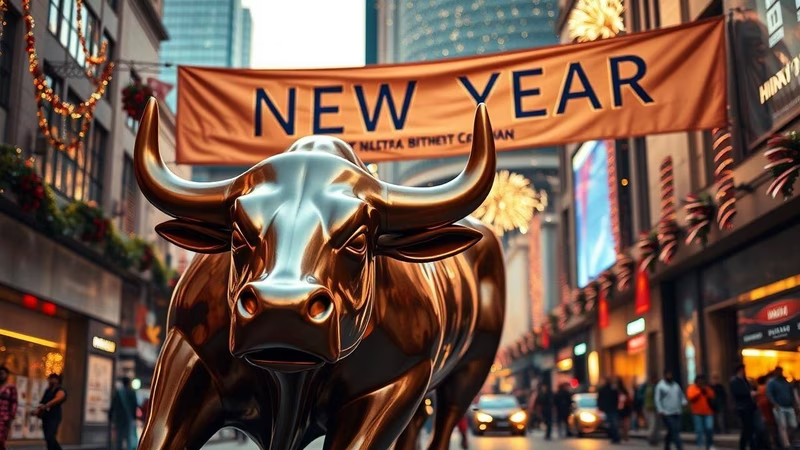
New Year’s Day is usually a time for champagne, reflection, and a well-earned break—even for the world’s busiest stock exchanges. But not in India. In a notable departure from global norms, both the National Stock Exchange (NSE) and the Bombay Stock Exchange (BSE) will be open for trading on January 1, 2026 .
Yes, you read that right. While Wall Street, the London Stock Exchange, and nearly every major financial hub observes January 1 as a public holiday, India’s markets are choosing to stay live. This rare scheduling decision offers both opportunity and urgency for domestic and international investors alike—and it’s already sparking debate in trading circles.
Table of Contents
- Why Are NSE and BSE Open on Jan 1, 2026?
- Global Markets vs. India: A Trading Anomaly
- NSE and BSE Open on Jan 1, 2026: What Traders Need to Know
- Complete NSE Holiday Calendar 2026 at a Glance
- Strategic Implications for Investors
- What About BSE? Is It Also Open?
- Historical Context: How Often Does This Happen?
- Conclusion: Don’t Miss the First Trade of 2026
- Sources
Why Are NSE and BSE Open on Jan 1, 2026?
The decision stems from the official 2026 trading holiday calendar
Since January 1, 2026, doesn’t coincide with any of these recognized closures—and isn’t declared a bank holiday by the Reserve Bank of India—the exchanges have opted to remain operational. This aligns with SEBI’s broader push to enhance market accessibility and align trading days with global economic realities.
Global Markets vs. India: A Trading Anomaly
January 1 is universally recognized as a non-trading day in most financial centers:
- United States (NYSE, NASDAQ): Closed
- United Kingdom (LSE): Closed
- Japan (Tokyo Stock Exchange): Closed
- European Union (Euronext, Deutsche Börse): Closed
This makes India one of the very few major markets open on New Year’s Day. For foreign portfolio investors (FPIs), this presents a unique window to react to year-end global events—like Fed policy shifts or geopolitical developments—without waiting for international markets to reopen.
NSE and BSE Open on Jan 1, 2026: What Traders Need to Know
If you’re planning to trade on the first day of 2026, here’s what to keep in mind:
- Full trading hours apply: Normal equity, F&O, and currency segments will operate as usual.
- Liquidity may be lower: With many traders on holiday, volume could be thin, leading to higher volatility.
- Broker support may vary: Confirm with your broker if customer service or technical assistance will be available.
- Settlement cycles remain unchanged: T+1 settlement continues as per SEBI guidelines.
Complete NSE Holiday Calendar 2026 at a Glance
The NSE has announced 15 trading holidays for 2026. Key dates include:
- Republic Day – January 26
- Maha Shivaratri – February 18
- Holi – March 13
- Good Friday – April 3
- Dr. B.R. Ambedkar Jayanti – April 14
- May Day – May 1
- Eid al-Fitr – March 30 (tentative)
- Bakri Eid – June 2 (tentative)
- Independence Day – August 15
- Ganesh Chaturthi – September 13 (tentative)
- Mahatma Gandhi Jayanti – October 2
- Dussehra – October 21
- Diwali/Laxmi Pujan – November 9 (tentative)
- Diwali (Balipratipada) – November 10
- Muharram – December 21 (tentative)
Note: Dates for Islamic holidays are moon-sighting dependent and subject to change.
Strategic Implications for Investors
This unusual opening creates tactical opportunities:
- Position squaring: Adjust year-end portfolios before global markets react in January’s first full week.
- Arbitrage plays: Potential price divergences between Indian and global assets due to the trading gap.
- Event-driven trades: React instantly to any overnight international news (e.g., oil price swings, U.S. economic data).
However, retail investors should tread carefully. Low liquidity can amplify slippage and widen bid-ask spreads, especially in mid- and small-cap stocks.
What About BSE? Is It Also Open?
Yes. The Bombay Stock Exchange follows the same holiday calendar as the NSE for 2026, as mandated by SEBI. So if NSE is open, BSE will be too—ensuring market-wide consistency .
Historical Context: How Often Does This Happen?
While rare, this isn’t unprecedented. The Indian stock market has occasionally remained open on January 1 when it doesn’t fall on a weekend or clash with a national holiday. The last time both NSE and BSE were open on New Year’s Day was in 2020—a fact many traders have forgotten amid the pandemic disruption that followed.
Conclusion: Don’t Miss the First Trade of 2026
The decision to keep the NSE and BSE open on Jan 1, 2026 reflects India’s growing ambition as a 24/7 financial hub. For savvy traders, it’s a golden—or at least, uniquely timed—opportunity. Whether you’re rebalancing your portfolio, hedging global exposure, or simply placing your “first trade of the year” for good luck, mark your calendars. January 1, 2026, won’t be a day off—it’ll be a day to trade.