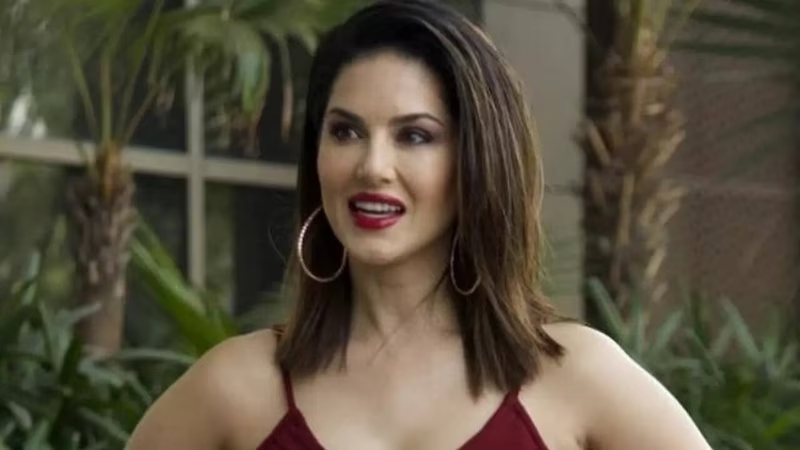
In a dramatic turn of events that highlights the ongoing tension between modern entertainment and religious tradition in India, **Sunny Leone’s New Year’s Eve DJ show in Mathura was cancelled**—not by authorities, but due to overwhelming pressure from local religious leaders. The decision, made just days before the event, came after powerful **sadhus (Hindu ascetics)** declared the performance “inappropriate” for one of Hinduism’s most sacred cities .
Despite organizers securing all necessary permissions, investing heavily in logistics, and adhering to municipal regulations, they chose to cancel the event “to respect local religious sentiments.” The move, while praised by spiritual groups, has sparked a wider national debate: Where should the line be drawn between cultural sensitivity and creative freedom?
Table of Contents
- Sunny Leone Mathura Show Cancelled: What Happened?
- Why Mathura Is a No-Go Zone for “Loud” Entertainment
- The Sadhus’ Stand: Protecting the Sanctity of Braj
- Organizers Face Major Losses Despite Compliance
- Bollywood, Religion, and Public Space in Modern India
- Have We Seen This Before? Past Controversies in Holy Cities
- Conclusion: Tradition, Tourism, and Tolerance
- Sources
Sunny Leone Mathura Show Cancelled: What Happened?
The event was scheduled for December 31, 2025, at a private resort on the outskirts of Mathura. Promoted as a “premium New Year’s gala,” it featured international DJs and Bollywood star Sunny Leone as the headline attraction. Tickets were priced from ₹2,000 to ₹10,000, and hundreds had already been sold .
However, news of the event quickly reached the ears of influential **akharas (monastic orders)** in the Braj region. Led by senior sadhus from the Digambar and Vaishnav traditions, they held emergency meetings and issued public statements condemning the “vulgarity” and “westernized revelry” in a city synonymous with Lord Krishna’s childhood .
Protests grew, with some groups threatening peaceful demonstrations on New Year’s Eve. Fearing unrest—and respecting the city’s ethos—organizers announced the cancellation on December 28, issuing full refunds and citing “unavoidable circumstances beyond our control.”
Why Mathura Is a No-Go Zone for “Loud” Entertainment
Mathura isn’t just another tourist destination. It’s one of the **seven holiest cities (Sapta Puri)** in Hinduism, believed to be the birthplace of Lord Krishna. The entire Braj region—including Vrindavan and Govardhan—is steeped in devotional history, pilgrimage routes, and centuries-old temples .
Unlike metropolitan cities like Mumbai or Delhi, Mathura’s cultural fabric is woven with bhajans, aartis, and spiritual discourse—not EDM beats and celebrity glamour. Local norms favor **sobriety, modesty, and reverence**—especially during religious months like Margashirsha (November–December) .
As one temple priest explained: “This isn’t about targeting Sunny Leone personally. It’s about preserving the spiritual atmosphere. Would you host a rave in Vatican City? The principle is the same.”
The Sadhus’ Stand: Protecting the Sanctity of Braj
The opposition wasn’t mere moral panic—it was rooted in deep theological and cultural concerns:
- Timing**: New Year’s Eve coincides with the sacred month of Paush, a period of austerity and devotion.
- Symbolism**: Sadhus argued that events featuring “provocative” imagery (a label often unfairly attached to Leone due to her past work) clash with Krishna’s ideals of purity and divine love.
- Precedent**: They feared this would open the floodgates for similar commercial events, eroding Mathura’s spiritual identity.
Notably, the Akhil Bharatiya Akhara Parishad—a national body of 14 major Hindu monastic orders—backed the local sadhus’ stance, calling it a “necessary defense of dharma (righteousness).”
Organizers Face Major Losses Despite Compliance
What’s striking is that the organizers had done everything “by the book.” They obtained:
- Permission from the Mathura District Administration
- No-objection certificates (NOCs) from fire and safety departments
- Sound permits with decibel limits
- Private venue booking, away from major temples
Yet none of that mattered in the face of moral authority. Industry insiders estimate the cancellation resulted in **losses exceeding ₹1.5 crore**—including artist fees, security, marketing, and logistics .
This raises a critical question for event planners: Are official permits enough in India’s holy cities? Or must “social license to operate” now be negotiated with religious stakeholders too?
Bollywood, Religion, and Public Space in Modern India
The incident reflects a larger national tension. As India embraces global pop culture, its ancient sacred geographies push back. Similar clashes have occurred in Varanasi, Ayodhya, and Haridwar—where authorities have banned loud music, dance bars, and even certain clothing near ghats and temples .
While some see this as regressive moral policing, others view it as **cultural self-preservation**. The challenge lies in balancing economic opportunities (like tourism and entertainment) with the intangible heritage of spiritual sites.
Have We Seen This Before? Past Controversies in Holy Cities
Yes—this isn’t the first time entertainment events have been axed in religious hubs:
- In 2023, a music festival near Kedarnath was cancelled after protests from priests.
- In 2022, a fashion shoot in Varanasi’s Assi Ghat sparked outrage and was shut down by locals.
- In 2019, Ayodhya banned non-devotional events during Ram Navami.
These cases suggest a growing consensus: **holy cities demand a different social contract**—one where reverence trumps revelry.
Conclusion: Tradition, Tourism, and Tolerance
The cancellation of the Sunny Leone Mathura show is more than a celebrity headline—it’s a microcosm of India’s evolving identity. While urban centers globalize, sacred spaces double down on tradition. For event organizers, the lesson is clear: in places like Mathura, **permissions aren’t just bureaucratic—they’re spiritual**. Moving forward, sensitivity, dialogue, and mutual respect will be the only sustainable way to bridge the gap between devotion and entertainment.
Sources
- Times of India: Sadhus say no to Sunny Leone: Actor’s New Year show in Mathura cancelled
- UP Tourism: Mathura-Vrindavan Heritage Guidelines
- Akhil Bharatiya Akhara Parishad: Official Statements on Cultural Events
- Ministry of Culture, India: Guidelines for Events in Heritage Zones